Keltner reveals how a single minute of daily awe cuts anxiety
Feeling lost and exhausted is actually a signal to slow down
You wake up tired. Your chest feels tight. You look at your to-do list, and instead of feeling motivated, you feel a heavy, dull ache. Life is moving too fast, and the world feels intensely overwhelming. When you are in this state, your brain undergoes a physical change. A small, almond-shaped region called the amygdala fires constantly. It registers threats everywhere. It overestimates uncertainty.
This continuous alarm system floods your body with cortisol. Your biology reacts as if a predator is chasing you down a narrow street. This constant alert state drains your cognitive batteries. It leaves you feeling completely listless. This state of vague, unfocused drift is the exact opposite of mental clarity. You lack focus. Your thoughts scatter.
But this weariness is not a personal failure. It is a biological survival mechanism that has run wild in our hyper-connected, high-pressure society. To break this cycle, you do not need a radical life overhaul. You do not need to quit your job or move to a remote island. You simply need to pause, reset your nervous system, and change how you interact with your immediate surroundings.
Your purpose is not a career choice hiding outside of you
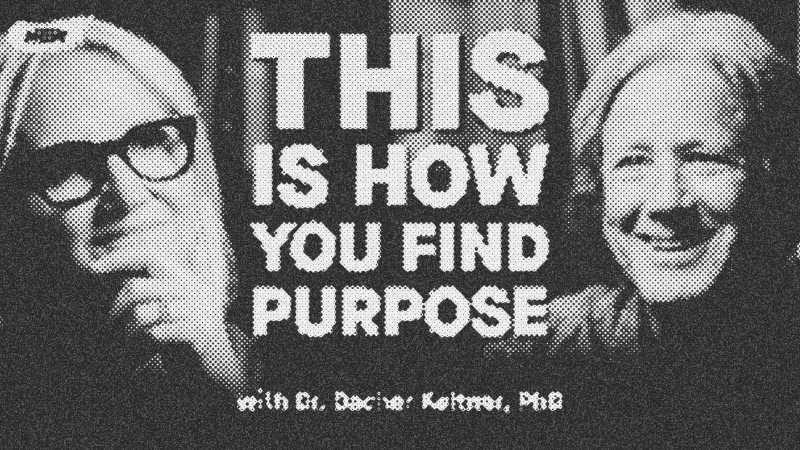
Many of us make the mistake of treating purpose as an external object. We believe we must go out and search for it, like a treasure buried in the woods. We tie it directly to our jobs, our salaries, or our social status. But this external search is a trap. During an insightful session on The Mel Robbins Podcast, renowned psychologist Dacher Keltner clarified that purpose is not something you find. It is a way you choose to move through the world.
True purpose happens when you connect your daily actions to something larger than yourself. It lives in your internal values, not your external resume. You can see this clearly in the workplace studies conducted at Yale. Researchers observed a hospital custodian whose job involved cleaning bedpans and washing dirty floors. Instead of viewing his work as menial labor, he defined his role as keeping the hospital sterile to save patients' lives. He connected his physical actions to a grand, compassionate mission. He transformed his job into a true calling.
When you shift your mindset from "What do I want to get from the world?" to "How can I serve something larger than myself?" you instantly reclaim your power. This is where your personal growth begins. It starts the moment you stop waiting for an external savior to show up and start looking at how you can bring your core values to life right where you stand.
Scientific data proves awe quiets your inner critic
For decades, scientists at the Greater Good Science Center have studied what keeps us mentally healthy. Their findings point to a single, incredibly potent emotion: awe. We experience awe when we encounter things that are vast, mysterious, and outside our ordinary frame of reference. This could be a sunset, a piece of live music, or the sheer complexity of a single leaf.
What happens to your brain during a moment of awe is truly remarkable. The default mode network, which is the brain region responsible for self-monitoring, ego, and endless planning, completely quiets down. Your mental checklist vanishes. Your self-criticism stops.
At the same time, awe stimulates the vagus nerve. This massive bundle of nerves calms your heart rate, relaxes your chest, and reduces bodily inflammation. Awe also triggers a healthy release of dopamine and oxytocin. These chemicals boost your mood and make you feel profoundly connected to the people around you. You stop feeling like an isolated individual struggling against the world. You realize you are part of a massive, living ecosystem.
Five sensory habits to rebuild your connection to life
You do not need to travel to the Grand Canyon to experience this shift. Dacher Keltner recommends simple, free practices that you can incorporate into your routine immediately to build resilience and joy.
Try the one-minute sky gaze
Step outside, leave your phone behind, and look at the clouds. Observe the changing colors of the sky. Let yourself be amazed by the scale of the atmosphere. Just sixty seconds of this focused attention can lower your daily stress levels.
Identify your core values from childhood
Ask yourself: what inspired you when you were eight years old? Was it dinosaurs, building blocks, drawing, or playing outside? These early interests point directly to your underlying strengths. Find small ways to reintroduce these activities on your weekends.
Go on an intentional awe walk
Once a week, take a walk with a specific focus. Alternate your attention between the very small and the very vast. Look closely at the intricate texture of tree bark, then look up at the entire canopy. Focus on a single raindrop, then look at the entire storm. This practice has been shown to improve brain health and reduce physical pain.
Find moral beauty in other people
Pay close attention to the small kindnesses happening around you. Watch a parent helping a child, or a stranger holding a door open. Recognizing the good deeds of others is one of the quickest ways to trigger positive physiological changes in your own body.
Reclaim your sensory awareness
Use your senses to drop out of your busy mind. Smell a flower, run your fingers over fresh grass, or close your eyes and listen to the birds. These simple acts of sensory attention anchor you firmly in the present moment.
Eleanor Roosevelt got it right with simple beauties
When you are grieving, tired, or anxious, these small steps can feel almost too simple. But their simplicity is their power. Host Mel Robbins and Dacher Keltner discussed how the late Eleanor Roosevelt would read a daily prayer centered on recognizing "simple beauties" and the "hidden loveliness" of other people.
This perspective is a conscious choice. Renowned figures from Jane Goodall to Charles Darwin have noted that recognizing wonder is essential for our survival. Jane Goodall famously observed that even chimpanzees seem to experience a quiet sense of wonder when looking at a thundering waterfall. It is a biological need to look beyond ourselves.
When we isolate ourselves, our pain grows. But when we engage with our social surroundings, we find comfort. Try speaking to a stranger at a market, or sharing a warm look with a coworker. These micro-interactions build a supportive social network that protects us during hard times. When you actively look for beauty, your world begins to expand.
Stop searching for your path and start step-by-step
Your life is a living story, and you are the author. If you are waiting for a perfect moment, a massive promotion, or a sudden burst of clarity to feel happy, you are delaying your own life.
We must remember the wise words of the Dalai Lama, who noted that if you want to be happy, you must practice compassion. The Buddhist teacher Thich Nhat Hanh similarly urged us to step away from fear and appreciate the quiet miracle of breathing. Meaning is not a luxury for the wealthy. It is a free resource that lives inside your own mind.
Take a deep breath. Look around your room. Find one beautiful object, listen to a great song, or text a friend to tell them you appreciate them. You are stronger than your current stress. Your growth does not require a massive leap. It happens one small, intentional step at a time.
- Dacher Keltner
- 25%· people
- Jane Goodall
- 17%· people
- Charles Darwin
- 8%· people
- Dalai Lama
- 8%· people
- Eleanor Roosevelt
- 8%· people
- Other topics
- 33%
If You Feel Lost, Stuck, or Behind in Life, Listen to This
WatchMel Robbins // 1:06:22

Mel Robbins is the creator and host of The Mel Robbins Podcast, one of the most successful podcasts in the world, and a #1 New York Times bestselling author. She has 40M followers and is known globally for practical tools on mindset and behavior change. The Wall Street Journal calls her a “billion-view podcaster,” and TIME says she gives millions “a reason to believe in themselves.” Her books are published in 63 languages. The Let Them Theory is a #1 bestseller across every major list and a top-selling book of 2025 with more than 8M copies sold. She also wrote The 5 Second Rule and The High 5 Habit, and has seven #1 Audible releases. Her company, 143 Studios, produces award-winning podcasts, books, courses, and events for partners like Starbucks, Ulta Beauty, JP Morgan Chase, LinkedIn, and Audible. She has been honored by TIME 100 Digital Voices, Forbes 50 Over 50, USA Today, Apple Podcasts, Spotify, and The Hollywood Reporter.