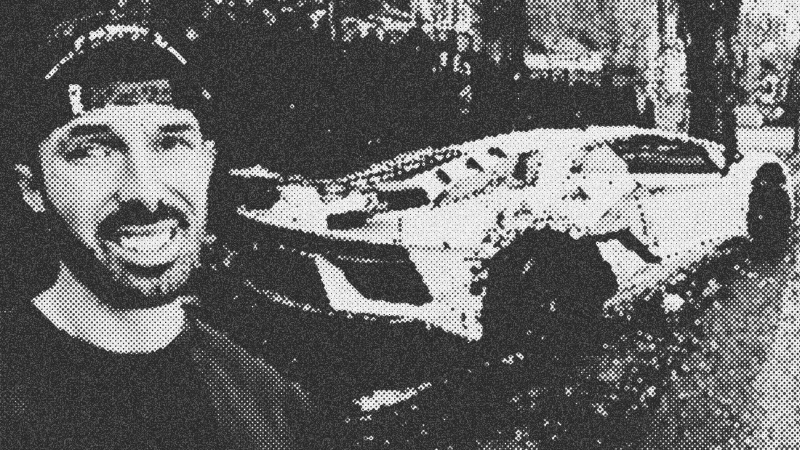
, you aren't just working on a car; you are managing an aerospace-grade marriage of carbon fiber and aluminum. The first rule of a wrecked rebuild is to never trust your eyes alone. Precision is the only currency that matters. The
utilizes a carbon fiber monocoque—the 'tub'—bolted to an aluminum rear frame that carries the massive V12 engine.
Initial inspections revealed a bulge in the rear X-brace, a primary structural component. In a high-performance chassis, a bulge usually indicates that the frame has absorbed a massive kinetic load, potentially twisting the entire rear assembly. Before you tear the engine out, you perform a 'ping test.' By unbolting the stressed brace, you observe if the chassis 'pings' back into its natural alignment. If the bolt holes fail to line up after the brace is removed, the frame is holding a memory of the crash. However, utilizing a
to measure cross-diagonal points from fixed chassis markers is the only way to verify true alignment. If the measurements match within a millimeter across the 'X,' the aluminum frame is straight, and the damage is isolated to the replaceable bolt-on components.
Solving the Gearbox Hydraulic Dilemma
Automated manual transmissions, specifically the Independent Shifting Rod (ISR) system found in the
series, are notorious for their sensitivity. A non-running supercar often hides a 'no-neutral' fault. If the hydraulic system leaks its mineral oil, the car cannot actuate the solenoids required to find neutral, and the ECU will prevent the engine from cranking to protect the drivetrain.
REBUILDING A WRECKED LAMBORGHINI SVJ
In this build, an impact from underneath cracked a gearbox mount, which in turn pushed upward into the solenoid block. This mechanical interference lifted the solenoid away from its seat, breaking the hydraulic seal. Repairing this requires more than just a new gasket; it requires resurfacing. If the solenoid seat is no longer flat, the seal will fail under the intense pressures of the shifting system. Precision tapping to flatten the seat and a fresh fill of mineral oil are the primary steps to restoring the shifting logic. Once the system holds pressure, the car can finally cycle through gears, a prerequisite for any dyno testing or road tuning.
The Lambda Logic: Exhaust Optimization and Limp Mode
One of the most common hurdles in a salvaged supercar rebuild is the 'limp mode' triggered by missing sensors. High-end cars like the
rely on a complex array of eight Lambda (oxygen) sensors to manage the air-fuel ratio. These sensors provide the ECU with real-time data on combustion efficiency and catalytic converter health. Without them, the ECU defaults to a 'safe' map, severely limiting RPMs to prevent engine damage.
titanium exhaust system isn't just about the acoustic reward—it’s about weight reduction and thermal management. Titanium is more rigid than steel, meaning it vibrates at a higher frequency and doesn't absorb sound, creating that signature V12 'scream.' However, the installation is a surgical process. You must cross-reference the sensor positions (1 through 4 on each bank) to ensure the ECU isn't receiving bank-to-bank data in reverse. A critical 'mechanic's hack' discovered during this build involves the Bosch part numbers. Lamborghini-branded sensors can cost nearly double what the identical
, it isn't just an inconvenience; it’s a mechanical lockout. The SVJ's doors are engineered to drop the window slightly when the handle is pulled to clear the roof seal. If the window is stuck in the 'up' position, the door cannot be opened without risking damage to the glass or the carbon fiber trim.
Diagnostics start at the fuses, but when the motor only operates in one direction (up) and fails to respond to the downward command, the issue is rarely the motor itself. Using a multimeter to check for power at the motor plug is essential. If the motor functions when jumped with external power, but receives no signal from the car, the fault lies in the
. These modules handle the complex logic of the window, mirrors, and locks. A fascinating discovery here is that despite the car's half-million-dollar price tag, many of these electronic modules are shared across the
parts bin. A module that fails on an SVJ might be the same unit used in a more common sedan, allowing for a significantly cheaper replacement part that restores full functionality to the window regulator.
The Aerocatch Scandal: Bypassing the Supercar Tax
Every mechanic knows that manufacturers markup outsourced parts. However, the
Purchasing the exact same part directly from the supplier for £70 is not just a cost-saving measure; it’s a victory for the builder's intelligence. This applies to various components, from the
oil filters to the window switches. The lesson for any high-end restoration is clear: identify the original equipment manufacturer (OEM). If the part is patented to the car brand, you're stuck with the premium. If it’s a standard catalog item, buy it from the source.
Tips & Troubleshooting: The 60 MPH Limiter
Even with a straight frame and a screaming exhaust, the
rebuild hit a wall at 60 MPH during dyno testing. When a car cuts power at a specific speed, it’s usually a safety intervention from the ECU. In this case, the fault was traced to the
uses an active rear-steer motor that requires constant CAN-bus feedback. If the ECU doesn't know where the rear wheels are pointed, it will limit vehicle speed to prevent a high-speed loss of control.
Tip: Before dropping £5,000 on a new motor, verify signal and power at the plug. High-vibration environments can often chafe wires or loosen pins, creating 'ghost' communication faults that look like hardware failure.
Refinement: Always clear all codes after a battery swap. Supercars are notorious for throwing 'low voltage' faults that can linger and cause limp-mode issues even after the mechanical problem is solved.
is a test of patience and technical discipline. By addressing the gearbox leaks, verifying the chassis alignment with a tram gauge, and navigating the complexities of the
parts bins, the car has evolved from a non-running wreck to a functional, high-performance machine. The outcome is a vehicle that retains its structural integrity and mechanical soul without succumbing to the astronomical markups of the dealership network. The next phase—paint and final assembly—will only succeed because the foundation under the hood is now precise and optimized.