Gaggia Classic GT Dual Boiler: A Legacy Machine in Search of a Purpose
The name Gaggia carries an almost religious weight in the espresso community. From the foundational Gaggia Gilda to the ubiquitous Gaggia Classic Pro, the brand practically invented the consumer's path to nine-bar espresso. After years of enthusiasts modifying single-boiler units with PID kits and pressure profiles, the Italian manufacturer finally answered the call with the Gaggia Classic GT Dual Boiler. It arrives promising the "Great Tradition" of its ancestors but faces a market that has moved significantly faster than its production lines.
Form Factor and Ergonomic Friction
The Gaggia Classic GT Dual Boiler is remarkably compact for its class. It occupies less counter depth than the Breville Dual Boiler and stays narrower than the Rancilio Silvia Pro X or Lelit Elizabeth. However, the design feels like a series of compromises. The machine features five spring-loaded plastic flip switches that feel notably cheap for a device costing $1,500 to $1,600. These tabs lack the tactile satisfaction one expects at this price point and appear prone to failure under heavy daily use.
The most glaring ergonomic oversight is the placement of the TFT touchscreen. While the screen itself is responsive and vibrant, it sits flat on top of the machine. Unless you stand over six feet tall, viewing and navigating the menu on a standard-height kitchen counter becomes a literal struggle. Furthermore, the glass surface and stainless steel body are magnets for smudges, requiring constant maintenance to maintain a premium appearance. On a positive note, the inclusion of an analog pressure gauge is a welcome touch, offering both reliability and a nod to the brand's mechanical roots.
The Pre-Infusion Gimmick
Gaggia markets a "soft infusion" or manual pre-infusion feature that supposedly helps extract the best from light, medium, and dark roasts. In practice, this system is deeply flawed. By pulsing the vibratory pump to produce a low-flow "dribble" of roughly 1.5 grams per second, the machine only wets the top layer of the coffee puck.
Testing with a coarse-ground Nordic light roast revealed that even after a full 20 seconds of manual pre-infusion, the water failed to penetrate the bottom half of the puck. This leads to massive extraction inconsistencies, where the top of the coffee is over-extracted while the bottom remains dry. For enthusiasts seeking true pressure profiling or saturation control, this feature offers little more than a psychological benefit. It lacks the sophisticated flow control found in competitors or even high-end community mods like Gaggiuino.
Thermal Performance and Steam Power
Internally, the machine utilizes a small brass brew boiler and a 0.9-liter stainless steel steam boiler. The thermal stability is adequate but not revolutionary. In back-to-back testing with a Scace device, the machine maintained temperature within one degree Celsius if given two to three minutes between shots. However, because the brew boiler is so small, consecutive shots pulled in rapid succession cause a significant temperature crash—sometimes dipping as low as 75°C.
The steam performance is a clear upgrade over the Gaggia Classic Pro. The large dedicated boiler provides consistent pressure that doesn't fade, allowing users to steam large quantities of milk without interruption. While the stock single-hole steam tip is slower than a four-hole variant, it offers a more forgiving experience for beginners. The transition between hot water and steam modes is handled well, with the machine quickly ramping up to 135°C to deliver dry, powerful steam.
Under the Hood: Build Quality Concerns
Opening the Gaggia Classic GT Dual Boiler reveals a reliance on plastic mounting and cost-saving components that feel out of place in a four-figure machine. The internal frame and boiler supports are largely plastic, as are many of the tube fittings. Most disappointingly, Gaggia used braided plastic-lined tubes for high-temperature water lines leading to the steam wand and hot water spigot instead of traditional copper.
The electronic brain is a large PCB housed in a protective liner, though it lacks the conformal coating often used to protect against moisture in high-end appliances. While the machine is designed to be easily serviceable—featuring a plug-and-play brass steam module—the overall material choice suggests a company trying to maximize profit margins on a legacy brand name rather than out-engineering its rivals.
Final Verdict: Too Little, Too Late?
The Gaggia Classic GT Dual Boiler is a functional, competent espresso machine, but it struggles to justify its existence. It provides essentially the same espresso quality as a Gaggia Classic Pro equipped with a nine-bar OPV and a third-party PID kit. The adjustable OPV and built-in timer are necessary modernizations, but they feel like features that should have been integrated into the base model years ago.
For the consumer, this machine is a tough sell. In the US market, it competes directly with the Breville Dual Boiler, which offers better thermal stability and volumetric accuracy, and the Profitec Move, which boasts superior build quality. Gaggia has entered the dual-boiler arena with a product that feels dated on arrival. Unless you are a brand loyalist who values the "Made in Italy" badge above all else, there are more innovative and better-built options available for the same investment.
- Gaggia
- 20%· companies
- Gaggia Classic GT Dual Boiler
- 20%· products
- Gaggia Classic Pro
- 15%· products
- Breville Dual Boiler
- 10%· products
- Away
- 5%· companies
- Other topics
- 30%
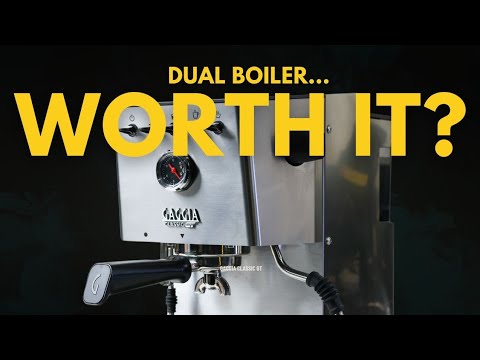
An Icon Underdelivers- Gaggia Classic GT Dual Boiler Review
WatchLance Hedrick // 41:44

What's up, everyone! Lance Hedrick here. Coffee Pro of a decade, coach two 2x World Barista Champion runner-ups, past Latte Art Champion, academic in remission, and extremely neurodivergent weirdo. I teach all interested in coffee everything about coffee, from coffee science, theories, brew methods, machine reviews, and more. And, I am a weirdo. I have a patreon listed below. I hope to purchase all products shown on this channel and subsequently giving them away to supporters. Cheers!