Lance Hedrick says $3,000 grinders cannot fix mediocre coffee beans
The vast divide between budget and luxury burrs
In the world of specialty coffee, the mechanical heartbeat of the morning ritual is the grinder. Lance Hedrick recently set out to dissect the functional reality behind the price tag, pitting the humble OXO Brew Conical Burr Grinder against the Lagom 01, a $3,000 titan of anodized aluminum. The comparison isn't just about build quality; it is a fundamental interrogation of whether precision engineering translates to a superior palate experience for the average home brewer. While the OXO represents an accessible entry point, its plastic internals and serrated cone burrs struggle to maintain the uniformity that high-end extraction demands.
Identifying the mechanical court jester
The evaluation began with a technical teardown of the OXO unit. Hedrick identifies it as the "court jester" of the setup, noting its plastic burr carrier and inconsistent feeding mechanism. The primary issue isn't just the materials, but the resulting particle distribution. Upon brewing a V60, the OXO produced what Hedrick described as "boulders"—massive, unground chunks of coffee reaching up to a third of a bean in size. These boulders lead to massive under-extraction in some areas of the bed, while the presence of excessive fines simultaneously introduces a drying, astringent finish that mutes the delicate notes of a high-quality Kenya.
Blind tests reveal the limits of precision
During a rigorous triangulation—a blind tasting method designed to eliminate bias—the Lagom 01 demonstrated its dominance. Hedrick successfully identified the odd-one-out, praising the high-end grinder for its tea-like clarity, juiciness, and balanced presentation. However, the narrative shifted when comparing the OXO to the Fellow Ode Brew Grinder Gen 2. While the Fellow produced a more homogeneous bed, the taste gap was surprisingly narrow. This highlights a critical law of diminishing returns: once you move past the erratic results of a blade grinder, the jumps in quality become increasingly nuanced and technical.
The verdict on bean quality versus hardware
The most provocative takeaway from this showdown is Hedrick's stance on resource allocation. He argues that the fastest route to a better cup isn't a $3,000 machine, but a higher-quality bean. A superior, ethically sourced coffee brewed on an entry-level burr grinder will consistently outperform a cheap bag processed through a world-class mill. While expensive hardware allows for the manipulation of specific flavor niches and aromatics, it remains a secondary variable to the raw ingredient. For those seeking the "end game," respect the bean before you obsess over the burr geometry.
- Lagom 01
- 22%· products
- Fellow
- 11%· companies
- Fellow Ode Brew Grinder Gen 2
- 11%· products
- Kenya
- 11%· places
- Lance Hedrick
- 11%· people
- Other topics
- 33%
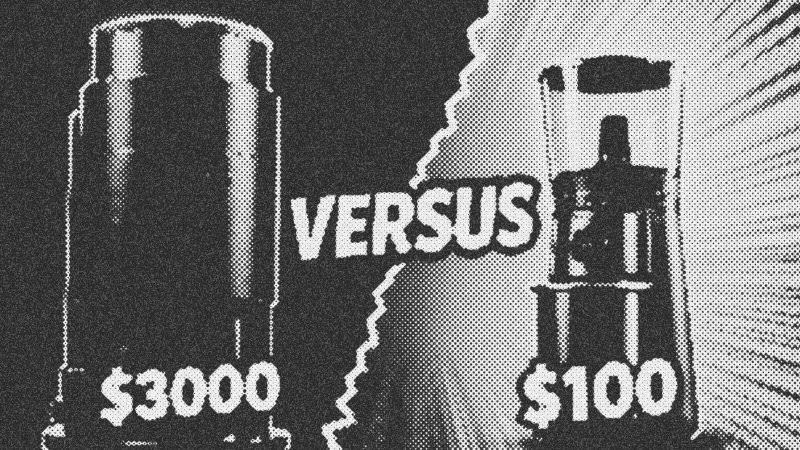
$100 vs $3000 Coffee Grinder Showdown
WatchLance Hedrick // 16:26

What's up, everyone! Lance Hedrick here. Coffee Pro of a decade, coach two 2x World Barista Champion runner-ups, past Latte Art Champion, academic in remission, and extremely neurodivergent weirdo. I teach all interested in coffee everything about coffee, from coffee science, theories, brew methods, machine reviews, and more. And, I am a weirdo. I have a patreon listed below. I hope to purchase all products shown on this channel and subsequently giving them away to supporters. Cheers!