The 54mm Flat Burr Showdown: Navigating the Mid-Range Coffee Grinder Market
Navigating the Mid-Range Grinder Landscape
Finding the sweet spot in consumer electronics often means looking at the mid-range—the place where diminishing returns haven't yet crippled the value proposition, but build quality finally matches enthusiast expectations. In the world of home espresso, that territory belongs to the 54mm flat burr category. This segment is currently dominated by three heavyweights: the Mahlkönig X54, the Baratza Vario+, and the Eureka Mignon Specialita. Each of these machines represents a different design philosophy, originating from Germany, the United States, and Italy respectively.
While the market often obsesses over 64mm and 83mm burr sets, the 54mm class offers a unique footprint and price point—typically ranging from $550 to $750. These aren't entry-level tools. They are designed for the serious home barista who wants to stop guessing and start dialing in precision extractions. However, choosing between them requires looking past the brand names and evaluating how their specific motor specs, burr geometries, and ergonomic quirks align with your daily workflow.
Mechanical Integrity: Motor Power and RPM Dynamics
On a spec sheet, the Eureka Mignon Specialita immediately asserts dominance. It boasts a 260-watt motor, nearly double the power of the Baratza Vario+ (130 watts) and the Mahlkönig X54 (120 watts). In practical terms, a more robust motor means less strain when grinding light, dense roasts at fine espresso settings. It’s the difference between a machine that hums through a light-roast Rwandan bean and one that sounds like it’s laboring.
RPM is another critical variable. Both the Eureka and the Baratza spin at 1350 RPM, while the Mahlkönig takes a more measured approach at 1050 RPM. Higher speeds can increase throughput, but they also risk higher heat generation and potentially a different particle distribution. The Mahlkönig's slower speed is a deliberate choice, aiming for a cleaner profile, though it results in a slightly longer wait for your morning double shot. When you listen to these machines, the Eureka Mignon Specialita is the clear winner in noise management, registering a dampened 70 decibels compared to the more piercing 80+ decibel whir of its competitors. This is achieved through clever rubber dampening gaskets that isolate motor vibration from the metal chassis.
The Burr Dilemma: Clarity vs. Body
Burrs are the engine of flavor, and here we see the starkest differences in philosophy. The Baratza Vario+ ships with ceramic burrs as standard. Ceramic is a traditional choice that produces a bimodal particle distribution—lots of "fines" that contribute to a thick, creamy mouthfeel and a traditional chocolatey profile. However, this comes at the cost of clarity. If you enjoy modern light roasts with high acidity, these burrs can feel muddled and bitter. For those users, the Ditting Steel Burrs are a mandatory upgrade. These are the gold standard of 54mm burrs, providing a unimodal-leaning grind that brings out floral notes and crisp acidity.
The Mahlkönig X54 uses its own proprietary steel burrs designed to bridge the gap. They provide more balance than the ceramics but lack the razor-sharp clarity of the Dittings. Meanwhile, the Eureka uses "Diamond Inside" cryogenically treated steel. These burrs are workhorses, favoring sweetness and body. They make for an incredibly forgiving espresso experience, particularly with medium-to-dark roasts. Interestingly, while Eureka markets these as 55mm, physical measurements reveal they are actually slightly smaller than the 54mm sets in the other two machines, proving that marketing numbers aren't always reflected in the calipers.
Workflow Realities and the Retention Tax
No grinder is perfect out of the box for the "single dosing" lifestyle popular among enthusiasts. If you dump 18 grams in, you rarely get 18 grams out without a fight. The Mahlkönig X54 attempts to solve this with internal sweeping arms that physically push grounds toward the chute. It's an improvement, but without a bellows, you'll still find half a gram to a gram hiding in the crevices.
The Eureka Mignon Specialita suffers from significant internal "dead space." Grounds cake up around the burr carrier, leading to old coffee mixing with new. To combat this, many users turn to 3D-printed modifications, such as tilted stands and bellows, to force air through the chamber. The Baratza Vario+ has seen the most significant internal upgrade in its latest iteration: a metal grinding chamber. Older Vario models used plastic carriers that would warp or expand under heat, ruining burr alignment. The move to metal brings commercial-grade stability to the home kitchen, allowing for "hyper-alignment" techniques that can make this $550 grinder punch far above its weight class.
Final Verdict: Which 54mm Grinder Wins?
Deciding between these three isn't about which is "best," but which matches your geography and flavor profile. If you live in North America, the Baratza Vario+ is the logical choice. The combination of its $550 price point, the availability of Ditting Steel Burrs, and Baratza's legendary customer support makes it a safe, high-performance investment. It is the "tinkerer’s grinder," capable of incredible results if you're willing to put in the work to align it.
For those outside the U.S., the Mahlkönig X54 becomes much more competitive. Its $750 U.S. price is a steep ask, but in Europe, where it is significantly cheaper, it offers a more premium build and more intuitive adjustments than the Vario. It feels like a piece of professional equipment, even if its filter coffee performance is merely passable.
The Eureka Mignon Specialita remains the king of the traditional home espresso setup. If you want a quiet, beautiful machine that sits on your counter with a full hopper of medium-roast beans, Eureka has nailed the brief. It’s the least suited for those who want to jump between espresso and pour-over every day due to its infinite dial system, but as a dedicated espresso tool, its sweetness and motor power are hard to beat. Choose the Vario for clarity, the Eureka for comfort, and the Mahlkönig for the middle ground.
- Baratza Vario+
- 22%· products
- Eureka Mignon Specialita
- 22%· products
- Mahlkönig X54
- 22%· products
- Ditting Steel Burrs
- 9%· products
- Baratza
- 4%· companies
- Other topics
- 22%
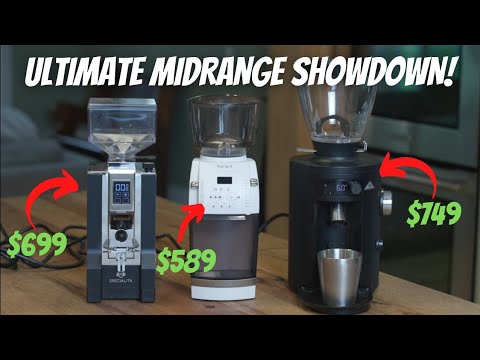
ULTIMATE MIDRANGE GRINDER SHOWDOWN!
WatchLance Hedrick // 57:11

What's up, everyone! Lance Hedrick here. Coffee Pro of a decade, coach two 2x World Barista Champion runner-ups, past Latte Art Champion, academic in remission, and extremely neurodivergent weirdo. I teach all interested in coffee everything about coffee, from coffee science, theories, brew methods, machine reviews, and more. And, I am a weirdo. I have a patreon listed below. I hope to purchase all products shown on this channel and subsequently giving them away to supporters. Cheers!