Manual Precision: A Comprehensive Deep-Dive into the Hand Grinder Market
The market for manual coffee grinders has exploded from a niche enthusiast corner into a crowded, high-stakes sector of consumer technology. After nine months of exhaustive double-blind testing and disassembly, the landscape reveals a stark truth: the difference between a mediocre cup and a transcendent one often lies in the microns of your adjustment system and the geometry of your burrs. This evaluation cuts through the marketing jargon of ten leading contenders, ranging from the budget-conscious Normcore Manual Coffee Grinder V2 to the over-engineered tanks like the Orphan Espresso Lido OG.
The Engineering of Extraction: Build Quality and Ergonomics
When you are hand-grinding for espresso, ergonomics aren't a luxury; they are a necessity. A grinder that feels like a toy will fail you under the high-torque requirements of light roast beans. The Timemore Chestnut X stands out immediately with its squared-off aluminum alloy body. Most grinders are circular, which can lead to slipping during vigorous use. The squared profile provides natural leverage points for the hand. Furthermore, their patented folding handle with a built-in rubber stopper solves the storage issue while doubling as a knocker to release static-bound grounds.
In contrast, the Kinu M47 Simplicity takes a minimalist approach to grip. It lacks silicone bands or knurling, instead featuring a prominent thumb stop that looks like a nose. This design choice forces the hand into an optimal high-grip position, safely away from the catch cup. While the Normcore Manual Coffee Grinder V2 offers a sleek aesthetic at a sub-$100 price point, its build quality falters in the details. The top cap lacks magnets or a secure click-lock, often popping off mid-grind, and the handle knob feels remarkably tight, hindering the fluid motion required for consistent RPM.
Dialing in the Microns: Adjustment Systems Compared
The most critical interface on any grinder is the adjustment system. If you cannot repeat a setting, you cannot master your coffee. The industry has moved toward three main styles: internal clicks, external rings, and stepless screw systems. The Comandante C40 MK4 remains the most frustrating in this regard. Despite its prestige, it relies on an internal click system with no numbers. To return to zero, you must click dozens of times, a process that feels archaic compared to modern rivals.
The Orphan Espresso Lido OG presents the most objective system on the market. Instead of vague "clicks," it uses a Vernier scale that measures the actual downward movement of the conical burr. It offers macro steps at 100 microns and a micro-stepless ring that allows for 5-micron adjustments. This level of precision is virtually unmatched in the manual world. Similarly, the 1Zpresso K Plus utilizes an external adjustment ring with 90 clicks per rotation, each representing 22 microns. This external placement allows for rapid, visual changes between filter and espresso settings without disassembling the unit.
Burr Geometry and the Pursuit of Flavor
Inside these machines, the burr sets dictate the particle distribution and, consequently, the clarity of your cup. Most modern grinders, including the 1Zpresso K Plus and Kingrinder K6, have adopted heptagonal (seven-spoke) geometries inspired by the Comandante "Nitro Blade." These burrs prioritize a slower feed rate, which yields a more uniform grind and higher clarity in filter brewing. During blind testing, the 1Zpresso K Plus consistently produced the brightest, cleanest cups, outperforming even the more expensive Comandante C40 MK4 in terms of vibrancy.
However, some manufacturers are pushing into experimental territory. The Etzinger Etz I introduces a stationary cone burr where the outer ring rotates—a reversal of traditional mechanics. While innovative, this specific execution was the most disappointing in flavor trials. It creates an excessive amount of fines, resulting in a bitter, traditional profile that lacks the high-definition separation sought by modern specialty drinkers. On the other end of the spectrum, the WonPlug Dual Burr utilizes a pre-breaker system. This two-stage process crushes the beans before they hit the final cutting teeth, resulting in surprisingly high consistency, though the user experience is marred by an unintuitive counter-clockwise grinding motion.
The Espresso Specialist vs. The Filter Favorite
Choosing a grinder requires identifying your primary brewing method. For espresso, the Kinu M47 Simplicity remains the gold standard for traditional palettes. Its 47mm burr set produces a texture and body that mimics high-end electric flat-burr grinders. Its alignment out of the factory is nearly perfect, ensuring that even at extremely fine settings, the burrs do not touch. The Orphan Espresso Lido OG is its primary rival here, offering a more robust build that could literally survive a battlefield.
For those who prioritize filter coffee and clarity, the 1Zpresso K Plus is the definitive choice. The heptagonal burr set excels at producing the "sweet and bright" profile that light-roast enthusiasts crave. While the Kingrinder K6 offers a similar burr geometry for half the price, the 1Zpresso K Plus justifies its premium through superior finishing and a magnetic catch cup system that is significantly more secure. The Kingrinder K6 does offer a unique value proposition for the tech-savvy: its top-end is designed to be compatible with cordless screwdrivers, allowing for motorized grinding when your arm tires.
Final Verdict: Cutting Through the Hype
After months of evaluation, the 1Zpresso K Plus emerges as the most complete package. It balances elite flavor profile, exceptional external adjustment, and thoughtful ergonomic design. It makes the Comandante C40 MK4 feel like a relic of a previous generation despite the latter's massive community support. If you demand a grinder that will last several lifetimes and you don't mind the massive physical footprint, the Orphan Espresso Lido OG is the industrial answer to a domestic problem.
Avoid the Etzinger Etz I if you value clarity, and look to the Normcore Manual Coffee Grinder V2 only if your budget is strictly under $100. For everyone else, the 1Zpresso lineup represents the current pinnacle of manual grinding technology. They have taken the standard set by Comandante and pushed it forward with faster grinding times, better adjustment interfaces, and superior build materials. In the world of consumer electronics, we often see incremental updates; the shift from internal click systems to external micron-based rings is a legitimate leap forward that every serious home barista should embrace.
- 1Zpresso K Plus
- 18%· products
- Orphan Espresso Lido OG
- 12%· products
- Comandante C40 MK4
- 9%· products
- Kingrinder K6
- 9%· products
- Normcore Manual Coffee Grinder V2
- 9%· products
- Other topics
- 42%
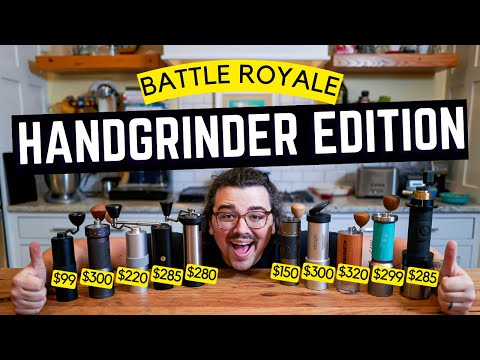
GUIDE TO HANDGRINDERS: Watch Before Buying
WatchLance Hedrick // 58:31

What's up, everyone! Lance Hedrick here. Coffee Pro of a decade, coach two 2x World Barista Champion runner-ups, past Latte Art Champion, academic in remission, and extremely neurodivergent weirdo. I teach all interested in coffee everything about coffee, from coffee science, theories, brew methods, machine reviews, and more. And, I am a weirdo. I have a patreon listed below. I hope to purchase all products shown on this channel and subsequently giving them away to supporters. Cheers!