Lance Hedrick: Most coffee drinkers enjoy TDS between 1.15 and 1.35
The Science of Variable Isolation
Brewing the perfect cup often feels like a guessing game between grind size, water temperature, and coffee-to-water ratio. Lance Hedrick suggests that the only way to truly understand your palate is to isolate these variables through systematic experimentation. By keeping the grind size, temperature, and dose constant while only adjusting the water volume, you can see how ratio affects the quality of extraction. This process reveals that the "golden ratio" of 1:16 is not a law, but a starting point that may not yield the most flavorful results for every bean.
Tools for the Precision Brewer
To replicate this experiment at home, you need a V60 or similar pour-over dripper, a reliable scale, and five identical vessels. While not strictly necessary, a refractometer helps quantify results by measuring Total Dissolved Solids (TDS). You also need a calculator for the C1V1 = C2V2 dilution equation, which allows you to equalize concentrations across different brews to compare the flavor quality of the extraction yield specifically.
The Extraction Ratio Experiment
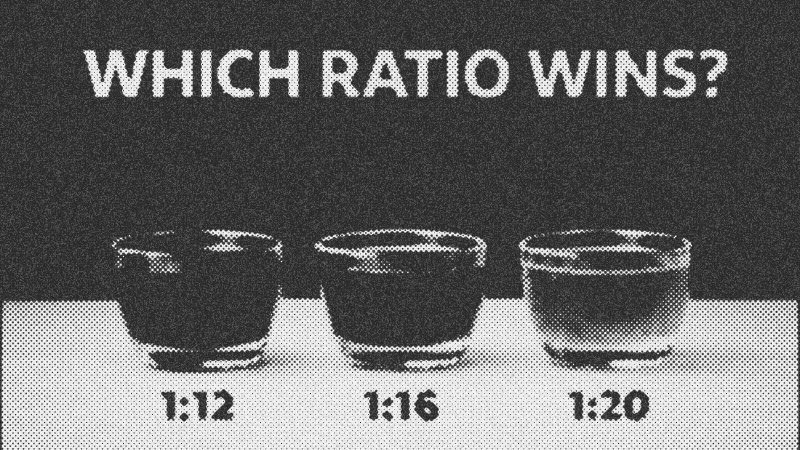
Prepare five separate brews using a consistent 15g coffee dose. Vary the water volumes to create ratios of 1:12, 1:14, 1:16, 1:18, and 1:20. This translates to water inputs of 180ml, 210ml, 240ml, 270ml, and 300ml. Note how the higher ratios increase the solvent contact, refreshing the concentration gradient and pulling more from the grounds. Once brewed, use the dilution formula to bring all cups to a uniform TDS—roughly 1.3. This step is vital because it removes the distraction of "strength" (intensity) so you can taste the actual "extraction" (the specific flavor compounds removed).
Tips for Balancing the Cup
If a 1:12 ratio feels too syrupy but has the best flavor notes, do not fear the bypass. Adding a small amount of water to a concentrated brew often preserves delicate floral and fruity characteristics that get lost or obscured by bitter components in longer extractions. Conversely, if you enjoy tea-like complexity, you might find the 1:20 ratio more rewarding. The goal is to find your personal "sweet spot" where acidity is juicy rather than punchy and the finish remains clean rather than astringent.
- Lance Hedrick
- 50%· people
- V60
- 50%· products
The Water Ratio Mistake Ruining Your Coffee
WatchLance Hedrick // 14:35

What's up, everyone! Lance Hedrick here. Coffee Pro of a decade, coach two 2x World Barista Champion runner-ups, past Latte Art Champion, academic in remission, and extremely neurodivergent weirdo. I teach all interested in coffee everything about coffee, from coffee science, theories, brew methods, machine reviews, and more. And, I am a weirdo. I have a patreon listed below. I hope to purchase all products shown on this channel and subsequently giving them away to supporters. Cheers!