Espresso drinkers should stir instead of swirling to fix 2% strength gap
The Physics of Layered Extraction
When espresso flows from the machine, it behaves as a stratified liquid rather than a homogenous solution. The initial output is dense, viscous, and syrupy, settling firmly at the bottom of the cup. As the extraction continues, the liquid becomes progressively thinner and less dense, layering on top of the initial syrupy base. This results in a "layered cocktail" effect where the top of the cup contains the weakest, least flavorful part of the shot, while the bottom hides the intense acidity and sweetness. Without intervention, a drinker experiences three disjointed sips that vary wildly in texture and balance.
Tactical Shift From Swirl to Stir
While many enthusiasts utilize the "wine swirl" to integrate these layers, James Hoffmann identifies this as a sub-optimal maneuver. Utilizing a refractometer to measure Total Dissolved Solids (Total Dissolved Solids), objective data reveals that an unstirred shot maintains a mere 8% strength at the top layer. Stirring increases this top-layer concentration to 10%, indicating a much more effective integration of the dense bottom solids into the lighter surface liquid. Swirling consistently fails to reach these concentration levels, leaving the espresso's potential locked in the bottom of the vessel.
Volatile Aromatics and Geometric Limitations
Swirling presents a secondary tactical disadvantage: the loss of aromatic compounds. Unlike a wine glass, which features a tapered rim designed to trap volatilized aromas in the head space, a standard espresso cup is wide and open. Swirling the liquid sends essential aromatic compounds into the room rather than the nose, effectively stripping the coffee of its olfactory complexity. Stirring preserves these delicate elements while achieving superior mechanical integration.
Future Implications for Cafe Standards
This analysis places the humble teaspoon at the center of quality control. Cafes that omit spoons from their service are essentially delivering an unfinished product, forcing the consumer to choose between an unbalanced drink or an ineffective swirl. For the discerning drinker, the objective data is clear: ignore the aesthetics of the swirl and embrace the mechanical efficiency of the stir for a balanced, 10% strength profile from first sip to last.
- espresso
- 17%· products
- espresso cup
- 17%· products
- James Hoffmann
- 17%· people
- refractometer
- 17%· products
- teaspoon
- 17%· products
- Total Dissolved Solids
- 17%· products
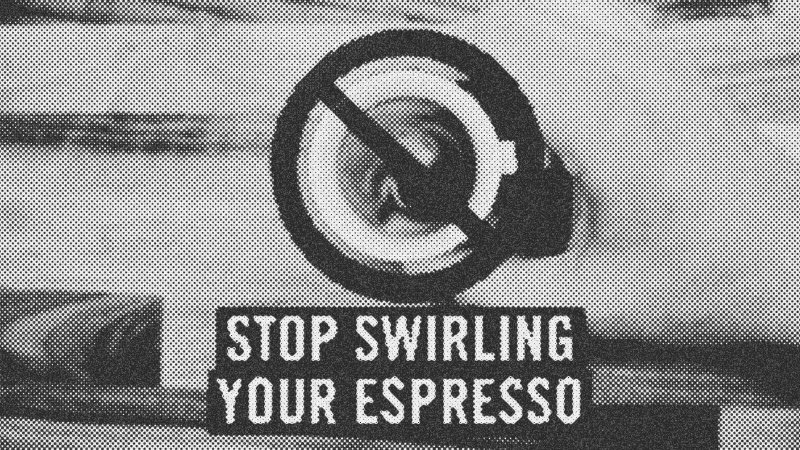
Stop Swirling Your Espresso
WatchJames Hoffmann // 5:02

Hi! My name is James, and I make videos about anything and everything to do with coffee, occasionally food and sometimes business/entrepreneurship. I create how-tos, guides, reviews, vlogs, video essays and mini-documentary films. In the real world, I've started a few companies, I wrote "The World Atlas of Coffee" and "How To Make The Best Coffee At Home". I do a little advisory work for startups too. If you want to get in touch, drop me a line but please read these two things first: 1. I don't do paid reviews. I have a Patreon that helps me buy the products I want to review to prevent bias (then I give them away!) 2. I get a lot of email, so sadly I can't help with queries about which equipment you should buy. TO GET IN TOUCH PLEASE REACH OUT VIA WEBSITE: https://www.jameshoffmann.co.uk/contact-me Management: Ziggurat XYZ