The Grit in the Grind: What Actually Happens When Stones Meet Burrs
The Hidden Hazards of the Harvest
Coffee is an agricultural product grown in the wild and processed under the sun. While specialty roasters employ rigorous quality control, the journey from a sun-drenched drying patio to your morning cup involves massive volumes of organic material. Occasionally, a piece of foreign matter—most often a small pebble or a fragment of "patio stone"—sneaks through. These stowaways are rare, yet they represent a significant fear for enthusiasts who invest hundreds or thousands of dollars in high-end DF64 Gen1.
Professional roasters mitigate this risk using a destoner, a machine that leverages airflow to separate light coffee beans from denser objects like stones, wood, or metal. However, smaller roasters or those with older equipment might miss the occasional fragment. When that click-clack of a stone hitting the burrs occurs, the immediate assumption is mechanical catastrophe. The reality, as it turns out, is far more resilient.
Stress Testing the Machinery
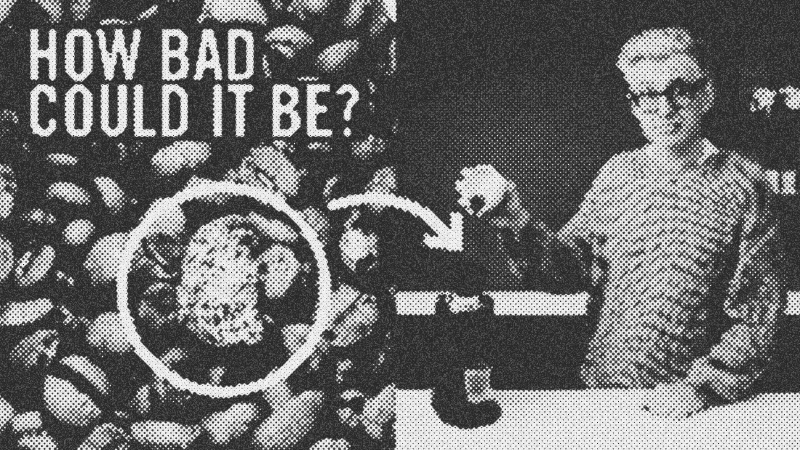
To understand the true impact of foreign objects, we subjected multiple grinders to a gauntlet of increasing mechanical stress. We started with the DF64 Gen1 equipped with high-RPM flat burrs and transitioned through to the Niche Zero and manual options like the Comandante. The testing sequence moved from soft wood to sandy patio stones, eventually escalating to hardened pebbles and metal screws.
Surprisingly, most grinders powered through stones with startling efficiency. Even a ceramic "false burr" grinder, often criticized for its build quality, pulverized a stone into a puff of dust. The Comandante manual grinder required no extra physical exertion to crush a bean-sized stone. While the sound of stone-on-metal is jarring, the mechanical torque of modern motors—especially those running at 1,400 RPM—tends to treat soft geological matter much like a very hard, light-roasted bean.
Analyzing Particle Distribution and Burr Integrity
Visual inspections under a video microscope revealed that while stones left dusty residues, they rarely caused structural damage to the finishing edges of the burrs. Most impacts occurred on the pre-breaking teeth, which do not dictate the final particle size of the grind. To confirm this, we utilized a particle size analyzer to map the distribution of coffee grounds before and after the "stone trauma."
Data overlays showed virtually zero change in the grind profile after processing several stones. The humps representing fines and boulders remained identical. It was only when we introduced metal—screws and washers—that the equipment suffered. Metal objects caused the grinder to jam and dented the cutting edges, leading to a measurable shift in coarseness. This suggests that while stones are a nuisance, they lack the hardness required to significantly degrade the hardened steel or titanium-coated burrs used in the industry.
Practical Implications for Coffee Lovers
If you discover a stone in your grinder, the first step is to inform your roaster. This feedback is essential for them to calibrate their destoner and prevent future occurrences. However, the data suggests you should not immediately demand a replacement burr set. Unless the object was metal, the damage is likely cosmetic and will not impact the flavor or extraction of your coffee.
A follow-up taste test confirmed this: a cup of coffee brewed with nearly a gram of pulverized stone was indistinguishable from a clean control cup. The stone remains insoluble and lacks the mineral intensity to overcome the dominant flavor of the coffee. Ultimately, while a stone in the beans is a sign of a processing slip-up, it is rarely the death sentence for your hardware that the internet makes it out to be.
- Comandante
- 18%· products
- destoner
- 18%· products
- DF64 Gen1
- 18%· products
- James Hoffmann
- 9%· people
- Niche Zero
- 9%· products
- Other topics
- 27%
Stones In Coffee: An Ill-Advised Investigation
WatchJames Hoffmann // 24:23

Hi! My name is James, and I make videos about anything and everything to do with coffee, occasionally food and sometimes business/entrepreneurship. I create how-tos, guides, reviews, vlogs, video essays and mini-documentary films. In the real world, I've started a few companies, I wrote "The World Atlas of Coffee" and "How To Make The Best Coffee At Home". I do a little advisory work for startups too. If you want to get in touch, drop me a line but please read these two things first: 1. I don't do paid reviews. I have a Patreon that helps me buy the products I want to review to prevent bias (then I give them away!) 2. I get a lot of email, so sadly I can't help with queries about which equipment you should buy. TO GET IN TOUCH PLEASE REACH OUT VIA WEBSITE: https://www.jameshoffmann.co.uk/contact-me Management: Ziggurat XYZ