$500,000 roller mill reveals why home coffee grinders hit a wall
The brutal physics of coffee extraction
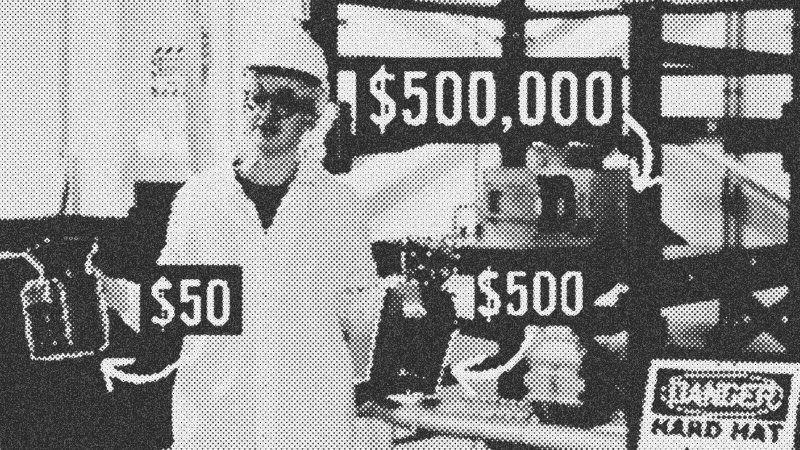
Most consumers assume a coffee grinder simply breaks beans into smaller pieces. In reality, a grinder is a precision engineering tool tasked with managing surface area. I recently put three wildly different machines to the test: a $50 Sboly Conical Burr Grinder, a $500 Baratza Vario+, and a staggering $500,000 industrial roller mill at the Cometeer facility. The objective was to determine if the half-million-dollar price tag offers a transformative experience or merely industrial-scale efficiency.
Burr geometry and particle distribution
The Sboly Conical Burr Grinder utilizes conical burrs, which are cost-effective but often struggle with consistency. During testing, the motor audibly strained, emitting a worrying scent of burning electronics. The Baratza Vario+ uses flat burrs, designed for a more uniform particle size. However, the industrial mill is a different beast entirely. It employs multiple stages of roller mills—cylindrical burrs that roll toward each other. This allows for unprecedented control over the grind curve, effectively decoupling the "fines" from the target particle size.
Laser analysis and the taste gap
Subjective tasting confirmed the technical data. The $50 machine produced a harsh, astringent cup, likely due to a high concentration of fines—micro-particles that over-extract and create bitterness. Alex Kaplan at Cometeer helped me analyze the results using a laser particle size analyzer. The data was clear: the $500,000 mill produced a tight, tall peak on the distribution chart with minimal fines. The Baratza Vario+ performed admirably, sitting roughly halfway between the two extremes in terms of distribution quality.
Efficiency and diminishing returns
The speed test highlighted the industrial necessity of the roller mill. While the home units managed roughly 75 to 90 grams per minute, the industrial mill processed 30 kilograms in 60 seconds. Beyond speed, the ability to "shape" the distribution curve—adjusting the hump of the tail for specific flavor profiles—is a luxury only accessible at this price point. For most home users, the jump from $50 to $500 provides the most significant leap in quality. Beyond that, you are paying for the physics of mass production and hyper-precision that rarely justifies the cost for a single morning cup.
- Baratza Vario+
- 27%· products
- Cometeer
- 18%· companies
- Sboly Conical Burr Grinder
- 18%· products
- Alex Kaplan
- 9%· people
- Baratza
- 9%· companies
- Other topics
- 18%
$50 vs $500 Vs $500,000 Coffee Grinder
WatchJames Hoffmann // 12:56

Hi! My name is James, and I make videos about anything and everything to do with coffee, occasionally food and sometimes business/entrepreneurship. I create how-tos, guides, reviews, vlogs, video essays and mini-documentary films. In the real world, I've started a few companies, I wrote "The World Atlas of Coffee" and "How To Make The Best Coffee At Home". I do a little advisory work for startups too. If you want to get in touch, drop me a line but please read these two things first: 1. I don't do paid reviews. I have a Patreon that helps me buy the products I want to review to prevent bias (then I give them away!) 2. I get a lot of email, so sadly I can't help with queries about which equipment you should buy. TO GET IN TOUCH PLEASE REACH OUT VIA WEBSITE: https://www.jameshoffmann.co.uk/contact-me Management: Ziggurat XYZ