The Freshness Fallacy: Does Grind Quality Outweigh Time?
Challenging the Golden Rule of Coffee
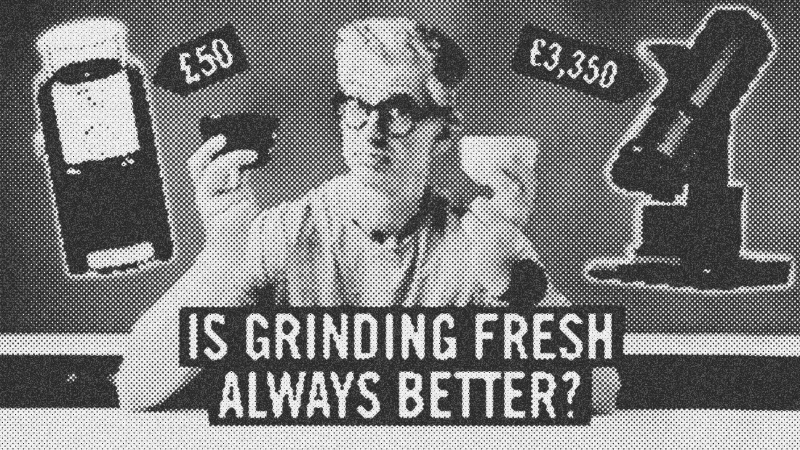
The most pervasive advice in specialty coffee is simple: grind your beans immediately before brewing. We treat coffee freshness as a binary state where the moment a bean is shattered, a countdown to mediocrity begins. This logic suggests that even the humblest blade grinder used seconds before brewing will outperform premium coffee ground days in advance. However, experimental data suggests this "freshness first" mantra ignores the critical impact of grind uniformity and particle distribution.
The High-End Stale vs. Low-End Fresh Experiment
To test this, we compared pre-ground coffee from a high-performance EG1 or EK43 grinder against fresh coffee from budget-tier hardware. The methodology involved aging high-end grinds from one to 16 days and pitting them against freshly ground beans from a whirly blade grinder, a false burr grinder, and a mid-range Baratza Encore ESP.
Initial cupping revealed a rapid decline in aromatic complexity. Within 24 hours, the vibrant sweetness of the high-end grind begins to fade. By day seven, the coffee loses its special character, turning flat and bitter. Yet, despite this decay, a surprising hierarchy emerged: the seven-day-old high-end grind remained more palatable than the fresh grind from a cheap blade or false burr machine. The bitterness and astringency produced by poor grind quality are often more offensive to the palate than the mere absence of aromatics in older, well-ground coffee.
The Consumer Perspective and Public Tasting
To move beyond the bias of a professional palate, a blind tasting with nearly 90 people at Prufrock Coffee in London provided broader data. Participants ranked four coffees from most to least preferred. While the data showed a slight preference for the Baratza Encore ESP, the results were statistically tight.
Interestingly, dedicated filter coffee drinkers were better at identifying and preferring the quality of a good burr grind, even if it wasn't perfectly fresh. Conversely, those who primarily drink espresso-based beverages showed less consistent preferences. This suggests that the "fresh is best" rule is most relevant when using capable equipment. If the grinder cannot produce a uniform particle size, the benefit of freshness is often negated by the extraction flaws inherent to uneven grinds.
Implications for the Home Brewer
This experiment offers a pragmatic olive branch to those without the budget for expensive home machinery. If you cannot afford a high-quality burr grinder, buying a bag of coffee at a local cafe and having them grind it on a professional EK43 may actually yield a better experience for the first five to seven days than using a cheap blade grinder at home.
Grinder quality is not just about flavor; it provides control. A home grinder allows you to adjust the size to suit your specific brewing method, whether it's a V60 or a French Press. However, for simple infusion methods where grind precision is less critical, the professional pre-ground option is a legitimate path to better flavor.
Conclusion: A Nuanced Approach to Freshness
While grinding fresh remains the gold standard for those with quality equipment, we must stop dismissing pre-ground coffee as universally inferior. The engineering of the burr and the resulting particle distribution play a role at least as significant as the roast date. For the average consumer, the best cup of coffee might not come from the freshest grind, but from the most consistent one.
- Baratza Encore ESP
- 17%· products
- EK43
- 17%· products
- blade grinder
- 8%· products
- Cometeer
- 8%· companies
- EG1
- 8%· products
- Other topics
- 42%
$50 Coffee Grinder Vs Pre-ground From A $3,500 Grinder
WatchJames Hoffmann // 20:31

Hi! My name is James, and I make videos about anything and everything to do with coffee, occasionally food and sometimes business/entrepreneurship. I create how-tos, guides, reviews, vlogs, video essays and mini-documentary films. In the real world, I've started a few companies, I wrote "The World Atlas of Coffee" and "How To Make The Best Coffee At Home". I do a little advisory work for startups too. If you want to get in touch, drop me a line but please read these two things first: 1. I don't do paid reviews. I have a Patreon that helps me buy the products I want to review to prevent bias (then I give them away!) 2. I get a lot of email, so sadly I can't help with queries about which equipment you should buy. TO GET IN TOUCH PLEASE REACH OUT VIA WEBSITE: https://www.jameshoffmann.co.uk/contact-me Management: Ziggurat XYZ