The Neurobiology of Craving: How the Brain and Gut Dictate Our Taste for Life
The Architecture of Perception
Most of us believe we see the world as it is. We imagine our eyes, ears, and tongue act as windows through which reality enters. However, as Charles Zuker explains, the brain is an organ locked in a dark room, speaking only the language of electrical signals. It never actually "touches" a sugar molecule or "hears" a sound. Instead, it relies on detection—the moment a molecule interacts with a receptor—to spark the journey of perception. Perception is the brain’s active reconstruction of those signals into meaning.
In the realm of taste, this process is remarkably streamlined. While vision involves millions of colors and infinite shapes, the taste system operates on just five basic lines of information: sweet, sour, bitter, salty, and Umami. These five qualities aren't just random sensations; they are biological imperatives. Sweet ensures energy intake, umami signals protein, and salt maintains electrolyte balance. Conversely, bitter acts as a poison alarm, and sour warns against fermented or spoiled food. By reducing the complexity of the world into these five channels, the brain creates a reliable compass for survival.
From Tongue to Cortex: The Hardwired Highway
The journey from a bite of food to a conscious experience is a high-speed transit through the nervous system. Every taste bud contains about 100 receptor cells, each tuned to one of the five primary tastes. When you consume something bitter, receptors at the very back of your tongue—your last line of defense—trigger an immediate, innate rejection. This isn't a learned behavior. We are born with a "valence" for these tastes; we seek the sweet and recoil from the bitter before we ever take our first step.
Once the signal leaves the tongue, it travels through the Vagus Nerve and the brain stem, eventually landing in the taste cortex. Here, the brain maintains a topographic map. There is a specific "sweet" spot and a "bitter" spot in your brain. This hardwiring provides a stable framework for life, but it isn't rigid. As we grow, the system exhibits plasticity. We learn to love coffee or bitter vegetables not because our receptors change, but because our brain associates the initially aversive signal with a positive internal gain, such as the metabolic lift from caffeine.
The Invisible Driver: Gut-Brain Signaling
Perhaps the most startling revelation in modern neuroscience is that our conscious preference for food is often a secondary effect of an unconscious dialogue between the gut and the brain. Andrew Huberman and Zuker explore how the gut acts as a second sensory organ, monitoring the nutritional value of what we ingest long after the taste has left our mouths.
In a landmark experiment, mice lacking sweet receptors were given a choice between water and sugar water. Initially, they couldn't tell the difference. However, after 48 hours, they almost exclusively drank the sugar water. They couldn't "taste" the sweetness, but their gut sensed the glucose. This "post-ingestive" signaling bypasses conscious taste entirely. The gut recognizes the energy source and sends a signal to the brain saying, "Whatever you just did, do it again." This is the biological root of the unquenchable craving for sugar—a drive that exists independently of the pleasure of eating.
The Modern Malfunction: Over-Nutrition and Highly Processed Foods
Evolution designed these circuits for a world of scarcity. In nature, sugar and fat are rare, high-value prizes. Today, however, highly processed foods co-opt these ancient pathways. By flooding the system with concentrated doses of sugar and fat, these foods create a "wanting" signal that far outstrips our actual nutritional needs. We are witnessing a historical pivot where diseases of malnutrition are no longer caused by a lack of food, but by the over-consumption of the wrong foods.
This shift suggests that obesity and metabolic disorders are not merely problems of the body or metabolism, but diseases of the brain's circuitry. When we consume artificial sweeteners, we satisfy the tongue, but we fail to satisfy the gut. Because the gut-brain axis only recognizes the glucose molecule, the craving remains active, leading many to continue seeking the caloric reward they were promised by the sweet taste but never received in the blood.
Conclusion
Understanding the biology of taste shifts the conversation from willpower to neurobiology. Our cravings are not failures of character; they are the result of an orchestra of signals where the brain is the ultimate arbiter. By recognizing that our preferences are malleable and that our gut is constantly whispering to our brain, we can begin to design environments and habits that work with our biology rather than against it. The future of human health lies in bridging the gap between metabolic science and neuroscience, treating the nervous system as the command center for our physical well-being.
- Andrew Huberman
- 14%· people
- Charles Zuker
- 14%· people
- Columbia University
- 14%· organizations
- Insulin
- 14%· products
- Stanford School of Medicine
- 14%· organizations
- Other topics
- 29%
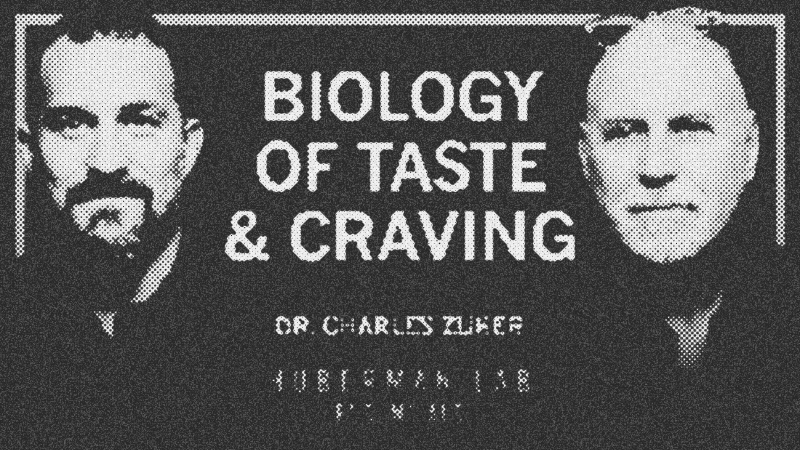
Essentials: The Biology of Taste Perception & Sugar Craving | Dr. Charles Zuker
WatchAndrew Huberman // 30:53

The Huberman Lab podcast is hosted by Andrew Huberman, Ph.D., a neuroscientist and tenured professor in the department of neurobiology of ophthalmology, and by courtesy, psychiatry and behavioral sciences at Stanford School of Medicine. The podcast discusses neuroscience and science-based tools, including how our brain and its connections with the organs of our body control our perceptions, our behaviors, and our health, as well as existing and emerging tools for measuring and changing how our nervous system works.