Viola Davis says her 60s are about owning a life that is finally hers
The Anesthesiologist and the Nurse Who Believed in Love
In the sterile, flickering light of a television hospital set in 1999, an anesthesiologist handed a bag of blood to a nurse. This wasn't the opening scene of a medical drama, but the beginning of a twenty-seven-year partnership that would eventually anchor one of Hollywood's most formidable power couples. Julius Tennon, then a recurring actor on City of Angels, saw Viola Davis and felt an immediate pull. He handed her his card with a simple invitation to hang out, unaware that his presence—clothed, as Davis jokingly notes—would lead to twenty-three years of marriage and a shared production empire. Their meeting was remarkably grounded, devoid of the artifice often associated with industry romances. They were two working actors, navigating the precarious climb of a career where success is never guaranteed and credit scores are often as bruised as egos.
Davis was initially terrified to reveal the financial scars of her past, specifically a credit score that had plummeted to 500. It is a detail that humanizes the EGOT winner, stripping away the polish of the Academy of Motion Picture Arts and Sciences to reveal the anxieties of a woman who clawed her way out of Central Falls, Rhode Island. Tennon’s response—a mix of pragmatism and unconditional support—set the tone for their relationship. He didn't see the credit score; he saw the woman. This foundation of safety allowed Davis to eventually transition from a working actor making $650 a week to a cultural icon. Their partnership at JuVee Productions is more than a business arrangement; it is a defensive wall against an industry that often tries to shrink Black women’s power or sanitize their truth.
Negotiating the Silence and the Spirit of Excellence
When Davis speaks, there are often long, thoughtful pauses—what she calls "negotiating." It is the habit of a woman who has spent decades navigating spaces where her voice carries the weight of representation and the risk of exclusion. She is careful not to step on toes, yet she is uncompromising when it comes to the "spirit of excellence." This quality is what she admires in younger actors like Timothée Chalamet. In a world that often mistakes mere presence for an event, Davis demands more. She bristles at mediocrity, preferring the raw ambition and "attitude" of those who refuse to be quiet. This appreciation for the "bad kid"—the one who sticks a finger in the wedding cake or refuses to play by the rules—is a window into her own childhood. Davis was once that "good girl" worshiping at the feet of people who didn't deserve her, and she now champions a self-possession that she had to fight to earn.
This commitment to excellence is what led her to Juilliard School, an experience she describes with a mix of gratitude and lingering trauma. The school’s attempt to "kill" her Rhode Island accent—forcing her to spend hours practicing the pronunciation of "father" with a pencil in her mouth—represents the classic struggle of the artist: the pressure to conform versus the need to be authentic. While she learned the technical skills required to tackle William Shakespeare and Anton Chekhov, she found herself falling asleep in classes taught by the world's greatest Shakespearean actors. It wasn't that she lacked talent; it was that the material didn't always excite her. It didn't speak to her cadences. It didn't feel like home. It wasn't until she found the work of August Wilson that her training and her identity finally merged, allowing her to stop translating herself for an audience and start existing within the stories of her own people.
The Absurdity of the Hollywood Love Scene
There is a sharp, witty edge to Davis's critique of industry norms, particularly the "nightmare" of the cinematic love scene. She has reached a point in her career where she can simply say "no." Her disdain for these scenes isn't about modesty; it's about a lack of realism. She mocks the choreographed absurdity of it all—the six-pack abs, the strategically placed scrub brushes, and the industrial amounts of makeup used to cover stretch marks. Davis argues that these scenes are rarely about intimacy; they are about male desirability. She famously told her How to Get Away with Murder co-star, Tom Verica, that they were going to "hold it up for the regular people." They would show the truth of middle-aged bodies, stretch marks and all, even if it meant leaving makeup smears all over the set’s white sheets.
Her demand for a "boyfriend with a gut" is a brilliant piece of media criticism. If a character has a gut, she argues, the writers are forced to actually write the scene. It becomes about the conversation, the connection, and the organic development of a kiss, rather than the spectacle of a gym-toned body. This focus on truth over spectacle is a recurring theme in her work, from the "plain-spokenness" of her parents to the gritty realism she brought to the screen in Fences. She rejects the
- Amy Poehler
- 5%· people
- August Wilson
- 5%· people
- Billy Brown
- 5%· people
- Cicely Tyson
- 5%· people
- City of Angels
- 5%· tv shows
- Other topics
- 76%
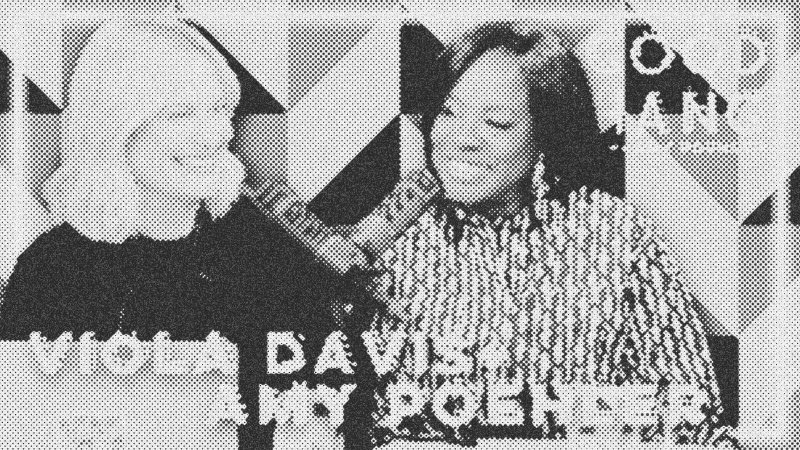
Viola Davis | Good Hang with Amy Poehler
WatchGood Hang with Amy Poehler // 1:18:10

Come hang with Amy Poehler. Each week on her podcast, she'll welcome celebrities and fun people to her studio. They'll share stories about their careers, mutual friends, shared enthusiasms, and most importantly, what's been making them laugh. This podcast is not about trying to make you better or giving advice. Amy just wants to have a good time.