Bending the Code: Tactical Breakdown of the BeamNG Upgrade Race
FailRace////6 min read
Tactical Overview: The Incremental Power Creep
Speedrunning and competitive gaming often hinge on a single variable. In the upgrade race at , that variable is the efficiency of incremental evolution. The scenario is simple but punishing: a series of one-lap sprints where performance dictates the level of customization allowed for the next round. Winners receive zero upgrades, while trailing participants gain up to two, creating a rubber-band mechanic that forces a choice between immediate victory and long-term technical superiority.
The environment demands a delicate balance of mechanical optimization. Every competitor started with a baseline vehicle—approximately 1990s era—locked to sport tires. This restriction is the ultimate limit. Regardless of how much horsepower a driver injects into their engine, the contact patch remains static. This creates a diminishing return on power, where the game’s physics engine eventually punishes excessive torque with uncontrollable wheelspin and thermal failure. Success in this format requires more than just driving skill; it requires an analytical approach to the vehicle’s components and a deep understanding of how calculates stress on virtual parts.
Key Strategic Moves: The Heavy Block Gambit
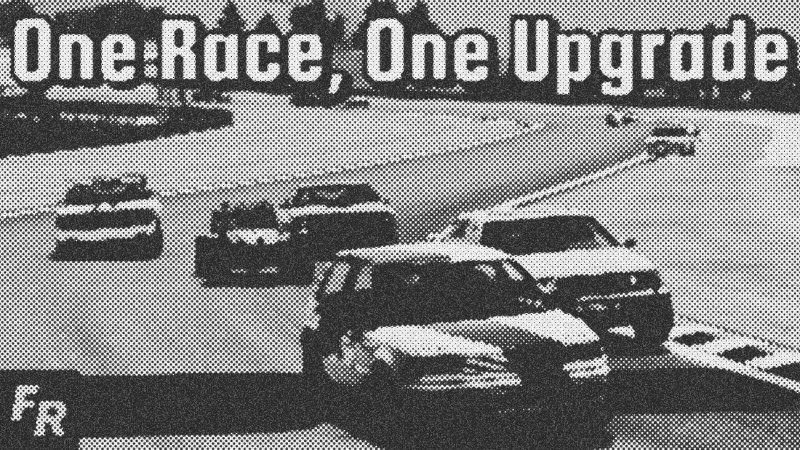
One of the most critical tactical decisions occurred in the second round. After a respectable third-place finish in the opening lap, opted for a move that seemed counterintuitive to the immediate goal of winning: he installed an ultra-heavy-duty long block in his . This upgrade actually increased the vehicle's weight and offered no immediate performance boost, resulting in a disastrous sixth-place finish. However, this was not a failure of skill; it was a deliberate sacrifice for future power scaling.
By strengthening the engine's internal structure early, prepared his car for a massive turbocharger upgrade that would have shattered a stock engine. This foresight allowed him to jump from 250 horsepower to a staggering 1,200 horsepower in a single leap. While competitors like and faced engine failures by pushing stock components too hard, the remained structurally sound. This "Point and Squirt" strategy turned the car into a ballistic missile—useless in technical corners but untouchable on the straights. It’s a classic example of breaking the game’s meta by identifying the primary bottleneck (engine durability) and over-engineering it before the real competition began.
Performance Breakdown: The Basto vs. The Missile
, driving the , provided the baseline for peak efficiency. His strategy was the polar opposite of the high-power gamble. By focusing on consistency and utilizing only three upgrades throughout the entire tournament, maintained a vehicle that was perfectly tuned to the layout. His car was lighter, stopped faster, and held higher mid-corner speeds than the heavier, more powerful alternatives.
In contrast, the represented raw, unbridled power. By the final rounds, it boasted 1,200 horsepower—nearly triple the power-to-weight ratio of the competition. However, the performance breakdown reveals a fatal flaw: the Anti-lock Braking System (ABS). In the high-speed transition to Turn 1, the failed to decelerate because the ABS could not process the extreme forces of a 1,900kg car hitting the brakes at 150 mph. This forced to disable the system entirely, shifting the burden of precision back to the driver. The won the championship not through superior power, but through a superior balance of weight and reliability, finishing just seven points ahead of the monstrous .
Critical Moments: The Turn 1 Decimation
The penultimate and final rounds highlighted the chaos of the "standing start" mechanics. In Round 6, a massive pile-up at Turn 1 reshuffled the standings. , who had spent the entire event building a with 3,200 horsepower, found his car completely undrivable. The physics engine simply could not translate that much energy through sport tires, leading to immediate snap-oversteer and retirement. This moment served as a warning: there is a hard limit to what the game's simulation can handle before a car becomes a liability.
The final two-lap race was the ultimate test of endurance. While had optimized his cooling with a high-performance radiator, his lack of experience with the new race suspension and high-speed braking zones led to a massive overshoot at Turn 1. This error allowed , driving the , to seize the lead. Although the had the power to close the gap, the damage to the synchronizers from missed shifts and the sheer unpredictability of the brakes meant settling for second place. These critical errors underscore that in high-level gaming, technical superiority is meaningless without the precision to control it.
Future Implications: The Weight-Power Equilibrium
This event proved that the most efficient path to victory in a upgrade race isn't necessarily the highest horsepower. The future of this format lies in the "Weight-Power Equilibrium." Drivers who focused on stripping weight and improving suspension geometry, like in the , found themselves consistently on the podium despite lower power figures. The was agile but vulnerable to collisions due to its low mass—a tactical trade-off that requires near-perfect defensive driving.
For future iterations, the optimization path should prioritize braking and cooling earlier. found that his stock brakes were surprisingly resilient, but his gearbox was a bottleneck. The addition of a race gearbox in the later rounds provided better power delivery, yet it came too late to overcome the point lead established by . The final lesson is clear: identify the physical limits of the tires first, then build every other system—engine, brakes, and suspension—to meet that specific limit without exceeding it. Anything more is just wasted code.
One Race, One Upgrade - The Rocketship Lexus - BeamNG Drive
WatchFailRace // 42:08