Teardown Worms: A Tactical Autopsy of Nautical Chaos and Piano Ballistics
The Architecture of Destruction: Scenario Overview
The tactical environment of Teardown serves as a digital laboratory for structural failure, and when filtered through the competitive lens of the Worms game mode, it becomes a high-stakes exercise in risk management and precision demolition. The scenario begins on a central, massive container ship—a "cheese boat" laden with explosives and yellow paint—surrounded by a fleet of secondary vessels including yachts, speedboats, and the now-infamous banana boat. The objective remains deceptively simple: maintain buoyancy while systematically compromising the structural integrity of the opposition.
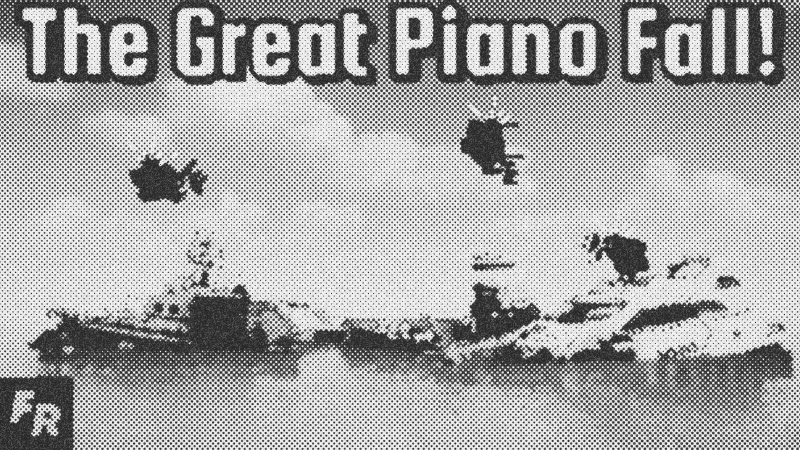
This specific engagement introduced a volatile variable into the standard rocket-and-sniper meta: the piano drop. Unlike the linear trajectory of a rocket, the piano functions as a gravity-fed kinetic projectile capable of delivering massive, though sometimes unpredictable, vertical force. The participants—a group of eight including Alex, Chris, Blazer, and Rusky—operated under strict turn-based constraints, allowing for one movement phase (driving or boarding) and one action phase (firing or welding). This structure forces players to weigh the immediate gratification of a direct hit against the long-term necessity of a secure platform.
Strategic Pivot Points: The Mobility vs. Stability Trade-off
Early-game maneuvers focused heavily on platform diversification. Staying on the primary container ship offered a large surface area but presented a collective risk; a single catastrophic failure would eliminate half the field. Alex and Shadows recognized this early, opting for smaller, more maneuverable yachts. The strategic logic here is sound: a smaller target is harder to hit with long-range ballistics, even if its total health pool is lower. However, this move introduced the "boarding risk," where players find themselves stranded if their vessel is disabled during transit.
One of the most significant tactical errors observed was the over-reliance on the container ship's bulk. While it felt safe, it became a stationary target for every player on the periphery. The "Cheese Boat" quickly transformed into a sinking monument to hubris. As the stern began to list, the remaining players were forced into increasingly desperate "parkour" maneuvers, attempting to bridge gaps with planks or jump to passing debris. This highlights a core tactical lesson in Teardown Worms: in a destructible environment, the largest object in the room is simply the one with the most ways to fail.
Weaponry and Ballistic Analysis: The Piano Meta
The introduction of the piano drop fundamentally altered the verticality of the engagement. While rockets are the bread and butter of hull breaching, the piano functions as a psychological weapon. Ma demonstrated the piano's utility early, using it not just for damage but as a physical obstacle. In several instances, a dropped piano effectively "welded" a hole shut or pinned a player against a bulkhead, complicating their next movement turn.
However, the ballistic profile of the piano is fraught with inaccuracy. At extreme ranges, the drop point becomes erratic, often resulting in "whiffed" shots that hit nothing but the ocean floor. Conversely, the rocket launcher remains the superior tool for precision sinking. Chris utilized rockets to target the "waterline" of the yachts, a tactic far more effective than aiming for the deck. By introducing water into the lower hulls, players like Rusky and Amy forced their opponents into a race against the game's physics engine. Once a vessel reaches a critical list angle, the driving seat becomes inaccessible, effectively neutralizing the player's mobility and ending their offensive threat.
Performance Breakdown: Individual Contributions and Failures
Chris emerged as the session's most resilient tactician, despite—or perhaps because of—his eccentric focus on Oreo cookies and defensive placement. His ability to survive on a disintegrating platform while others succumbed to the depths speaks to a "survivalist" playstyle. He prioritized repair and positioning over flashy kills, which kept him in the game long after more aggressive players like Rusky had been submerged.
Blazer provided the session’s most chaotic energy, often acting as a double-edged sword for his teammates. His decision-making was frequently compromised by a desire for "funny kills" over tactical ones, leading to missed opportunities with the piano drop. However, his willingness to engage in "drive-by spray painting" and high-speed boat maneuvers forced other players out of their comfort zones. Euan and the Banana Boat served as the tactical wildcard. The banana boat, while virtually defenseless, became a protected entity through a combination of pity and humor, illustrating how social engineering can be a viable defense strategy in multiplayer gaming.
Critical Moments: The Sinking of the Dream Team
The formation of the "Dream Team"—a loose alliance between Alex, Chris, Rusky, and Amy—marked a shift toward collective security that ultimately proved fatal. Grouping four players on a single medium-sized yacht created a "high-value target" that the remaining players could not ignore. The tactical impact was immediate: the ship began to sink under its own weight and the incoming fire.
The most critical moment occurred when Rusky attempted to jump from a sinking speedboat to the relative safety of the yacht, only to be knocked into the water by a misplaced piano. This event effectively broke the alliance and sent the remaining members into a panic. When the physics engine finally registered the amount of water on the yacht's deck, the vessel tipped, throwing three players into the sea simultaneously. It was a stark reminder that in Teardown, physics is the ultimate arbiter, and alliances are only as strong as the deck they stand on.
Future Implications: Evolution of the Nautical Meta
Looking forward, the "Puffin" victory—where a small, overlooked spectator boat outlasted the heavy hitters—suggests a need for a paradigm shift in strategy. Future players should prioritize "stealth buoyancy." Instead of seeking the largest ship, the optimal move may be to occupy a small, low-profile vessel and stay on the periphery until the heavy hitters have compromised each other's integrity.
Additionally, the use of the blowtorch as a defensive tool remained underutilized. Welding doors shut and reinforcing key structural pillars could have extended the life of the container ship significantly. Future engagements will likely see a more sophisticated use of "boarding actions," where players use their movement turn to sabotage an opponent's boat directly rather than relying on long-range ballistics. The "Piano Era" has begun, and while it is chaotic, it has added a layer of vertical complexity that makes every turn a life-or-death calculation in the world of Teardown Worms.
Teardown Worms - The Great Piano Fall!
WatchFailRace // 1:22:29

FailRace is a place where cars are raced, rolled, put through incredible challenges and sometimes crashed rather spectacularly all for your entertainment on some of the best driving video games around. If you are feeling super generous you can help support this channel on patreon :), the link can be found below