Choi analyzes why rubbish vehicles dominate Hellride circuit in GTA 5
Optimized Chaos on the Hellride Circuit
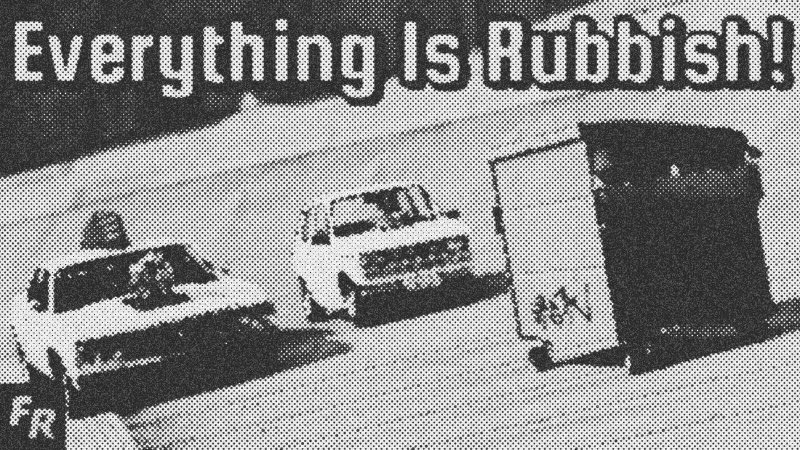
The GTA 5 racing meta usually revolves around downforce and traction coefficients, but the Hellride circuit shifts the objective from speed to survival. This specific event utilized a custom spawn set consisting entirely of low-tier, "joke" vehicles, creating a scenario where technical mastery is defined by how well a pilot can mitigate mechanical failure. In a environment where you might transition from a high-speed wheelchair to a double-decker car or a literal bin, the standard racing line becomes irrelevant. Success here depends on exploiting track geometry—specifically the banked turns—to compensate for the abysmal steering racks found on vehicles like the Tamworth or the Admiral Limo.
Mechanical Exploitation of Banked Geometry
When a vehicle possesses a steering angle that takes a full second to respond to input, traditional braking points are useless. Throughout the two-race series, the primary strategic adjustment was the heavy reliance on banking. By positioning a sluggish vehicle high on the track's curves, gravity and centripetal force do the work the steering rack cannot. This was particularly evident when handling the IKEA Uros and the various Lemons car variants. While these vehicles lack the nimbleness to navigate flat chicanes, they can maintain momentum through verticality. If you lose that momentum, as seen during the middle segments of Race 1, the recovery time is catastrophic because these low-torque engines cannot regain speed on an incline.
The Lemon Special Performance Breakdown
Performance metrics for this "rubbish" spawn set aren't uniform. The Lemons Comet emerged as the clear apex predator of the trash tier, offering handling characteristics that, while loose, allow for actual course correction. Contrast this with the Starter Rope or the Couch Car, which represent mechanical dead ends. These vehicles are essentially mobile obstacles. In Race 2, the transition from a boat car to a broken Emperor proved that even a marginally functional car is a massive upgrade over specialized joke vehicles. The technical challenge is not just driving fast, but managing the RNG of the vehicle swap to ensure you aren't stuck in a Tuktuk while opponents pull ahead in Drag Queens.
Impact of Unintentional Physics Interventions
In a race defined by absurdity, the most critical moments often occur during unplanned collisions. In Race 1, a 30-second lead evaporated near the finish line due to a collision with a Food Bike. Conversely, in Race 2, a podium finish was secured not through pure pace, but through the mechanical "evisceration" of Danger Man and Amy by heavier, less controllable trucks. This demonstrates that in high-chaos racing, mass and hitbox size are often more valuable than top speed. Saving an opponent by accidentally ramming them back onto the track—an event that occurred with Danger Man in the first race—highlights how physics glitches can override a pilot's intent, forcing a constant state of tactical improvisation.
Future Implications for Chaos Racing
This event proves that GTA's racing engine remains highly resilient even when pushed to its most illogical limits. For future challenge runs, the data suggests that vehicle weight should be prioritized over handling. A Dump Truck or a Bus might be slow, but its ability to clear the track of smaller, faster threats like the Leg Day BMX or Go-Kart creates a safer, albeit slower, path to completion. Precision in this context isn't about hitting the apex; it's about predicting where the next physics explosion will happen and ensuring you aren't at the epicenter.
- Danger Man
- 18%· people
- Amy
- 9%· people
- Drag Queen
- 9%· products
- GTA 5
- 9%· games
- IKEA Uros
- 9%· products
- Other topics
- 45%
Random Racing But Everything Is Rubbish! - Gta 5
WatchFailRace // 26:22

FailRace is a place where cars are raced, rolled, put through incredible challenges and sometimes crashed rather spectacularly all for your entertainment on some of the best driving video games around. If you are feeling super generous you can help support this channel on patreon :), the link can be found below