Prudence in the Age of Artificial Intelligence: Navigating Market Volatility and Speculative Fright
The Viral Anatomy of Market Speculation
A viral phenomenon known as the Centrini global intelligence crisis recently sent shockwaves through the financial sector. This document, written in a haunting past tense, presents a "posthuman" future as if it were historical fact. This stylistic choice effectively bypassed the logical filters of many investors, causing tangible sell-offs in individual stocks mentioned within its pages. When science fiction dictates market reality, we are no longer looking at fundamental analysis; we are witnessing a contagion of fear. True wealth management requires us to distinguish between structural technological shifts and the emotional noise generated by well-articulated doomsday scenarios.
The Absence of Counter-Narrative
Professionalism in investment thesis development demands balance. The Centrini global intelligence crisis fails this test by omitting any counterpoints, functioning more as a sensationalist wake-up call than a disciplined financial study. Critics like Chris Camillo correctly identify this as a dangerous trend where authors seek attention over accuracy. To build a resilient portfolio, one must seek out the "response to the action." For every disruption AI brings to Software-as-a-Service (SAS), there is a human response, a regulatory shift, or a physical bottleneck that slows the predicted collapse.
Physical Reality and the Accountability Premium
We must remember that two-thirds of global GDP remains tied to physical labor. While Claude can write sophisticated code, it cannot rewire a circuit breaker or repair an HVAC system. We may see an inversion of the wage premium where skilled trades become the new high-status "bankers" of the economy. Furthermore, Austin Lieberman introduces the vital concept of "Accountability as a Job Category." AI can execute tasks, but humans own outcomes. Boards, clients, and patients will always require a human entity to trust, to blame, and to sue. This accountability ensures that human oversight remains an indispensable asset.
Conclusion: Strategic Patience Over Prediction
History proves that even the most brilliant economists consistently fail to predict the specifics of industrial revolutions. The current AI transition is moving at a velocity that defies traditional modeling. In this environment, the most prudent strategy is not to guess the state of the world in 2030, but to focus on provenance and authentic human creativity. As AI output becomes infinite and cheap, the value of human-verified work will command a significant premium. Stay focused on the data, ignore the fan fiction, and remember that in a world of high-speed change, the ability to remain calm is your greatest competitive advantage.
- Centrini global intelligence crisis
- 15%· products
- Austin Lieberman
- 8%· people
- Chris Camillo
- 8%· people
- Claude
- 8%· products
- Dave Hanson
- 8%· people
- Other topics
- 54%
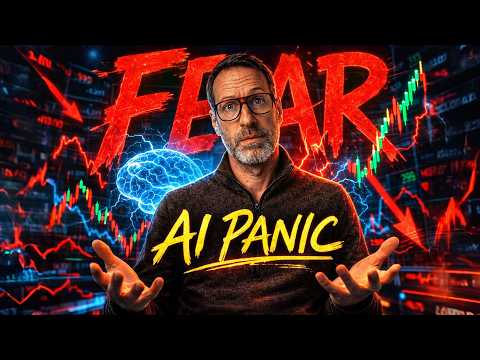
AI Fear Is Driving This Market
WatchDumb Money Live // 13:05

We are Dave Hanson, Chris Camillo & Jordan Mclain. On this channel, we reveal our actual investments and thoughts on the stock market every week. We’re just like you, but we found a way to turn tens of thousands into tens of millions. How? Not by working. We quit our jobs to invest our own money. We find investment ideas in our real lives. Wall Street professionals call people like us “Dumb Money”. They think they’re the only ones smart enough to invest. We’re here to prove them wrong. Unlike most finance gurus, we don’t have anything to sell. No courses, no software. It’s just us. We watch online trends to give our investments a social edge. Our goal is to give everyone tools to make their money work for them, by investing in whatever they’re most passionate about.