Delaying harvest by one month yields 61 percent more bales on Witcombe
Managing the Logistics of Witcombe Park Farm
Optimizing operations on Witcombe Park Farm within Farming Simulator 25 requires a strict focus on machine efficiency and crop timing. The recent phase of the agricultural plan focused on two main objectives: finishing a massive silage harvest and testing a crop-maturation theory on the farm's hay and alfalfa fields. The farm relies heavily on feeding a high-performance dairy herd. Maximizing forage volumes while keeping machinery costs low is the primary operational challenge. Every hour of equipment hire directly chips away at the bottom line.
Strategic Decision: Choosing Manual Carting Over Forager Trailers
During the silage harvest of the largest maize field, a key operational choice emerged. Some operators recommend attaching a tipper trailer directly to the back of the forage harvester. This setup eliminates the need for a second tractor running alongside. However, this strategy introduces its own inefficiencies. It requires stopping the harvester worker to unhitch and swap trailers every time the capacity fills.
Instead, the tactical choice was made to run a tractor and trailer alongside the hired forager. While this requires active driving from the player, it maintains continuous harvesting. The hired worker keeps moving. The only bottleneck with this method is the time lost during turning maneuvers on tight headlands. The helper routinely bumbles through multi-point turns, driving up the hourly machine rental fee. To mitigate this, manual control was used to clear the headlands first, establishing a clean perimeter before letting the automated worker take over the straight, efficient passes.
The Half-Million Liter Silage Milestone
Silage production represents the economic backbone of this operation. The tactical objective for this cycle was to push past the half-million-liter threshold in total silage storage. The results from the final field exceeded initial projections. The headland passes alone yielded 75,015 liters of chopped material. Once the main body of the field was cleared, the final load brought the main pit to 347,000 liters.
Combined with the 189,000 liters secured from the previous fields, the farm surpassed its goal, accumulating over 536,000 liters of total silage. Compacting the pit immediately to 100% and sealing it prevented spoilage. Additionally, verifying that the Biogas Plant (BGA) hopper holds 102,000 liters—rather than a restrictive 24,000 liters—confirmed that the farm has the intake capacity to process this massive volume without encountering severe supply-chain bottlenecks.
Yield Analysis: Testing the One-Month Delay
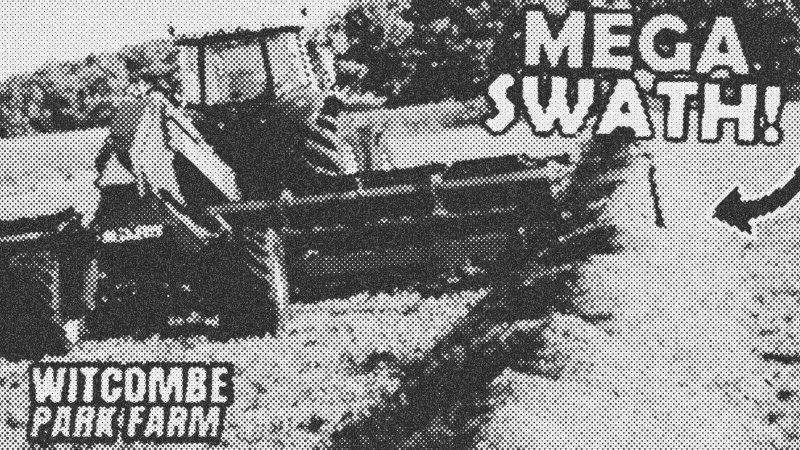
To optimize the hay and alfalfa yields, a simple but vital experiment was conducted. The crops were left to grow for an extra month in the field to see if the increased density would translate to a higher bale count. The fields were cut, tedded, and then swept with a Merge Pro windrower to create massive swaths before bailing.
The previous harvest, completed a month earlier in the growth cycle, yielded a combined total of 13 bales using the Quadro Pro Baler Pack at the maximum 240-centimeter size. Under the delayed harvest strategy, the same fields produced a staggering 21 bales. This represents an 8-bale increase—a 61.5% jump in total forage volume. The visual density of the swaths was immense, causing the baler and tractor to physically shake under the sheer volume of material entering the pickup. The data proves that waiting for peak density is the superior economic choice, far outweighing the minor delay in the crop rotation schedule.
Future Implications for Dairy Herd Management
This successful harvest completely changes the farm's feed security. With over 500,000 liters of fermenting silage and 21 high-density hay and alfalfa bales, the milking cows are secure for multiple seasons. The next tactical steps will involve moving the hay bales to the main storage shed and setting up a conveyor system to automate the transfer of fermented silage into the BGA. This level of feed surplus allows the farm to scale up its livestock numbers without fear of running out of Total Mixed Rations (TMR). Delayed harvesting is now the established standard for all future grass and alfalfa cycles.
- Farming Simulator 25
- 33%· products
- Quadro Pro Baler Pack
- 33%· products
- Witcombe Park Farm
- 33%· locations
HOW MANY BALES FROM THE MEGA SWATH? | Witcombe Park Farm Farming Simulator 25 - Episode 25
WatchDaggerwin // 28:42

Farming Simulator, Euro Truck Simulator and various other let's plays. Slow-paced and realistic gameplay...usually! With dry humour! My NEW PC Spec Alienware R16 Processor - Intel(R) Core(TM) 14th Gen i9 14900KF (24-Core, 68MB Cache, 2.4GHz to 6.0GHz Thermal Velocity Boost) Operating System - Windows 11 Pro, English Graphics - NVIDIA(R) GeForce RTX(TM) 4090, 24GB GDDR6X Memory - 64GB, 2x32GB, DDR5, 5200MHz Storage 2 x 4TB M.2 PCIe SSD PSU - 1000W Platinum Rated 240mm Liquid-Cooled CPU Please note: The email address provided below is for business enquiries only. If you wish to comment, moan or congratulate please use the YouTube messaging system. Thanks :)