Dean builds AI tool to replace lost Jurassic Park animation rig
The metallic skeleton that saved Jurassic Park's digital dinosaurs
A tangle of metal, joints, and wires sat sealed behind glass, a physical ghost from the dawn of the digital age. This was the Dinosaur Input Device (DID), an ingenious bridge built when stop-motion animators faced sudden extinction. In the early 1990s, Industrial Light & Magic was preparing to make Jurassic Park using traditional go-motion puppets. Then, a secret digital CGI test changed everything. Suddenly, traditional animators who spent their lives moving physical puppets frame by frame saw their careers evaporating.
To save their craft, stop-motion legend Phil Tippett and a team of engineers built the DID. It was a physical armature covered in encoders that translated physical movements directly into a digital character model. It allowed artists to put their hands inside the computer, combining analog muscle memory with digital rendering. Yet, decades after its Academy Award-winning success, these devices have vanished from active production pipelines.
Recreating a lost 90s filmmaking relic on a budget
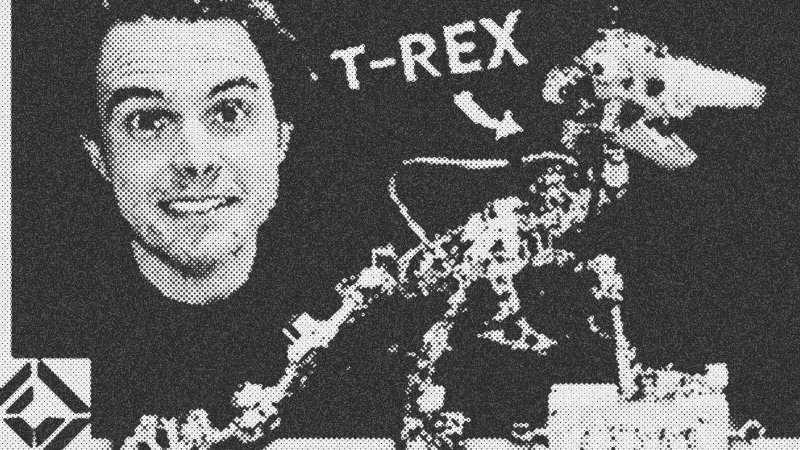
For a modern animator struggling with the cold, two-dimensional barriers of a computer screen, the DID represented the ultimate tactile dream. Posing a 3D character on a flat monitor with a mouse is notoriously unintuitive. You must constantly rotate cameras, drag axes, and guess at depth. In contrast, grabbing a physical figure allows an animator to feel weight, tension, and kinetic potential instantly.
Determined to break through this creative wall, filmmaker Dean set out to build a modern, working version of this legendary input device. The quest began with a pilgrimage to the San Francisco headquarters of ILM to study one of the remaining original armatures. The physical challenges became apparent immediately. The original device was a cable-management nightmare, packed with chunky mechanical encoders at every joint.
Back in the workshop, Dean attempted to build a physical position rig using a manual stop-motion winder and custom-printed magnetic encoders. This physical rig, built with help from tech specialist Nico, successfully mapped three-dimensional space to move a digital character inside Blender. But extending this physical architecture to capture every individual limb joint threatened to derail the project. The complex electronics, nested axes, and mathematical scaling required to map a physical armature to a digital model proved incredibly daunting.
Replacing mechanical encoders with cutting-edge computer vision
Just as mechanical limitations stalled the physical build, a new technological path opened up. Nico introduced a breakthrough concept from recent computer vision research: single-image, full-body 3D human mesh recovery. Instead of using heavy, expensive physical sensors, what if a computer could use a statistical model of a skeleton to estimate poses from a simple camera feed?
This shift changed the entire project. By running a webcam feed through a custom python model inside Blender, they bypassed physical wiring entirely. Dean and his team built a real-time pose estimation tool that allowed them to pose a physical action figure in front of a camera and instantly update the digital skeleton on screen. They even packaged this technology into a free, open-source Blender plugin, democratizing real-time motion capture for independent filmmakers.
Real-time pose estimation challenges the legendary animators
To put the newly created hybrid rig to the test, Dean invited industry legends to try the device. Stop-motion pioneer Randy Cook, who supervised animation on films like the Lord of the Rings trilogy, stepped up to the puppet. Cook had not animated in stop-motion for nearly thirty years.
Using the camera-based setup, the veteran animators blocked out a complex jumping animation. Cook manipulated the physical figure, and the system registered the key frames with remarkable speed. While the technology worked, the session sparked a deeper realization about the nature of the craft. Cook pointed out that physical devices can sometimes get in the way of performance, acting as an obstacle between the animator's mind and the screen.
Why physical puppetry fell between the frames of modern CGI
The experiment revealed why the original DID ultimately went extinct. Stop-motion is an art form of singular performance, requiring an animator to build an entire movement in a single, uninterrupted pass. Computer graphics succeeded because they allowed animators to work in layers, refining hips, then arms, then facial expressions over multiple passes. The DID was stuck in the middle, attempting to serve both philosophies without fully satisfying either. True creative breakthroughs do not come from finding a perfect tool, but from building personalized workflows that conquer the inner critic and let the artist play.
- Blender
- 13%· products
- Dean
- 13%· people
- Dinosaur Input Device
- 13%· products
- Industrial Light & Magic
- 13%· companies
- Jurassic Park
- 13%· movies
- Other topics
- 38%
I Remade a LOST Animation Device from the 90’s
WatchCorridor Crew // 28:34
