The High Stakes of Horsepower: Auction Wins and Engine Failures at the Freedom Factory
The morning at the garage started with the kind of tension you only find when a man with a credit card and a bad influence are staring at an online auction. George was hovering over a keyboard, sweat on his brow, looking at a 2005 Chevrolet Silverado with only 16,000 original miles. It was a red-painted unicorn, a relic from an era before trucks became rolling computers. In the world of mechanics, we call this a "survivor." Every bolt was factory-tight, and the undercarriage looked like it hadn’t seen a puddle in two decades. The bid was climbing, and the adrenaline was hitting harder than a shot of nitrous. When you’re chasing a machine that clean, the logical part of your brain—the part that thinks about budgets and garage space—tends to shut off in favor of the part that just wants to hear that small-block hum. George eventually hammered the bid at $26,000, a move that felt like putting it all on red at the casino, quite literally. It was a victory, but the kind that comes with a side of bidder's remorse once the screen says "Sold."
Precision and mechanical sympathy took a backseat shortly after as the focus shifted to some of the more unorthodox testing grounds we have here. We rolled out the RC Ford Crown Victoria—a full-sized sedan converted to remote control. People think drifting a real car is hard, but try doing it from 50 feet away while the steering response has a half-second delay. Adam LZ stepped up to the plate, and let me tell you, watching a professional driver struggle with a laggy servo is a humbling sight. The car was erratic, a ghost in the machine making it veer toward the grass. Within a few laps, the inevitable happened. A miscalculated turn sent the big white cruiser into the wall, buckling the frame rail and blowing out the radiator. It was a mechanical casualty, but in this line of work, if you aren't breaking stuff, you aren't trying hard enough. We cleared the debris because the real main event was waiting in the wings: a BMW E36 with a heart that definitely didn't come from Bavaria.
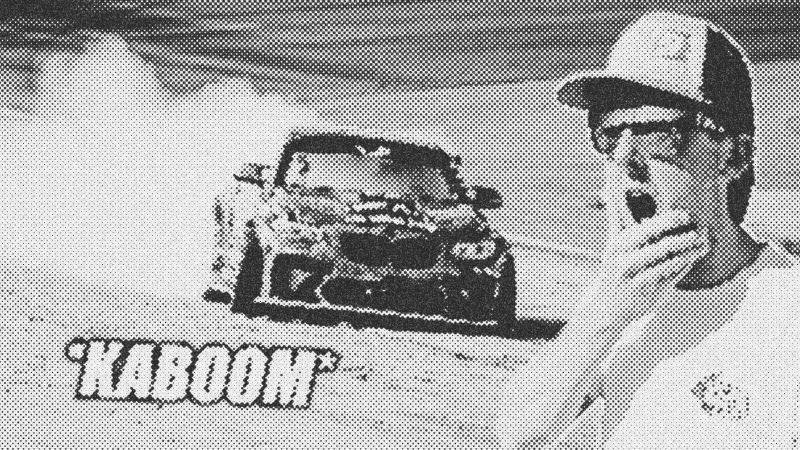
Under the hood of Adam's BMW sat a 632 cubic inch big block built by Steve Morris Engines. This isn't just an engine; it's a cathedral of internal combustion. To put that into perspective, most modern drift cars are happy with a 376-ci LS3. This monster was pushing double the displacement and enough torque to rotate the earth. Adam handed me the keys, and the moment I strapped in, I knew I was in for a different kind of violence. The car was set up with a Magnuson Supercharger on his other rig, but this big block was all naturally aspirated raw power. On my first few pulls, I realized the power steering was out. I was muscling 632 inches of iron through the corners, fighting the rack just to keep the nose pointed at the apex. Once we got the pump working, the car transformed. It was singing at 8,500 RPM, soaring like a bald eagle down the straightaways. I was grabbing fourth gear on the bank, feeling the tires scream for mercy as the chassis struggled to contain the sheer grunt of that Steve Morris masterpiece. It was the most effortless power I've ever felt in a drift car.
Then, the music stopped. I was letting off the throttle, mid-transition, when a sound echoed through the Freedom Factory that makes every mechanic's stomach drop. It wasn't a pop or a hiss; it was the heavy, metallic thud of a connecting rod exiting the side of an expensive block. The engine died instantly. As I rolled to a stop, the smell of hot oil and coolant filled the cabin—the scent of a $70,000 disaster. We pushed it off the track, leaving a trail of high-dollar lubricant behind us. Initial post-mortem suggests oil starvation. When you’re pulling high G-loads in a car with that much displacement, the oil pan has a massive job to do. If the pickup runs dry for even a second at those revs, it’s game over. It’s a bitter pill to swallow, especially when the car was performing so perfectly. But that’s the reality of pushing engineering to the absolute limit. You respect the build, you enjoy the ride, and when the rod comes out for Biff, you tear it down and build it stronger. Precision is everything, and today, the margin for error just ran out.
- Adam LZ
- 13%· people
- BMW E36
- 13%· products
- Chevrolet Silverado
- 13%· products
- Ford Crown Victoria
- 13%· products
- Freedom Factory
- 13%· companies
- Other topics
- 38%
I Blew Up Adam LZ's $70,000 Engine...
WatchCleetus McFarland // 48:40
