The Resilience of Truth: Navigating the Complexities of Climate Science and Human Potential
The Psychology of Contested Science
We live in an era where information is abundant but clarity remains elusive. When we discuss Climate Change, we aren't just looking at atmospheric data; we are confronting a mirror of our own anxieties, values, and fears about the future. Richard Betts, a leading scientist at the Met Office, suggests that the primary friction in this field isn't actually about the physics of greenhouse gases. Most reasonable observers accept that Carbon Dioxide traps heat. The true discord arises when we discuss the implications of that science—the urgency of change, the economic trade-offs, and the radical shifts required in our daily lives.
From a psychological perspective, this resistance is a natural defense mechanism. When the solution to a problem requires us to dismantle the systems that provide our comfort, we often find reasons to doubt the problem itself. Growth, whether personal or planetary, requires a willingness to sit with discomfort. True resilience involves looking at the data without flinching and asking: "What kind of steward do I want to be for the next generation?"
Decoding the Architecture of Climate Models
A common argument against long-term climate action is the perceived failure of short-term weather forecasting. If we cannot predict rain in Newcastle next Tuesday, how can we predict the global temperature in 2080? This skepticism reveals a fundamental misunderstanding of systems thinking. Weather is about the specific behavior of the atmosphere in a localized window; climate is the study of long-term energy balances.
Richard Betts points out that early models from the 1970s have proved remarkably accurate, predicting a warming trend of roughly 0.65 degrees by the turn of the century. These models are not crystal balls; they are sophisticated risk assessment tools built on millions of lines of Fortran code. They represent our best attempt to map out the consequences of our current trajectory. When we view these models as risk assessments rather than deterministic prophecies, we move from a mindset of helplessness to one of intentionality. We recognize that while the future isn't perfectly predictable, it is heavily influenced by the choices we make today.
The Carbon Cycle and Nature's Resilience
There is a profound beauty in the earth's ability to self-regulate, a concept often discussed through the lens of "greening." As we pump more Carbon Dioxide into the atmosphere, plants respond by enhancing photosynthesis. This is a negative feedback loop—nature's way of trying to balance the scales. Satellite data confirms that many parts of the world are greener today than they were decades ago, partly because higher CO2 levels allow plants to grow with less water.
However, we must be careful not to use nature's resilience as an excuse for human complacency. While the Amazon Rainforest and other ecosystems are fighting to absorb our excess, they have limits. When temperatures rise too high, the beneficial effects of CO2 are offset by heat stress and drought. This is the ultimate lesson in personal growth as well: our systems can handle a certain amount of stress, but without intentional recovery and boundary-setting, eventually, even the most resilient system will reach a tipping point.
Global Responsibility and the Just Transition
The conversation around emissions often shifts toward China, currently the world's largest emitter. It is easy to point fingers at a distant nation to absolve ourselves of local responsibility. Yet, a deeper analysis reveals a complex web of interdependence. Much of China's industrial output is driven by Western consumption; we have effectively outsourced our emissions to maintain our high living standards.
This brings us to the concept of the "Just Transition." How do we elevate the living standards of the developing world without repeating the environmental mistakes of the Industrial Revolution? This is a question of global emotional intelligence. It requires developed nations to support others in adopting sustainable technologies, moving away from coal not through coercion, but through collaborative investment. We cannot ask a community to rip out its economic heart—be it coal mining or heavy industry—without providing a new, sustainable pulse to replace it.
The Philosophy of Stewardship and Nuclear Power
When we strip away the charts and the policy papers, we are left with a philosophical question about our role on this planet. Are we merely passengers on "Spaceship Earth," or are we the crew? Being part of the crew implies a moral obligation to act as guardians of biodiversity and beauty. This stewardship requires us to be pragmatic rather than dogmatic.
For many, this pragmatism leads to Nuclear Energy. Despite the historical stigma associated with past accidents, many scientists, including Richard Betts, suggest that meeting 1.5 or 2-degree targets without nuclear power is statistically improbable. To achieve our potential as a species, we must be willing to re-evaluate old beliefs in the face of new crises. We must weigh the long-term challenge of nuclear waste against the immediate, existential threat of a destabilized climate. It is about choosing the path that preserves the most life and the most beauty for those who will follow us.
Conclusion: The Path Toward Intentional Growth
Our journey toward a sustainable future is not just a technical challenge; it is a profound opportunity for a mindset shift. We must move away from the shame-based narratives that dominate activism and instead focus on creative, constructive solutions. Whether it is building unauthorized cycle paths to demonstrate local need or investing in the next generation of carbon-capture technology, our power lies in our ability to take intentional steps.
The climate crisis is a call to awaken our inherent strength. It asks us to be more self-aware, more empathetic toward other nations, and more motivated to protect the intricate tapestry of life that sustains us. The future is not yet written, and while the models show us the risks, they also show us the possibilities. Growth happens one intentional step at a time, and today, we have the opportunity to take that step together.
- Richard Betts
- 17%· people
- Alex Epstein
- 6%· people
- Amazon Rainforest
- 6%· places
- Charles Eisenstein
- 6%· people
- China
- 6%· places
- Other topics
- 61%
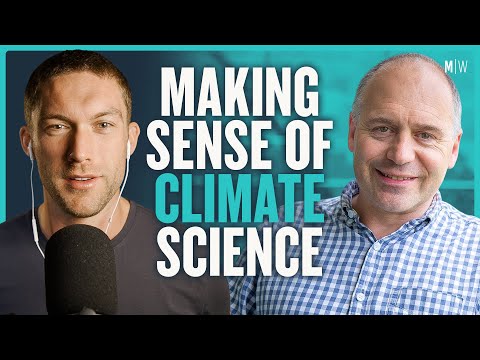
Why Is Climate Science So Disputed? - Richard Betts
WatchChris Williamson // 1:00:00
