The Art of Relevance: Reshaping Your World Through Wisdom and Connection
The Architecture of the Meaning Crisis
We often find ourselves trapped in a world where information is limitless but significance feels scarce. This is the heart of the modern meaning crisis. You might feel a persistent sense of disconnection, not just from others, but from the very foundations of your own life. It shows up as an underlying anxiety, a feeling that despite being constantly connected through technology, we are drifting in a void of shallow interactions. This isn't just a personal failure; it's a systemic mismatch between our biological heritage and the cultural machinery we've built.
John Vervaeke suggests that we often study what we lack. For many of us, what's missing is a sense of sacredness—not necessarily in a religious sense, but as a deep, resonant connection to reality that makes life feel worth living. We've professionalized our challenges and intellectualized our pain, yet the hunger remains. This hunger is actually an invitation. It’s a signal that your current "operating manual" for life is no longer sufficient for the environment you're navigating. To grow, you must first acknowledge the gap between who you are and the wisdom you seek.
The Four Ways of Knowing
To bridge this gap, you must understand that being human involves more than just holding the right beliefs. Our culture has placed a massive pedestal under propositional knowing—the "knowing that" something is true. We focus on facts, arguments, and data. But John Vervaeke identifies three other essential dimensions of knowing that are often neglected.
First is procedural knowing, or "knowing how." This is the domain of skills and expertise, like riding a bicycle or practicing Tai Chi. Second is perspectival knowing, which is the "knowing what it's like" to be you, right here and now. It is your situational awareness and the unique salience landscape you inhabit. Finally, there is participatory knowing, the most foundational level. This is the agent-arena relationship where you and your environment co-shape one another. When you enter a room, you assume a role, and the room becomes a specific kind of place.
True wisdom isn't just having better facts; it's the coordination of all four levels. If you only focus on propositions, you become a "knowledge worker" who lacks the embodied skill to actually live well. You might know the theory of compassion but lacks the procedural skill to execute it in a heated moment. Growth requires an integrated approach that touches the heart, the body, and the mind simultaneously.
The Ecology of Practices
Insight is not a one-time event; it is a metabolic process. You need a diverse "ecology of practices" to maintain your cognitive fitness. No single habit can solve the complexity of the human condition because every strength has a corresponding weakness. For instance, while mindfulness helps you break out of old frames, too much of it can lead to a lack of critical focus.
To balance this, you need opponent processing. This means pairing practices that pull you in different directions to keep you centered. Pair mindfulness with active open-mindedness to ensure your insights are checked by rigorous logic. Incorporate psychophysical practices like Tai Chi or Yoga to anchor your abstract thoughts in physical reality. These aren't just hobbies; they are ways to "re-bind" yourself to the world.
Furthermore, we must recover the art of serious play and ritual. In our modern rush for utility, we've trivialized play as mere entertainment. But ritual is a liminal space where you can "taste" new versions of yourself without the high stakes of permanent commitment. It allows you to experiment with different perspectives and roles, slowly building the capacity for an aspirational journey toward a wiser self.
From Ego to Awe: The Path of Reverence
One of the most powerful shifts you can make is moving from egocentrism to reverence. We often think of meaning as a sense of purpose—having a goal to achieve. But purpose is often just about what the world can do for your ego. A deeper sense of meaning comes from mattering, which is the feeling that you are connected to something larger than yourself.
This is where the experience of awe becomes vital. When you stand under a night sky and feel small, your ego is being diminished. This can be terrifying, but it is also liberating. It breaks the prison walls of your self-concern and opens you up to the infinite complexity of reality. John Vervaeke calls the virtue of appropriately relating to this experience reverence. It is the ability to shape your vulnerability into receptivity.
When you approach your life with reverence, you stop trying to "grasp" wisdom and start learning how to receive it. You begin to see your challenges not as obstacles to be removed, but as apertures through which you can see more clearly. This shift requires a profound kind of love—a love that recognizes a lack but uses that opening to foster a deeper sensitivity to the world around you.
The Courage to Change the Culture
Living a meaningful life often requires the courage to "steal the culture" from within. Our current societal machinery—driven by algorithms and outrage—is designed to exploit our self-deceptive patterns. It makes us feel inadequate so it can sell us solutions. To resist this, you must build "communities of practice" where authentic dialogue, or Dia-logos, can happen.
True friendship is different from mere companionship. A friend is someone committed to your becoming wiser, and you to theirs. As you grow, you may find that some old relationships fall away because they were built on shared stagnation. This can be lonely, but it makes room for a higher quality of connection. You aren't just looking for people to agree with your propositions; you're looking for people to participate in the project of mutual transformation. This is a long-term, intergenerational project, but it is the only way to generate a cultural solution to a crisis that politics and markets cannot solve. Your commitment to your own growth is the first step in reclaiming a world that matters.
- John Vervaeke
- 17%· people
- Tai Chi
- 11%· habit formation
- Augustine
- 6%· people
- Chris Williamson
- 6%· people
- Jordan Hall
- 6%· people
- Other topics
- 56%
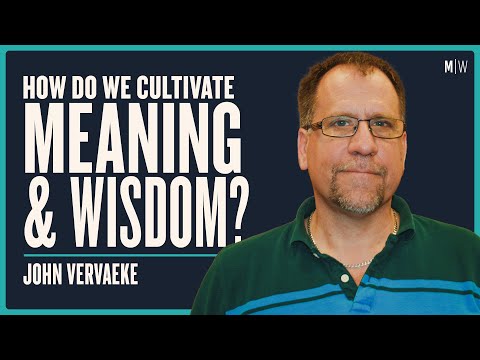
Creating A Life Of Meaning & Wisdom - John Vervaeke | Modern Wisdom Podcast 294
WatchChris Williamson // 1:21:15
