Boreing says reactionary right risks becoming a 'purity death spiral'
The Architecture of Influence
The landscape of modern media is shifting from corporate logos to individual faces, a transition Jeremy Boreing, co-founder and CEO of The Daily Wire, identifies as the move from company-based to talent-based influence. This shift isn't merely about who holds the microphone; it is about the psychological contract between the speaker and the listener. In a world where Elon Musk outpaces his own companies in social reach, the value of a brand is increasingly tied to the perceived authenticity of a single human voice. This creates a unique pressure for entrepreneurs who must decide whether to be the operator in the engine room or the talent on the stage.
Boreing highlights that the success of Ben Shapiro wasn't just a byproduct of his rapid-fire delivery, but a strategic deployment of a "once in a generation talent." The early days of The Daily Wire weren't built on a grand corporate strategy but on the recognition that people relate to people, not abstractions. However, this personality-led growth carries a hidden cost: the trap of the "wanky" title. Boreing and his host Chris Williamson acknowledge that terms like "thought leader" or even "entrepreneur" can create a distance between the creator and the reality of their work. For those looking to scale their impact, the lesson is clear: true influence is emergent. It cannot be "speed-hacked" through a polished persona. It requires the slow, often invisible work of becoming someone worth listening to.
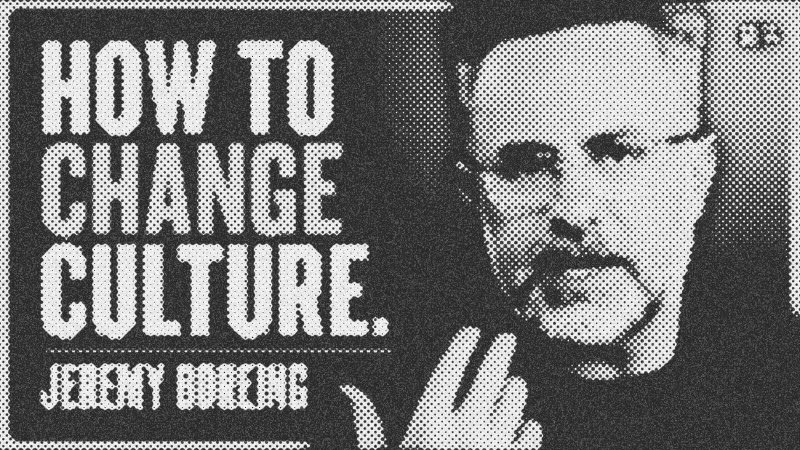
The Athlete’s Mindset in Intellectual Pursuit
One of the most striking insights from Boreing’s leadership style is the demand for professionalization in content creation. He points to Michael Knowles as an example of a creator who treated his intellectual development like an athlete treats their physical conditioning. In the early years of his show, Knowles consumed the Western canon at a rate of two books per week—not pop-psychology or productivity hacks, but the foundational works of Church Fathers and philosophers. This "pre-season conditioning" is what allows a voice to endure beyond the fleeting lifespan of a "hot take."
This approach mirrors the "War of Art" philosophy popularized by Steven Pressfield, which advocates for "turning pro." Most content creators treat their work like a hobby, leaving massive amounts of capacity on the table. By failing to optimize for sleep, hydration, and deep study, they essentially compete as amateurs in a professional arena. Boreing’s refusal to host his own daily show stems from this realization: greatness requires a choice. You cannot live every life you desire. By choosing to build the infrastructure that allows others to thrive, Boreing emphasizes that the operator’s role is not a secondary position but a primary engine of cultural change. Success in the creator economy isn't just about what you say; it’s about the depth of the reservoir you’re drawing from.
Navigating the Three Corrosive Elements
As a creator or entrepreneur scales, they inevitably encounter what Boreing calls the three most corrosive elements: Fame, Wealth, and Power. These are not just rewards; they are psychological stressors that can warp a person’s original mission. The primary temptation once success is achieved is to shift from wealth creation—finding market opportunities and creating value—to wealth preservation. This shift often makes successful people risk-averse, the very opposite of the traits that made them successful in the first place.
There is also a profound risk of losing one’s "common humanity" through the pursuit of convenience. While outsourcing tasks like laundry or scheduling is a logical move to maximize time over target, it can lead to a state where one is no longer capable of being inconvenienced by a friend in need. This isolation creates a "less human" version of the self. To remain resilient, one must actively fight against the insulating effects of success. The goal is to grow in capacity without shrinking in empathy. This requires a conscious effort to stay connected to the messy, inconvenient realities of everyday life, rather than retreating into a sterile environment of high-level leverage and automated systems.
The Purity Death Spiral and Forbidden Truths
The most dangerous pitfall for the modern right, according to Boreing, is the "purity death spiral." This happens when an audience and a creator enter into a "purity compact," where the creator is expected to live up to an impossible moral ideal. Because no human is actually pure, this standard eventually becomes a weapon used to destroy the creator. Boreing explicitly rejects this model, opting for what he calls "lowercase R republicanism." This philosophy involves a constant tension: representing the constituency without ever betraying them, while also having the courage to lead them away from their worst instincts.
This tension is particularly visible in the rise of figures like Andrew Tate. These actors often gain trust by speaking a "forbidden truth"—something the audience feels is true but is not allowed to say in public. The psychological trap is that once someone reveals a hidden truth, the audience's instinct is to trust them implicitly on all other subjects. Boreing warns that the realization that you’ve been lied to by the mainstream should lead to skepticism of all new voices, not blind faith in the person who lifted the veil. A healthy movement requires leaders who can distinguish between a diagnosis of a problem and a valid prescription for its cure.
Creative Conservatism and the Post-Woke Era
For too long, the right has functioned primarily as a critic of culture rather than a creator of it. Boreing argues that "creating things is a fundamentally liberal proposition," and the right’s historical lack of creativity has left a vacuum that the left has filled. The future of The Daily Wire is focused on bridging this gap through "creative conservatism." This involves moving beyond reactionary content to build alternative institutions in entertainment and children’s programming, such as the Bentkey app.
We are likely past "Peak Woke," a moment Boreing pinpoints around the summer of 2020. However, the decline of one ideology does not automatically mean the health of another. The risk now is a "European-style conflict" between the worst instincts of both sides. To avoid this, the right must move beyond being "anti-left" and start defining what it is actually for. This means providing answers to the "now what?" questions of people whose lives are already messy and don't fit into neat, foundational boxes. Building a future that people actually want to live in requires more than just tearing down bureaucratic tyranny; it requires the imagination to build something beautiful and meaningful in its place.
Cultivating a Legacy of Imagination
The ultimate goal of these efforts is to create a space where children can simply be children, free from partisan agendas or hyper-sexualized content. Boreing views the Bentkey initiative as perhaps his most significant legacy. By focusing on values like imagination, wonder, and creativity, he seeks to undergird society at its most foundational level. This isn't about teaching politics to toddlers; it's about protecting the developmental space required for a healthy human soul to grow.
As the media landscape continues to fracture, the winners will be those who provide genuine value and maintain their integrity in the face of fame and wealth. Whether through animated comedies like Burnt Hiram or philosophical discussions on the Western Canon, the focus remains on the long game. Success is not measured by the number of clicks on a reactionary headline, but by the ability to influence the culture through intentional, high-quality creation. Growth happens one intentional step at a time, and the most important step is often the one that takes you away from the crowd and toward a deeper, more difficult truth.
- The Daily Wire
- 13%· companies
- Bentkey
- 9%· companies
- Almanack of Naval Ravikant
- 4%· books
- Andrew Tate
- 4%· people
- Ben Shapiro
- 4%· people
- Other topics
- 65%
Can The Daily Wire Destroy Mainstream Media? - Jeremy Boreing
WatchChris Williamson // 1:00:06
