The Generational Mirage: Why the Millennial Label Fails a Digital Frontier
The Problem with Generational Homogeneity
We are obsessed with labels. It is a fundamental human drive to categorize, to simplify, and to place others into neat little boxes. However, when we look at the term millennial, we are looking at a box that has become impossibly cluttered and largely incoherent. The current classification system suggests that a 38-year-old with a mortgage, two children, and a stable career shares the same fundamental worldview and life experience as a 23-year-old just entering the workforce. It is a mess. By grouping individuals across a 15-to-18-year span into a single demographic, we ignore the massive developmental and cultural shifts that occurred within that window.
Thea and Yves from the Social Minds Podcast argue that this broad categorization is not only inaccurate but actively damaging. The problem lies in the "snowflake" stereotype—a lazy, narcissistic, avocado-toast-eating caricature that has been projected onto an entire generation by the "old guard." This rhetoric serves to alienate rather than understand. When we use these terms, we aren't describing a real group of people; we are repeating a marketing buzzword that has lost its soul.
Innovation as the True Generational Marker
If traditional markers like birth years are failing us, what should we use instead? The answer lies in technology. For the Millennials, the defining characteristic isn't a specific event like 9/11 or a financial crash; it is the unprecedented speed of technological innovation experienced during their formative years. There was a world before the internet, and there was a world after it. Those caught in the middle—the "bridge" generation—watched the transformation of human communication in real-time.
Consider the timeline. In the mid-90s, the first Nokia phones arrived. Within a decade, we moved from brick phones to cameras in pockets, to video calls, to Facebook and Instagram. This wasn't just a change in gadgets; it was a fundamental shift in the state of human existence. Innovation happened so rapidly that our social laws, our understanding of privacy, and even our neurological development were forced to play catch-up. This is the true hallmark of the millennial: the experience of living through the most rapid period of change in human history.
The Fragmentation of Experience
Because this innovation was so concentrated, it created a massive disconnect even within the generation itself. Older millennials remember the screeching sound of dial-up internet and a childhood largely free of digital surveillance. Younger millennials, often bordering on Gen Z, may have received their first smartphone in primary school. Their brains have been conditioned by different levels of stimulus. To suggest they are the same group is to ignore the profound impact of digital immersion on psychological development.
The Psychology of the Snowflake Rhetoric
Where did the "snowflake" narrative come from? Much of it can be traced back to figures like Simon Sinek, whose viral critiques of millennials in the workplace suggest they were coddled by participation trophies and over-protective parenting. This narrative posits that young people are hypersensitive because they weren't exposed to failure. However, this critique ignores a crucial psychological principle: the people pushing this narrative were the ones who created the environment.
If a generation lacks resilience, it is because the "old guard"—the parents and leaders—shielded them from the very stressors required to build it. We see this in the biological world; children raised in overly sterilized environments are more likely to develop asthma and allergies because their immune systems never learned to fight. Socially, the same thing occurs. If we disinfect social interactions and remove the possibility of discomfort, we prevent the development of emotional maturity. Calling millennials snowflakes is essentially a confession of failure by the generation that raised them. It is Frankenstein complaining about its creator.
The Social Media Virus and the Attention Economy
While technology was the delivery mechanism, Social Media was the virus. We are now seeing the long-term effects of an always-on communication loop. For many, the capacity to engage in "deep work"—a concept popularized by Cal Newport—has been severely compromised. Our bodies have been conditioned to a level of stimulus that a static book or a quiet room cannot match. We are dopamine addicts, constantly checking for the red notification or the infinite scroll.
Tristan Harris and others in the Center for Humane Technology movement have highlighted how platforms use cognitive tricks to keep us engaged. These are not accidental features; they are subversive strategies designed to exploit human psychology for profit. The "infinite scroll" is perhaps one of the greatest psychological traps ever devised, designed to eliminate the natural "stopping cues" that tell our brains we’ve had enough. Millennials and Gen Z are the guinea pigs for this experiment. They are the "canaries in the coal mine," showing us the mental health consequences of the attention economy before we have the legislation to control it.
The Shift Toward Introspection
In response to this digital saturation, we are seeing a resurgence of interest in mindfulness and self-awareness. Apps like Headspace and the work of Sam Harris on the Waking Up app represent a counter-culture. People are realizing that to survive the digital age, they must retrain their brains to value idle time and boredom. Growth happens in the quiet moments, yet our current environment is designed to eliminate quiet entirely.
Moving Beyond the Age Bracket
As we look toward the future, the relevance of age-based demographics is fading. With the advent of data tracking and behavioral analysis, marketers and leaders no longer need to rely on the birth year on a passport. We can now look at mindsets, values, and actual behaviors. Why target a 30-year-old simply because of their age when you can target someone—of any age—who values sustainability, practices deep work, and avoids the traditional social media traps?
Gen Z will likely be the generation that finally regulates this technology. They have seen the mistakes made by the millennials who went in first. They are becoming savvier, more aware of how they are being manipulated, and more willing to curate their digital experiences for their own well-being. The future of personal growth lies in this intentionality—the recognition that we must be the masters of our tools, not their subjects.
A Call for Compassion and Nuance
Ultimately, the conversation around millennials needs a shift in tone. Instead of mockery, there should be compassion. This group navigated a state-shift in human history without a map. They were handed powerful, addictive tools by a generation that didn't understand them and then criticized for the resulting behaviors.
We must move past the lazy stereotypes and recognize that inherent strength lies in the ability to navigate these new challenges. Growth is not a homogenous process that happens to an entire generation at once; it happens one intentional step at a time for each individual. By moving beyond the mirage of the "millennial" label, we can begin to see people for who they actually are: individuals striving for connection and meaning in a rapidly evolving world.
- Cal%20Newport
- 5%· people
- Center%20for%20Humane%20Technology
- 5%· companies
- Deep%20Work
- 5%· books
- 5%· companies
- Frankenstein
- 5%· books
- Other topics
- 77%
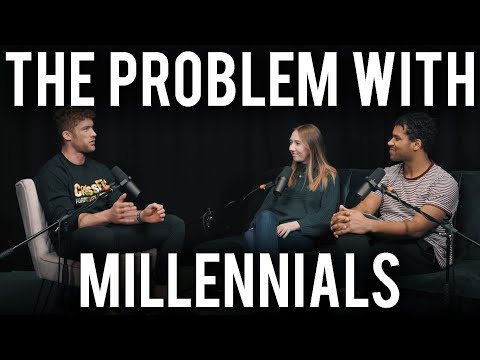
The Problem With Millennials | Theo Watt & Eve Young
WatchChris Williamson // 1:06:41
