The Architecture of Real Confidence: Bridging the Gap Between Competence and Self-Belief
The Inaction Paradox and the Psychology of Open Loops
Most people view confidence as a personality trait—something you either possess or lack from birth. However, true confidence is often a byproduct of the decisions we make when faced with uncertainty. James Smith suggests that much of what we label as "low confidence" is actually a convenient excuse to choose the path of least resistance. By claiming we aren't confident enough to ask for a raise or speak to a stranger, we inoculate ourselves against the possibility of failure. This protective mechanism creates a stagnant life defined by the Zeigarnik Effect, where unclosed loops—the "what-ifs" of our existence—drain our mental energy and increase chronic anxiety.
Every time you lean out of a challenge, you aren't just avoiding a single event; you are training your brain to become a person who avoids difficulty. The subconscious mind keeps a meticulous tally of these withdrawals. When you decide not to act, you leave a loop open in your psyche. These loops haunt us. On a deathbed, humans rarely regret the things they did that failed; they regret the things they never tried. Closing these loops, regardless of whether the outcome is a "win" or a "loss," provides the psychological closure necessary for growth. Even a rejection is a form of success because it provides data and terminates the mental drain of uncertainty.
The Competence-Confidence Feedback Loop
The popular mantra "fake it until you make it" is often a shallow strategy that fails under real pressure. Real confidence is built on a foundation of Competence. You cannot think your way into self-belief; you must act your way into it. Smith emphasizes that after ten years of consistent effort in a field, you don't feel confident—you simply know what you are doing. The world perceives this as a magical superpower, but it is actually just the byproduct of a long-term relationship with failure.
We must stop viewing failure as a destructive force and start seeing it as a utility. Failure is the most efficient teacher of competency because it narrows the path, showing us exactly what does not work. In the realm of Personal Growth, seeking competency in one primary vehicle, such as Brazilian Jiu-Jitsu, allows for a controlled environment where the feedback loop is immediate. When you learn to survive a sparring session with a black belt, the anxiety of a business meeting or a social interaction begins to feel manageable. The goal is not to be fearless, but to become a person who has evidence of their own resilience.
The Matthew Principle in Personal Growth
There is a brutal reality to how success and confidence accrue in the real world, often referred to as the Matthew Principle. Taken from the biblical observation that those who have will be given more, and those who have nothing will have it taken away, this principle describes the "winner-take-all" nature of psychological momentum. In confidence, this manifests as a self-reinforcing cycle: a small win provides a modicum of self-belief, which encourages a slightly larger risk, leading to a greater win, and eventually, a level of capability that appears superhuman to the uninitiated.
This divergence is why the gap between the high-performers and the average person feels so vast. It is not because the high-performer is fundamentally a different species; it is because they have leaned into the compounding interest of wins. Conversely, those stuck in a cycle of loss and inaction find it increasingly difficult to break out because their lack of confidence prevents them from building the very competence needed to escape. Breaking this cycle requires a radical commitment to Progressive Overload in our mental lives—setting the bar low enough to achieve a win, then incrementally raising it until the momentum shifts.
The Red Pill, the Blue Pill, and the Search for Meaning
In the modern landscape of dating and social dynamics, much of the conversation has been hijacked by the "manosphere" and its focus on the Red Pill and Black Pill ideologies. While these frameworks attempt to use Evolutionary Psychology to explain human behavior, they often fall into the trap of viewing the opposite sex as an adversary. Chris Williamson and Smith discuss the need for a "third-wave" approach—one that recognizes biological realities without sacrificing romantic ideals or mutual respect.
True confidence in social settings comes from a place of self-worth that is not transactional. When men or women view relationships through a zero-sum lens, they remain in a state of hyper-vigilance and insecurity. Real growth involves moving past the "pickup artist" tactics of the early 2000s and into a space where personal development is aimed at becoming a high-value human being for the sake of long-term stability and family. Transitioning from the pursuit of transient status to the preparation for fatherhood or motherhood represents a profound shift in one's "why." This shift provides a deeper, more resilient form of confidence that external metrics like followers or bank balances cannot touch.
The Utility of Deprivation and the Numbing of Success
As we ascend the ladder of success, a new challenge emerges: the numbing effect of achievement. Many driven individuals find that once they reach a goal—whether it is a million followers or a bestseller list—they feel relief rather than joy. This "Gold Medal Syndrome" can lead to a form of depression where the chase was more fulfilling than the catch. To counter this, intentional deprivation becomes a tool for recalibration. James Smith discusses his changing relationship with Alcohol and social norms as a way to ensure he is not relying on "bottled confidence."
By removing the crutches we use to navigate the world—whether that is alcohol on dates, caffeine for productivity, or dating apps for validation—we force our natural systems to adapt. Sobriety and deprivation serve as a form of Rejection Therapy. When you can navigate a social event stone-cold sober or handle a training session without a stimulant, you are building a level of internal trust that is unshakeable. You prove to yourself that your success is not a result of your tools, but a result of your inherent capacity to perform under any conditions.
Conclusion: The Path Forward
Real confidence is not found in a book or a motivational speech; it is found in the dirt of the arena. It is the residue of thousands of closed loops and a refusal to use "insecurity" as a shield against life. Whether it is stepping onto a Jiu-Jitsu mat to be humbled or sitting down to write a book despite the fear of being "unqualified," the path is the same: action must precede the feeling. By embracing the Matthew Principle and committing to a life of progressive challenge, we transform from spectators into the architects of our own potential. The bar is set lower than you think because most people will never start—simply moving forward puts you ahead of the majority.
- James Smith
- 11%· people
- Matthew Principle
- 11%· psychology
- Alcohol
- 6%· products
- Black Pill
- 6%· culture
- Blue Pill
- 6%· culture
- Other topics
- 61%
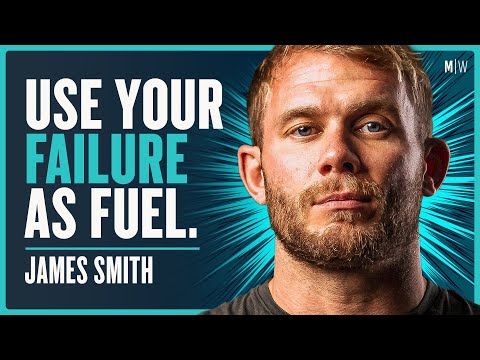
How Do You Develop Real Confidence? - James Smith
WatchChris Williamson // 1:37:48
