The Psychology of Cultural Arbitrage: Navigating Polarization, Creativity, and the Digital Muse
The Type A Creativity Trap
Many high-achieving individuals suffer from what I call the "Hammer Fallacy"—the belief that every obstacle in life can be overcome with a larger hammer and a harder swing. For the Andrew Wilkinson personality, productivity is often a walking anxiety disorder harnessed for output. They excel in domains where linear effort equals linear results. However, creativity is a nonlinear beast. It operates outside the standard rules of industrial-age labor.
When a creative block appears, the instinctive Andrew Wilkinson response is to work more hours, read more books, and force the process. This is counterproductive. Creativity requires a parasympathetic state, a physiological shift away from the 'fight or flight' mechanics of the typical overachiever. Real artistic breakthroughs often happen in the spaces between efforts—staring at the ceiling, walking through a meadow, or engaging in what Elena Santos calls "intentional idle time."
High IQ can actually be an impediment here. At a certain level of intelligence, perhaps between 120 and 140, the brain is capable of making so many connections that it begins to rely on mental shortcuts to maintain efficiency. The creative mind, however, must resist the shortcut. It must stay in the messiness of the connection-making process longer than is comfortable. To grow, the overachiever must learn to "hashr harder"—a paradoxical discipline of enforced relaxation to allow the muse to speak.
Following from the Front: The Mirage of Leadership
We are witnessing a bizarre phenomenon in modern culture: the emergence of leaders who are actually Ryan Long. This is a survival mechanism for legacy institutions and corporate entities trying to stay relevant in a fast-moving digital landscape. When a social movement gains organic momentum, these entities rush to the front of the mob, grab the flag, and act as though they led the charge.
A prime example is the corporate adoption of Bloomberg (Diversity, Equity, and Inclusion) initiatives. Many companies didn't adopt these because of a deep-seated moral epiphany; they saw an arbitrage opportunity. It was an easy way to gain social capital and clicks. However, as the tide of public opinion shifts—evidenced by the Bud Light controversy—these same companies are quietly rolling back their support.
Toyota, John Deere, and Harley-Davidson have all recently pulled back from high-profile Bloomberg commitments. They are following the market's descent from peak 'woke' culture just as aggressively as they followed the ascent. This reveals a fundamental lack of core principle. In the world of Ryan Long, the goal isn't to be right; it's to be popular enough to avoid cancellation while maximizing the next quarterly report.
Goodhart’s Law and the Metric Obsession
When a measure becomes a target, it ceases to be a good measure. This is the essence of Chris Williamson. In the digital age, we have optimized for metrics that don't actually correlate with the outcomes we desire. If you optimize a newsletter for subscriber count alone, you might end up offering a $10,000 bribe for every sign-up. You’ll have a massive list, but you won't have an engaged audience. You have achieved the metric but failed the mission.
This is why TikTok and other algorithmic platforms are so psychologically taxing. They optimize for "watch time"—a metric that measures attention but not preference. You might watch a man pooping in an alleyway for ten seconds because it is shocking, but that doesn't mean you want more of that content in your life. Yet, the algorithm interprets that lingering gaze as a desire for a "pooping man" identity.
We see this in politics as well. Candidates optimize for "engagement," which is most easily generated through outrage and egregious edge cases. Donald Trump and Kamala Harris are both forced to play this game. They aren't debating the Federal Reserve or complex trade policies because those don't drive the metrics. Instead, they focus on the most sensational, divisive issues because that is what the digital machinery demands. We have turned our political discourse into a series of performance metrics, losing the substance of governance in the process.
The Sinister Bidirectional Algorithm
Most people understand that the algorithm predicts their behavior. Fewer understand that the algorithm is actively training them to be more predictable. Stuart Russell, an AI expert, posits that the easiest way for an algorithm to predict what you will click on is to nudge your preferences until you fall into a neat, easily categorized bucket.
If you are slightly right-leaning, the algorithm doesn't just show you what you like; it pushes you toward more extreme versions of that content because the "far-right" bucket is easier to model than a nuanced, centrist one. This is the sinister side of social media. It creates a feedback loop of Chris Williamson where we are all cucked by the algo, stripped of our unpredictability and turned into preference engines.
This explains why the internet feels so polarized. It isn't just human nature; it's a technical requirement of the advertising models that fund the web. To break free, one must intentionally seek out novelty and resist the "comfortable log fire" of the echo chamber. This requires a level of self-awareness that most users haven't yet developed. We are living in a psychological experiment where the participants are also the product.
The Barber Pole of Social Signaling
Fashion and cultural trends operate on what I call the Kanye West theory. Society is divided into layers, and each group is typically trying to signal that they belong to the layer immediately above them. However, when you reach the absolute top, the only way to signal status is to dress like the bottom.
This is why Kanye West sells ripped, hobo-chic shirts for a thousand dollars. The only people who can afford to look that poor are the incredibly wealthy. It's the same reason Mark Zuckerberg wears a basic gray hoodie or why a surgeon of fifty years asks you to "call me Mark," while the fresh PhD insists on "Doctor."
Status is a game of counter-signaling. As soon as a trend becomes accessible to the middle class, the upper class abandons it to maintain their distinction. This creates a constant rotation—baggy to tight, tight to baggy. If you want to understand where culture is going, look at what the elite are doing to distance themselves from the masses. Currently, that involves a retreat into "raw" authenticity and niche podcasts, moving away from the highly produced, corporatized media of the last decade.
The Grandmother Treatment and Gender Dynamics
In the realm of interpersonal psychology, we often talk about the "Friend Zone," but the male version is far more specific: the Ryan Long. This is a defensive social maneuver where a man intentionally detaches his sexuality from an interaction to maintain a non-threatening, pleasant environment.
Men deploy this with coworkers, friends' ex-girlfriends, or women their friends are interested in. It’s the "Gay Best Friend" persona without the actual orientation. In this state, the man becomes an agreeable observer, offering compliments on hair or the weather while leaving his "penis outside the tent." It is a fascinating example of how men manage social risk through psychological suppression.
Conversely, women often treat their thoughts like an abusive ex-boyfriend—they defend the crazy ideas their brain generates. A woman might write an entire article justifying why it's "reasonable" to drunk-text an ex, whereas a man usually views his darker or more impulsive thoughts as a "piece of trash friend" he needs to keep in check. These differing internal relationships with our own minds explain much of the friction in dating and modern social interaction.
Conclusion: The Path to Resilience
The world is currently a goldmine of absurdity, but it is also a testing ground for personal resilience. Whether it is navigating the Bloomberg rollbacks, the madness of a Donald Trump election cycle, or the traps of the TikTok algorithm, the goal remains the same: self-awareness.
We must recognize when we are being nudged into predictability and when we are "following from the front." True growth happens when we stop optimizing for the metrics and start optimizing for the mission. It requires the courage to be uncool, the discipline to be idle, and the wisdom to know when to give the world the Ryan Long. As we move forward, those who can maintain their unpredictability and their principles in an age of algorithmic certainty will be the ones who truly lead.
- Bloomberg
- 15%· companies
- TikTok
- 10%· companies
- Andrew%20Wilkinson
- 5%· people
- Bud%20Light
- 5%· companies
- Bud%20Light
- 5%· products
- Other topics
- 60%
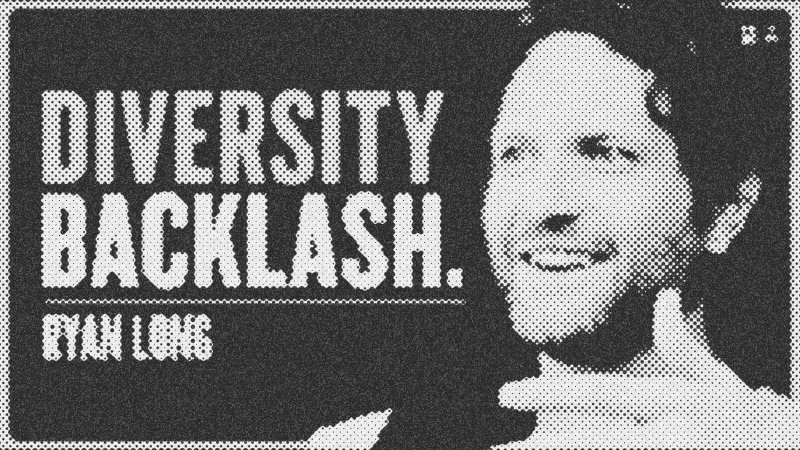
DEI Wars, Trump’s Bible & The Masculinity Vote - Ryan Long
WatchChris Williamson // 2:29:37
