Breaking the People-Pleasing Trap: A Guide to Radical Authenticity and Boundary Setting
The Invisible Architecture of the People-Pleasing Trap
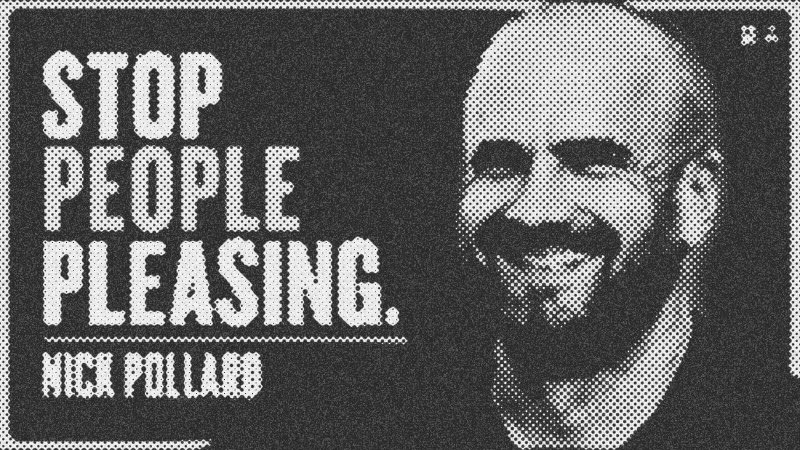
Many of us walk through life under the weight of an unwritten contract: if I make everyone else happy, I will be safe, loved, and enough. This is the heart of the people-pleasing trap. It is not a character flaw; it is a sophisticated, albeit exhausting, survival strategy often forged in childhood. Nick Pollard, known as 'The People Displeaser,' highlights how social media has intensified this, creating an environment where we measure our internal worth against the curated, insurmountable lives of others.
When we function from this place, we operate from an external locus of control. We become obsessed with optics management—prioritizing how we are perceived over how we actually feel. This isn't just about being 'nice.' It is a form of dishonesty. Every time you say 'yes' when you mean 'no,' you are lying to yourself and the world. You are sacrificing your inherent vibrancy for a hollow peace that never lasts. Real growth begins when you realize you don't have to hate where you are to want to be better, and you don't have to be everything to everyone to be worthy of space.
The Root Cause: Insufficiency and the Fear of Abandonment
At the core of every people-pleaser lies a deep-seated feeling of insufficiency. The internal track is a constant loop of 'I am not enough.' To drown out that noise, we overcompensate by becoming hyper-attuned to the needs of others. This behavior often stems from childhood 'enmeshment,' where a child was made the center of one parent's world while the other was absent or abusive. The child learns that their safety depends on their ability to regulate the emotions of the adults around them.
This develops into a 'transference'—a childhood coping strategy that we drag into adulthood, long after it has stopped serving us. For the people-pleaser, rejection doesn't feel like a simple 'no'; it feels like total abandonment. When you advocate for yourself, that inner child screams in terror, believing that if you aren't useful, you will be left behind. Recognizing this link is the first step toward rehabilitation. You are no longer that vulnerable child; you are an adult with the power to meet your own needs.
The High Cost of Being 'Nice'
We often frame people-pleasing as a virtue—altruism, consideration, or kindness. But when these acts are compelled by fear rather than chosen by love, they lose their virtue. The cost is staggering. Your physical well-being takes a backseat; you don't have time to cook, sleep, or exercise because you are too busy bailing others out. Financially, it can ruin you as you bail out relatives or friends at the expense of your own security.
Perhaps the most painful cost is the loss of joy. Giving to yourself feels inappropriate or even shameful. You might stand in a store, unable to buy yourself a gift even with a full bank account, because it doesn't serve the purpose of making someone else happy. Over time, you lose your sense of self-identity. If you spend decades molding yourself to the expectations of others, you eventually wake up and realize you have no idea what your own opinions are. You become a 'sales monkey' for a life you never actually wanted to live.
A New Framework: The Four Questions of Self-Inquiry
When you feel that physical sensation of people-pleasing taking over—the hunched shoulders, the sinking feeling in your chest—you need a psychological circuit breaker. Pollard recommends four specific questions to navigate these moments of pressure. First, ask: What am I believing right now? Usually, the answer is some version of 'I am not enough' or 'They will hate me.' Second: How am I reinforcing this belief? Are you ruminating or staying silent to avoid conflict?
Third, shift the perspective: What would I prefer to believe? You might prefer to believe that you will be okay regardless of their reaction. Finally: What do I need to do to reinforce this new belief? This is where action happens. It might mean speaking a truth that feels like a 'metric ton' of discomfort or simply taking a walk to get out of your head. These questions move you from reactive system-two thinking into a deliberate, conscious state of being.
Establishing Your Personal Bill of Rights
Boundaries are often misunderstood as walls we build against other people. In reality, boundaries are about how you show up. They are a reflection of your value system. To maintain them, you must establish what Pollard calls a 'Bill of Rights.' This is a physical or mental list of the things you will and will not tolerate. It might include: 'I am allowed to ask for what I want,' 'I do not tolerate yelling,' or 'I am allowed to have an opinion.'
These are not whimsical hopes; they are operational guidelines. When you know where your 'trip wires' are in advance, you don't have to negotiate with yourself in the heat of the moment. If someone violates a right—such as kindness—you don't demand they change; you change your participation in the situation. You might say, 'I don't appreciate this tone, so I am going to leave for fifteen minutes.' You are not in charge of other adults' decisions; you are only in charge of your own.
The 'Game of No' and the Road to Resilience
For those who are terrified of the word 'no,' the only way out is through repetition. One powerful practice is the seven-day 'Game of No.' For one week, your default answer to every request is 'no.' The rules are simple: you can tell people you are playing, and you can change your mind after ninety seconds. The goal isn't to become a hermit; it's to sit with the discomfort of the 'no' for a minute and a half.
You will find that the world does not end. Most people will be surprised, but they will survive. This practice resets the value system in your brain, breaking the addiction to the 'dopamine rush' of saying yes. You begin to realize that your 'yes' has no value if you are incapable of saying 'no.' By reclaiming your 'no,' you finally make your 'yes' mean something. This is the path to becoming 'unconsciously competent' in your own skin, eventually reaching a point where authenticity becomes your natural state.
Embracing the Lonely Chapter of Growth
Rehabilitating yourself from people-pleasing involves a difficult middle ground. As you start setting boundaries, people who benefited from your lack of them will likely leave. This 'lonely chapter' is inevitable. You may lose your 'fake friends' and the superficial connections you bought with your compliance. However, this loneliness is also a space of immense freedom. It is the time when you finally get to play, to invent a new version of yourself, and to discover what you actually like when no one is watching.
Eventually, you find that people who truly love you will respect your new boundaries. They might even like this version of you better because you are finally 'real.' The path out of the people-pleasing trap is a 'mortal quest' that takes place entirely within your own mind. It is a slow process of course-correction, like steering a guided missile. You won't always be on target, but as long as you keep aiming away from what is false, you will find your way to a life that is honest, adventurous, and finally, your own.
- Alex Hormozi
- 5%· people
- Bill Perkins
- 5%· people
- Chris Williamson
- 5%· people
- David Goggins
- 5%· people
- James Clear
- 5%· people
- Other topics
- 75%
How To Put Yourself First Without Feeling Guilty - Nick Pollard
WatchChris Williamson // 2:03:18
