The Quantum Mindset: Finding Meaning in an Uncertain Universe
The Architecture of Invisibility
We live in a world that feels solid, yet science tells us this is a convincing illusion. When you rest your hand on a desk, you aren't touching matter; you are feeling the invisible push of electromagnetic repulsion. Atoms are 99.99% empty space. If the nucleus of an atom were the size of a fly in the center of a sports stadium, the electrons would be buzzing around the very top row of the stands. Everything in between is a void. This realization, shared by Jim Al-Khalili, forces us to confront a fundamental truth: our perception of reality is limited by our senses.
In personal growth, we often struggle with the 'voids' in our lives—the periods of uncertainty or the gaps between where we are and where we want to be. Just as the empty space in an atom isn't truly empty but filled with forces that give matter its structure, our moments of stillness are often where the most significant internal forces are at play. Recognizing that there is more to the universe than meets the eye is the first step toward developing a resilient, curious mindset. We must learn to respect the invisible.
The Mystery of the Rainbow
There is an old conflict between science and soul, famously captured by the poet John Keats, who accused Isaac Newton of destroying the beauty of the rainbow by reducing it to prismatic colors. This sentiment suggests that understanding the 'how' of a phenomenon somehow drains the 'why' of its magic. However, the true path to awe lies in the opposite direction. Understanding the refraction of light doesn't make a rainbow less beautiful; it adds a layer of intellectual wonder to the visual experience.
In our own journeys, we sometimes fear that self-awareness—analyzing our habits, our traumas, or our biological drives—will make our lives feel 'cold' or 'rational.' We worry that if we understand the psychology of our joy, the joy itself will vanish. But growth requires us to be both the poet and the physicist. We can appreciate the magic of our lives while simultaneously seeking the truth of how they function. This dual perspective is what creates a deep, unshakeable sense of well-being.
Dark Matter and the Purpose of Frustration
Theoretical physics is currently grappling with Dark Matter and Dark Energy, two substances that we know exist because of their gravitational effects, yet we cannot see or explain them. They make up the vast majority of our universe, leaving our 'visible' world as a mere fraction of reality. Jim Al-Khalili describes this as a 'fun kind of frustration.' It is the drive to solve a mystery that keeps the field alive.
This mirrors the human experience of potential. We often feel the 'gravitational pull' of who we are meant to be, even if we cannot yet see the path or define the goal. This internal dark matter—our latent talent and unexpressed desires—exerts a force on our lives. Instead of being frustrated by the lack of immediate clarity, we should adopt the scientist's perspective. The mystery isn't a wall; it's a frontier. The fact that you don't have all the answers yet is exactly what makes your journey significant.
The Fallacy of Certainty
One of the most profound lessons science offers is the value of Intellectual Humility. Al-Khalili recounts the story of 'faster-than-light neutrinos,' an experiment that seemed to disprove Albert Einstein. While the media jumped on the discovery, the scientific community remained skeptical. Eventually, the result was traced back to a loose cable. This wasn't a failure of science; it was a triumph of the scientific method’s commitment to evidence over ego.
In a culture that demands instant opinions and '100% certainty,' admitting you were wrong is often viewed as a weakness. Whether in politics or personal relationships, we dig in our heels to protect our 'brand.' But growth is impossible without the willingness to update our 'priors.' If we cannot admit that our previous understanding was based on incomplete data, we remain trapped in old patterns. True strength is found in the sentence: 'I have new information, and therefore, I have changed my mind.'
The Multiverse of Choice
The Fine-tuned Universe theory suggests that if any of the fundamental constants of physics were slightly different, life would be impossible. Some see this as evidence of a creator; others, like Al-Khalili, suggest the Multiverse theory. If there are infinite universes, it isn't surprising that we find ourselves in the one that can support us. We are the lottery winners of cosmic proportions.
This perspective shift is vital for resilience. When we feel overwhelmed by the 'odds' against us, we must remember that our very existence is the result of an almost impossible string of successes. You are the product of billions of years of cosmic evolution and thousands of years of ancestral survival. When you view yourself as a 'cosmic lottery winner,' your daily stresses begin to shrink. You aren't just navigating a career or a relationship; you are the conscious expression of a universe that found a way to look back at itself.
Ethics at the Speed of Light
As we look toward the future—Mars missions, Quantum Computing, and Artificial Intelligence—we face a new kind of risk. Technology is moving faster than our ethical conversations. We are creating 'black balls' of technology that could either save us or destroy us. Al-Khalili argues that if we cannot slow down the technology, we must speed up the conversation.
This applies to our personal lives as well. Our digital tools—social media, instant communication, 24/7 productivity—are evolving faster than our biological ability to process them. We are 'fine-tuning' our efficiency but losing our sense of presence. To maintain our mental health, we must be intentional about our 'inner ethics.' We need to ask not just 'can I do this?' but 'should I?' and 'at what cost to my soul?'
Conclusion: The Horizon of Growth
The pursuit of knowledge, whether it’s the search for a Theory of Everything or the search for personal fulfillment, is a journey without a final destination. Once we discover the Higgs Boson, we look for the next particle. Once we achieve a personal goal, we look for the next challenge. This isn't a 'hedonic treadmill' to be avoided; it is the heartbeat of a purposeful life.
Embrace the empty space. Value evidence over opinion. Stay curious about the dark matter in your own heart. The universe is far stranger and more beautiful than we can imagine, and so are you. Your greatest power lies in your ability to keep asking questions, keep updating your beliefs, and keep walking toward the mystery.
- Jim Al-Khalili
- 10%· people
- Albert Einstein
- 5%· people
- Artificial Intelligence
- 5%· technology
- Dark Energy
- 5%· misc
- Dark Matter
- 5%· misc
- Other topics
- 71%
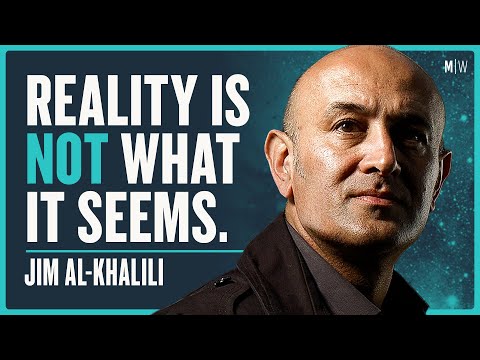
Physics Is Far Stranger Than You Think - Jim Al-Khalili
WatchChris Williamson // 1:02:47
