The Cognitive Toolkit: Navigating Complexity with Mental Models
The Architecture of Superior Decision-Making
Your greatest power lies in recognizing your inherent strength to navigate challenges, and growth happens one intentional step at a time. To truly evolve, we must move beyond brute force effort and look toward the architecture of our thoughts. Mental Models act as the operating system for the mind, a collection of frameworks that allow us to process a world with trillions of inputs more effectively. Most people spend their lives reacting to the symptoms of their problems rather than understanding the systems that create them. By installing these cognitive "apps," we shift from mere survival to a state of strategic intentionality.
The human brain is biologically programmed for a world that no longer exists—one where risks were immediate and physical. In the modern era, the most significant risks are often hidden in the abstract, while the greatest rewards lie in being "weird" enough to see what others miss. Building a mental toolkit isn't about memorizing facts; it is about developing a library of principles that can be applied across disciplines, from business and technology to personal relationships and resilience.
The Leverage Revolution: Doing More with Less
One of the most profound shifts in personal growth is the transition from a "hustle" mindset to a "leverage" mindset. Many of us were raised on the narrative of the sixteen-hour workday, equating exhaustion with achievement. However, as George Mack points out, signaling how hard you work is often a distraction from actually achieving results. True growth comes from Leverage—the ability to augment your natural abilities through tools. This is the difference between a human running on foot and a human on a bicycle; with the right tool, the human becomes the most efficient locomotive force on the planet.
Naval Ravikant identifies four distinct forms of leverage that define the modern landscape. The first two are traditional: people and capital. Having a staff or investing money allows your output to exceed your input. But the newest forms—code and media—are the most democratic. Code works for you while you sleep, and media allows you to distribute your message to millions with zero marginal cost of replication. If you are not utilizing at least one form of leverage, you are effectively trading your life for a linear return. This is why we must stop viewing time as a currency and start viewing it as life itself. A full-time job you hate is a full-life job you hate. Leverage is the mechanism that buys that life back.
The Fragility of Excellence: Avoiding the Zero Multiplier
In our pursuit of success, we often focus on addition—more habits, more skills, more connections. Yet, we frequently ignore the "Multiply by Zero" effect. This mental model reminds us that no matter how many billions you accumulate in one area, if you multiply it by zero in another, the result is total ruin. You might spend decades optimizing your longevity through intermittent fasting and exercise, but if you drive without a seatbelt or engage in high-stakes reckless behavior, all that accumulated health value is instantly liquidated.
This principle applies to character and reputation as well. One lapse in integrity, one "drunken night" of poor judgment, or one ethical failure can act as the zero that nullifies a lifetime of effort. Resilience isn't just about bouncing back; it’s about identifying the weakest link in your chain before it snaps. We see this in productivity as well. People will obsess over expensive nootropics like Alpha Brain while ignoring the fact that they haven't mastered basic deep work. They are trying to optimize a 1% gain while their inability to focus is multiplying their potential by zero. Growth requires the courage to face the most uncomfortable link in your system and fix it first.
Global vs. Local Maxima: The Danger of Narrow Optimization
Many people spend their lives trapped in a "Local Maximum." They are busy optimizing a specific variable—getting a 1% raise at a job they dislike or making a slightly faster version of an obsolete product. Tobias Lütke, the CEO of Shopify, uses the example of shipping. Before the 1950s, the shipping industry was obsessed with building faster ships. They were optimizing the local maximum of speed. Meanwhile, cargo was still being loaded box-by-box by hand, taking days and costing a fortune.
Malcolm McLean, a truck driver with a wider perspective, looked for the "Global Maximum." He realized the problem wasn't ship speed; it was the system of loading. By inventing the shipping container, he reduced costs from six dollars a ton to sixteen cents. He didn't just improve the existing model; he broke it to find a better one. In your own life, are you just trying to get better at a game you shouldn't be playing? True potential is often found by zooming out and assuming that your current way of operating is fundamentally wrong—or at least, only a level six out of ten. The goal is to be "less wrong" over time rather than defending a mediocre status quo.
The Linguistic Matrix: Words as Thought Technology
Our reality is shaped by the vocabulary we have available. This is the "Linguistic Red Pill": if you don't have a word for a concept, you can't fully think the thought. It remains a vague notion rather than an actionable tool. For example, the German word Schadenfreude (taking pleasure in others' pain) allows us to identify and manage a specific human impulse that might otherwise go unnamed and unchecked.
We see the danger of limited vocabulary in modern discourse. People debate terms like "ego" or "entrepreneur" without realizing they are using entirely different definitions. One person sees ego as Kanye West's confidence; another sees it as the Eckhart Tolle concept of a false self. Without linguistic precision, we are just "bloviating"—talking a lot without saying anything. To improve the quality of your thoughts, you must expand your vocabulary. Reading George Orwell's 1984 reveals that the destruction of language is the destruction of independent thought. By creating and refining our own internal dictionary, we gain the ability to articulate our truth and navigate the world with greater clarity.
Embracing the Maverick: The Value of Irrationality
There is a hidden cost to being perfectly logical: you end up exactly like everyone else. If you follow the consensus, you will get average results. George Mack and Chris Williamson argue that we need more "weirdos." Most people are so socially conditioned to avoid being laughed at that they never take the risks necessary for a breakthrough. But if people aren't snidely laughing at you, you probably aren't at the frontier of anything meaningful.
Sometimes, being "irrational" is the most rational strategy. Consider the athlete who irrationally believes God is on their side during a match. Whether it's true is irrelevant; the belief provides a psychological placebo that enhances performance. This is the "Clouds and Dirt" strategy used by Gary Vaynerchuk. You need the high-end vision (the clouds) and the gritty, tactical execution (the dirt), while ignoring the middle ground of consensus and politics. True growth happens when you stop trying to fit into the "matrix" and start synthesizing your unique traumas, joys, and predispositions into a competitive advantage. Your uniqueness is not a bug; it is your greatest feature.
Conclusion: Standing on the Shoulders of Giants
In our hyper-rational age, we often discard the wisdom of the past, assuming that because we have smartphones, we are smarter than our ancestors. Yet, as Nassim Taleb reminds us, the "absence of evidence is not evidence of absence." Just because a ancient practice hasn't been validated by a 2024 clinical trial doesn't mean it lacks value. Traditions are often solutions to problems we have simply forgotten exist.
As you move forward, remember that growth is an iterative process. Whether you are applying Parkinson's Law to your work or using "Forcing Functions" to overcome procrastination, the goal is the same: to become a toolmaker for your own mind. We are all fallible, but by building a robust toolkit of mental models, we give ourselves the best possible chance to thrive. The future belongs to those who are curious enough to be weird, disciplined enough to seek leverage, and wise enough to respect the principles that have stood the test of time.
- George Mack
- 10%· people
- 1984
- 5%· books
- Alpha Brain
- 5%· products
- Amazon
- 5%· companies
- Atomic Habits
- 5%· books
- Other topics
- 71%
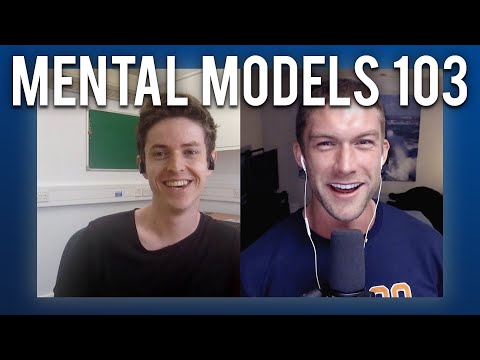
Mental Models 103 | George Mack | Modern Wisdom Podcast 178
WatchChris Williamson // 1:28:49
