The Freedom Beyond Fear: Redesigning Your Internal Landscape for Radical Resilience
The Psychological Trap of the Preservation Mindset
Most of us spend our lives constructing a fortress of safety, mistakenly believing that security is the precursor to happiness. We avoid the metaphorical roller coasters and the literal risks because we view fear as a stop sign rather than a boundary marker. When you allow fear to dictate your choices, you aren't just staying safe; you are remaining captive. The fundamental challenge of the human experience is that fear doesn't stay confined to one category. If you are afraid of failure in business, that anxiety eventually bleeds into your relationships and your self-perception. It permeates the soul.
Erwin McManus suggests that we are the only species inextricably linked to the future, yet we treat that future as a source of dread rather than a canvas for creation. When the potential pitfalls of a dream become more vivid than the benefits of achieving it, you have entered a state of paralysis. This is where most people live—in the "average." Being average is the ultimate camouflage. It protects you from the critique of others, but it also ensures you never touch your true potential. To break this cycle, you must acknowledge that your current boundaries are not defined by your lack of ability, but by the specific fears you refuse to cross.
The Factory Defect: Why Negativity Sticks
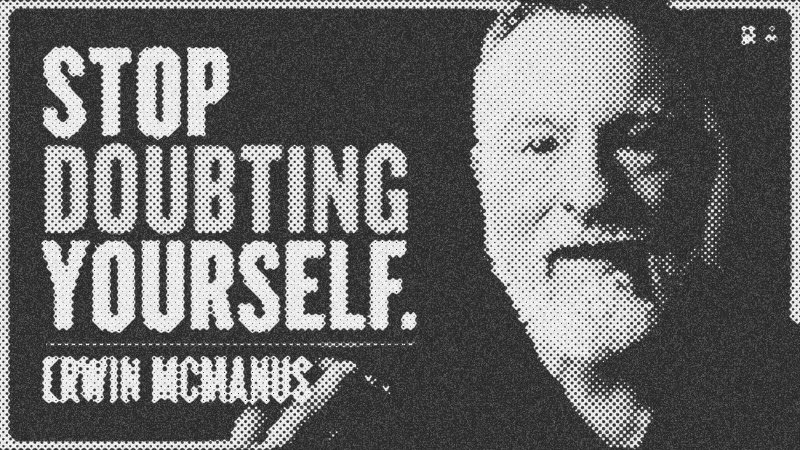
There is a disturbing asymmetry in human psychology: positive emotions are fleeting, while negative ones have iron-clad staying power. You can have a decade of beautiful memories, but one sharp argument or a perceived failure can dominate your mental space for weeks. We are, in a sense, factory defects. If we choose to do nothing, we do not drift toward hope or compassion; we drift toward depression and anxiety. Character is not a natural byproduct of existence; it is a hard-won trophy of intentional effort.
If you leave your garden untended, it doesn't grow roses; it grows weeds. Similarly, the "worst version" of yourself is what appears when you stop putting in the work. This realization is actually empowering. It means that your current state of dissatisfaction isn't a permanent identity; it's simply the result of a lack of movement. Understanding that negative emotions require a "fact-check" from your conscious mind allows you to stop being a victim of your own chemistry. You must learn to fight for your optimism with the same intensity that your brain uses to cling to its grievances.
Overthinking as a Control Mechanism
Overthinking is rarely about finding a solution; it is almost always an attempt to control an uncontrollable outcome. We don't overthink how well a presentation might go or how deeply someone might love us. We overthink the vectors of weakness. High achievers are often the most plagued by this because their success was built on vigilance. However, there is no level of achievement where this internal noise disappears. Whether you are a Joe Burrow in the NFL or an entrepreneur, the battle remains the same.
Sean McVay of the Los Angeles Rams deals with the same paralyzing mental loops as a rookie in a minor league. The secret isn't to stop the thoughts, but to change the language your brain speaks. Your brain doesn't actually value your internal monologues; it only respects action. When you are stuck in a loop of "what if," the only antidote is "now what." Moving forward, even with a sub-optimal plan, breaks the pattern. The first instinct is usually the correct one, and the subsequent hundred thoughts are typically just your ego trying to mitigate the social consequences of failure.
Moving from Worth-Seeking to Worth-Based Living
Most of the world is caught in a exhausting race to prove their value. We think that if we reach a certain bank balance, win a specific award, or gain enough followers, we will finally be "gold." But value is subjective and volatile. If you let the world decide your worth, you are a slave to public opinion. You are effectively letting strangers determine if you are a diamond or an avocado.
True resilience comes from accepting your intrinsic value as a baseline that cannot be altered by performance. This is the difference between being in love with yourself (narcissism) and actually loving yourself (self-awareness). When you love yourself, you see the flaws and the "factory defects," but you don't use them as evidence of unworthiness. You move from a place of abundance. If your value is already secure, then a business failure or a personal rejection is just data, not a death sentence. This shift allows you to take the kind of radical risks required for an extraordinary life because you no longer have your entire identity on the gambling table.
The Synergy of Humility and Ambition
We often treat humility and ambition as if they are at war. We assume a humble person must be timid, and an ambitious person must be arrogant. This is a false dichotomy. In reality, you can only be truly humble if you are powerful. Otherwise, your "humility" is just a lack of options. True humility is the mastery of power for the benefit of others.
Ambition, when stripped of its selfish corruption, is a virtue. It is the generative force that compels you to optimize your intelligence and talent for the world. If you have been given a high capacity, you have a staggering responsibility to use it. Living only for yourself is the ultimate form of greed because it withholds your potential from a world that needs it. When you align your ambition with a purpose bigger than your own ego—like serving humanity or alleviating suffering—fear loses its grip. You are no longer protecting yourself; you are fulfilling a mission.
Concluding Empowerment: The Funeral of Fear
To live a life that is truly "alive," you must be willing to have a personal funeral for your fears. You have to reach a point where you tell yourself that you are dead to your doubts and your need for self-preservation. When you have nothing left to lose because you have already given your life away to a higher purpose, you become dangerous to the status quo. You become fearless not because of a lack of adrenaline, but because of an abundance of intention. Your freedom is waiting on the other side of the very thing you are currently avoiding. Stop existing in the safety of the average and start living in the risk of the extraordinary. The work is hard, but the alternative is a life of regret, and that is the only thing truly worth fearing.
- Chris Williamson
- 9%· people
- Erwin McManus
- 9%· people
- Joe Burrow
- 9%· people
- Los Angeles Rams
- 9%· companies
- Mind Shift
- 9%· books
- Other topics
- 55%
Fear Is Running Your Life. Here's How To Break Free - Erwin McManus
WatchChris Williamson // 1:01:34
