The Architecture of Conviction: Philosophy, Veganism, and the Search for Secular Virtue
The Intellectual Path to Radical Change
Most people change their lifestyles through external pressure or a sudden emotional epiphany. For Alex O'Connor, known to millions as Cosmic Skeptic, the transition to veganism was a clinical, almost mathematical process of elimination. He began by publicly inviting his audience to dismantle the philosophical arguments for animal rights, essentially daring the world to prove him wrong. When no logically sound defense for the consumption of animal products remained, he faced a choice: ignore his findings or align his life with his logic.
This shift highlights a profound psychological principle. Growth often requires us to be our own most rigorous interrogators. O'Connor's journey wasn't about a sudden love for animals but a deep-seated commitment to internal consistency. He noted that many public intellectuals, including Sam Harris, often sidestep the moral implications of their own suffering-based philosophies. By refusing to answer like a politician, O'Connor embraced the friction that comes when your intellect demands a change that your habits resist.
The Moral Geometry of Speciesism
At the heart of the modern ethical debate is the concept of speciesism. Drawing heavily from Peter Singer and his seminal work Animal Liberation, O'Connor argues that our current treatment of animals is a failure of logic. If we reject racism and sexism on the basis that arbitrary physical differences shouldn't dictate moral worth, we must apply that same standard to species.
The IQ Trap
O'Connor challenges the common defense that human intelligence justifies the exploitation of animals. He posits a disturbing but logical counter-argument: if intelligence is the yardstick for the right to live without torture, would we be comfortable placing humans with lower cognitive abilities into factory farms? Most would recoil at the thought. This visceral reaction proves that we don't actually believe intelligence is the source of moral value.
The Primacy of Suffering
If intelligence isn't the metric, what is? For O'Connor, the answer is the capacity to suffer. This utilitarian approach simplifies the moral landscape. Whether a creature can solve a calculus problem is irrelevant; what matters is whether it can feel a bolt through its brain or the distress of confinement. By focusing on suffering, we move away from "sanctity of life" arguments, which can be nebulous, and toward a measurable, empathetic standard.
The Veil of Ignorance and Social Design
To strip away personal bias, O'Connor utilizes the John Rawls framework known as the Veil of Ignorance. Imagine you are tasked with designing a society, but you have no idea who you will be in that society. You could be a billionaire, a laborer, or a factory-farmed chicken.
When viewed through this lens, the current agricultural system becomes indefensible. Given that chickens outnumber humans three to one, a rational person behind the veil would never risk being born into the current industrial food complex just for the sake of a human's temporary sensory pleasure. This thought experiment forces us to confront the fact that we only support these systems because we are currently on the winning side of a power imbalance. True growth involves recognizing that might does not make right.
Environmentalism and the Consistency Gap
There is a striking disconnect in modern activism, particularly within groups like Extinction Rebellion. Many activists are willing to block traffic or face arrest to protest climate change, yet they continue to consume beef and fish. O'Connor views this as a form of "piecemeal morality."
If the Amazon is burning to create grazing land for cattle, then the choice of what to put on one's plate is as much a political act as a protest in the streets. He argues that activists must be consistent to maintain their integrity. It is difficult to take a moral stance against an oil company while simultaneously funding an industry that is a primary driver of deforestation and ocean depletion. Consistency isn't just a philosophical preference; it is the currency of credibility in any movement for change.
Virtue Without a Deity
A recurring critique of secularism is that the decline of religion leads to a decline in moral virtue. O'Connor, currently studying theology at Oxford University, argues that this is a fundamental misunderstanding of what it means to be good. Many religious arguments for morality are actually just suffering-based arguments in disguise. For instance, the desire to avoid Hell is simply the desire to avoid extreme pain.
He suggests that religion has historically tried to monopolize social cohesion and camaraderie. When people seek community in football teams or diet-based groups, they aren't filling a "god-shaped hole"; they are fulfilling a natural human need for connection. Secular morality, grounded in observable reality and the shared experience of pleasure and pain, offers a sturdier foundation than metaphysical claims. It allows for a morality that belongs to the individual, rather than one imposed by a government or a church. The future of virtue lies not in ancient dogmas, but in our capacity for rational empathy and the courage to act on what we know to be true.
- Alex O'Connor
- 9%· people
- Animal Liberation
- 9%· books
- Christopher Hitchens
- 9%· people
- Cosmic Skeptic
- 9%· tv shows
- Extinction Rebellion
- 9%· organizations
- Other topics
- 55%
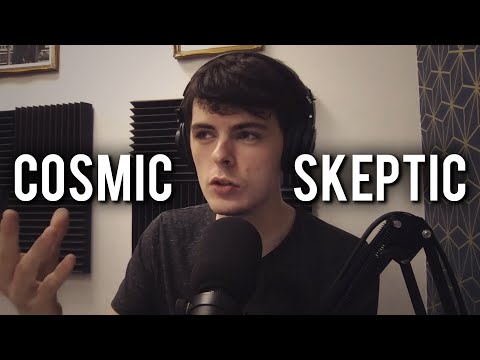
Veganism, Atheism and Morality | Cosmic Skeptic | Modern Wisdom Podcast 103
WatchChris Williamson // 1:05:28
