The Architecture of Decision: Installing High-Performance Mental Models
The Psychological Operating System
Think of your mind as a complex piece of hardware. Most of us go through life running on the factory-default software, rarely questioning if our decision-making protocols are optimized for the challenges we face. George Mack suggests a different approach: viewing mental models as specific applications you install to gain extra functionality. When you upgrade these "apps," you don't just work harder; you think better. The goal is to build a lattice of mental models that allow for clearer perception and more effective action in a world characterized by noise and complexity.
Our brains evolved for a landscape that no longer exists. We are hard-wired for survival on the savannah, not for navigating 21st-century markets or global pandemics. This biological lag creates friction. By consciously adopting frameworks like those discussed by Charlie Munger in Poor Charlie's Almanack, we bridge the gap between our primal instincts and our modern goals. This isn't just about business success; it is about psychological resilience and the ability to maintain internal stability when external conditions shift.
The Superpower of Numerical Fluency
Many individuals treat mathematics as a dry academic requirement they escaped after high school. However, George Mack argues that basic numeracy is actually a superpower in the modern world. Most people avoid numbers because numbers represent reality, and reality is often uncomfortable. Whether it is a business founder who ignores their profit margins or a person who refuses to track their daily habits, avoiding the math is a form of psychological avoidance.
Numerical fluency allows you to break down monumental goals into manageable components. Take the example of Coca-Cola. Charlie Munger analyzed how the company could turn a small investment into a trillion-dollar empire by calculating the global need for water ingestion and the potential to capture a tiny fraction of that market. When you understand the math, the path to a "two trillion dollar" outcome becomes a series of logical steps rather than a vague dream. This same principle applies to personal growth. If you want to change your life, you must stop "winging it" with creative ideas and start looking at the cold, hard data of your time allocation, your financial health, and your physical progress.
The Time-Priority Gap
One of the most revealing exercises involves tracking time against stated priorities. You might claim that your health or your new business is your top priority, but a numerical audit of your week often reveals a different truth. If you spend 5% of your time on your primary goal and 40% on low-value stimulation, your "software" is misaligned. Correcting this requires the courage to face the numbers and the discipline to reallocate your most precious resource: time.
Conditioning and the Habit of Success
Understanding the mechanics of Classical Conditioning and Operant Conditioning provides a roadmap for human behavior. Much like Ivan Pavlov triggered salivation in dogs, brands like Coca-Cola have spent decades conditioning us to associate their product with relief and happiness. They avoid negative feedback loops by ensuring the product never creates a "satiety memory" that would make the consumer feel sick.
On a personal level, you can use these same principles to engineer your environment. If you want to build resilience, you must create positive reinforcement for difficult tasks. The mistake most people make is relying on willpower alone. Instead, you should aim to create a "Lollapalooza Effect"—a term coined by Charlie Munger to describe what happens when multiple mental models or psychological forces act in the same direction at once. When you align your environment, your social circle, and your internal rewards, success becomes an emergent property of your system rather than a constant uphill battle.
The Danger of Opportunity Cost Blindness
We often suffer from a specific cognitive deficit: Opportunity Cost Blindness. When faced with a choice, we tend to view it as a binary—stay in the job or quit, stay in the relationship or be single. We fail to see the eight billion other people or the thousands of other career paths available. This blindness keeps us trapped in suboptimal situations because we only calculate the risk of leaving, never the massive cost of staying.
George Mack notes that we only realize the scale of this cost in hindsight. After leaving a toxic environment, we look back and wonder why we spent years fighting for a situation that was fundamentally flawed. To combat this, you must adopt a base-level filter that assumes there is always more opportunity than you can currently fathom. This mindset encourages "A/B testing" your life—trying new cities, new roles, or new social circles to gather data rather than making permanent decisions based on a narrow worldview.
Principles, Agents, and Ownership
In the world of business and personal productivity, the Principal-Agent Problem is a significant hurdle. A "Principal" has skin in the game; if the project fails, they suffer. An "Agent" is often just a person on the clock who gets paid regardless of the outcome. To achieve high-level growth, you must move from an agent mindset to a principal mindset. This means taking radical ownership of your results.
This also applies to how we manage our own lives. Are you the principal of your life, or are you merely an agent following a script written by your culture or your family? When you act as a principal, you seek Leverage. You look for ways to make your work go further—using code, media, or delegation to multiply your impact. George Mack highlights tools like Zapier as a modern form of leverage that allows non-technical people to automate manual tasks and free up mental bandwidth for high-priority creative work. If you are still doing manual tasks that could be automated for a few dollars, you are undervaluing your own potential.
The Power of the Guiding Principle
What separates the world-shapers like Jeff Bezos and Elon Musk from the rest of us is often the simplicity of their guiding principles. Jeff Bezos filters every decision through customer experience: will this make it faster or cheaper for the customer? Elon Musk asks: will this get us closer to Mars? In a chaotic world with infinite choices, having one clear "North Star" simplifies decision-making and ensures all energy moves in a single direction.
Most people struggle because they have forty poorly defined goals instead of one clear obsession. They are being pulled in a million different directions by social media, peer pressure, and internal conflict. Finding your guiding principle isn't about finding what makes you "happy" in a superficial sense; it's about finding the mission that is worth the struggle. Once you have that direction, speed becomes a secondary concern. As the saying goes, direction over speed always.
Navigating a Changing World
As we look toward the future, the models of the past are being tested. The rise of Remote Work and the potential of Blockchain to revolutionize systems like voting are prime examples of the shift toward decentralization. George Mack and Chris Williamson discuss these as "Bull or Bear" scenarios—identifying where we should be optimistic and where we should be cautious. For instance, remote work is a massive boon for talented individuals in the developing world who can now access global markets, but it may be a threat to those in developed countries who lack unique skills.
Ultimately, your success in this changing landscape depends on your ability to update your mental operating system. You must be willing to uninstall outdated beliefs about work, money, and status and replace them with high-leverage frameworks. Resilience isn't about standing still; it's about having the mental agility to pivot when the data changes. By building your own library of mental models, you don't just survive the future—you architect it.
- George Mack
- 17%· people
- Charlie Munger
- 10%· people
- Coca-Cola
- 7%· companies
- Elon Musk
- 7%· people
- Jeff Bezos
- 7%· people
- Other topics
- 52%
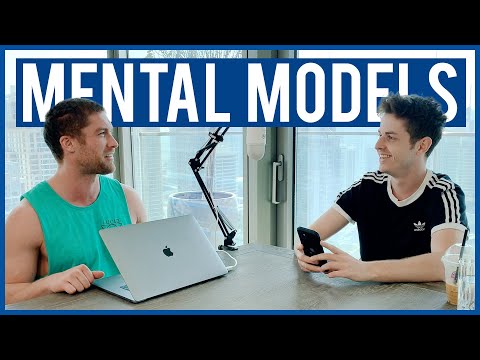
Mental Models 104 - Bear Or Bull? | George Mack | Modern Wisdom Podcast 253
WatchChris Williamson // 1:08:18
