The Architecture of Belief: Navigating Nihilism, Certainty, and the Human Condition
The Fragility of Knowledge and the Gettier Explosion
For centuries, the philosophical world rested comfortably on a definition of knowledge inherited from Plato. This consensus, known as Justified True Belief (JTB), suggested that for someone to truly 'know' something, three criteria must be met: the individual must believe the claim, the claim must actually be true, and the individual must have a valid justification for that belief. It was an elegant, stable foundation that lasted until 1963, when Edmund Gettier published a three-page paper that shattered the glass house of epistemology.
Alex O'Connor highlights this as one of the rare 'step changes' in philosophy. Gettier cases involve scenarios where someone has a belief that is both true and justified, yet it feels intuitively wrong to call it knowledge because the justification is only accidentally linked to the truth. Imagine looking at a broken clock that stopped at 3:30. If you look at it at exactly 3:30 PM, you believe it is 3:30, it is true that it is 3:30, and you are justified because clocks are generally reliable. Yet, you don't 'know' the time; you are simply lucky. This revelation triggered a massive intellectual 'migraine' for philosophers, forcing a total rebuild of how we understand our connection to reality. It serves as a potent reminder that our sense of certainty is often built on shifting sands.
Emotivism and the Hidden Drivers of Morality
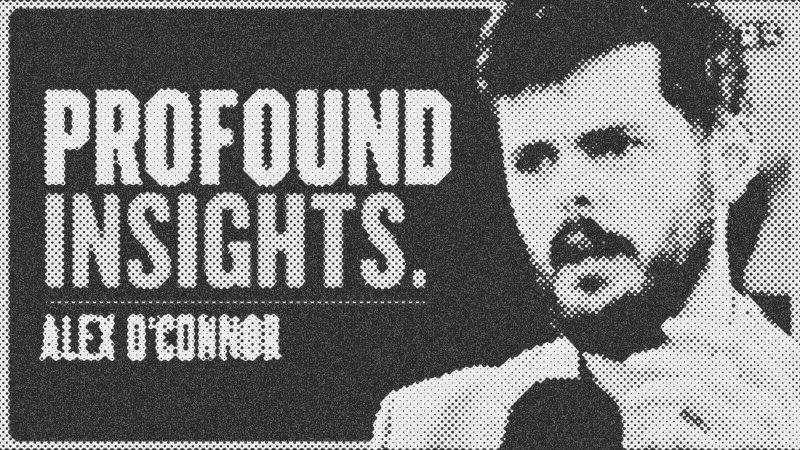
When we debate ethics, we often pretend to be objective observers weighing facts. However, Alex O'Connor introduces the concept of Emotivism, a theory championed by A.J. Ayer in his provocative work Language, Truth and Logic. Ayer argued that ethical statements are not factual descriptions of the world but are instead mere expressions of emotional preference. In this view, saying "murder is wrong" is functionally equivalent to saying "Boo! Murder!"
This perspective is deeply unsettling because it suggests that our most profound moral convictions lack truth value. They aren't 'true' or 'false' in the way that 'gravity exists' is true. This explains why ethical debates—such as those surrounding abortion or gun control—frequently devolve into factual disputes about statistics or biology. We struggle to engage with the underlying ethical core because that core is made of pure emotion, not empirical data. By recognizing the extent to which emotions dominate our ethical thinking, we can begin to peel back the layers of our own biases. We aren't just logic machines; we are 'meaning-making' creatures who project our internal states onto the external world to find a sense of order.
Terror Management and the Denial of Death
Human behavior is frequently a complex dance around the one reality we cannot change: our own mortality. Alex O'Connor and Chris Williamson explore Terror Management Theory, which posits that much of human culture is a defense mechanism against the paralyzing fear of death. This concept, popularized by Ernest Becker in The Denial of Death, suggests that we create 'immortality projects'—art, religion, political movements, or even professional legacies—to feel as though we exist beyond our biological expiration date.
This theory manifests in surprising ways. Studies show that when judges are reminded of their mortality, they become significantly more punitive, seeking to harshly reaffirm the legal systems they participate in as a way to bolster a structure that outlives them. Even the modern productivity and longevity movements can be viewed as sophisticated forms of death denial. We try to 'hack' our biology or squeeze more output into our days not just for efficiency, but as a silent protest against the finite nature of time. When we understand this, our motivations become clearer. We realize that our pursuit of status or legacy is often a quiet plea for permanence in an impermanent universe.
The Paradox of Choice and the Anthropic Killer
Probability often defies our natural intuition, leading to paradoxes that challenge our sense of agency. The 'Anthropic Dice Killer' paradox illustrates how population-level thinking can clash with individual logic. In this thought experiment, a killer rolls a die for an exponentially increasing number of victims. If he rolls a six, everyone in that current round dies. If you wake up blindfolded in this scenario, your individual chance of the next roll being a six is 1 in 6. However, from a broader perspective, you are statistically far more likely to be part of the final, largest group that eventually gets killed.
This mirrors the Doomsday Argument in cosmology, which suggests that because we find ourselves alive at a time of high human population, we are likely near the end of the human story rather than the beginning. These mental models are 'sexy paradoxes' because they force us to confront the limitations of our perspective. We tend to view ourselves as the protagonists of a linear story, but mathematics suggests we are often just data points in a larger, indifferent distribution. This realization can be a catalyst for a specific type of humility, acknowledging that the 'obvious' answer depends entirely on the scale of the lens we use.
The Free Will Friction and the Determinism Delusion
Few topics provoke more immediate hostility than the denial of free will. Alex O'Connor notes that even mentioning Robert Sapolsky or the idea of a Determined universe causes a visceral reaction in most audiences. This resistance stems from a threat to our sense of sovereignty. If we are merely the sum of our biology, environment, and prior causes, then the concept of 'authorship' over our lives evaporates.
Critics like Ben Shapiro argue that even if free will doesn't exist, we must act as if it does to maintain a functional society. O'Connor counters that this is a 'figurative truth' that falls apart under scrutiny. We don't need the illusion of free will to get out of bed; we get out of bed because we are hungry or driven by desires we didn't choose to have. The friction occurs because we want to take credit for our successes while distancing ourselves from our failures. Accepting a lack of free will doesn't lead to fatalism; it leads to a more compassionate understanding of human behavior. If everyone is 'determined' by their circumstances, the desire for retribution is replaced by a desire for systemic solutions and empathy.
Historical Echoes and the Evolution of Faith
The discussion shifts to the foundations of religious belief, specifically the historical claims of Jesus Christ's resurrection. O'Connor analyzes the Gospels not as divine revelation, but as historical documents that show clear signs of mythological development. The earliest accounts, like the Gospel of Mark, lack the fantastical post-resurrection appearances found in later texts like the Gospel of John.
While some use the contradictions between these accounts as evidence of their authenticity—arguing that conspirators would have aligned their stories better—O'Connor sees a trajectory of increasing embellishment. This analysis touches on a broader societal trend: the 'Mass Cope' regarding Judeo-Christian values. As grand religious narratives collapse, many secular thinkers are scrambling to claim that modern liberal values—like human rights and science—are rooted in the very traditions that often opposed them. This 'annexation' of progress by religion is an attempt to find clothes for our 'naked' nihilism. We are in a transitional period where we recognize the utility of old beliefs but can no longer ignore the truth of their inconsistencies. The challenge of the future is not to cut down the forest of the past, but to irrigate the desert of meaning that remains.
- Alex O'Connor
- 17%· people
- A.J. Ayer
- 4%· people
- Ben Shapiro
- 4%· people
- Chris Williamson
- 4%· people
- Determined
- 4%· books
- Other topics
- 65%
Interesting Ideas From Philosophy For A Better Life - Alex O'Connor (4K)
WatchChris Williamson // 1:39:09
