The Rationality Paradox: Navigating Cognitive Biases and Truth in a Modern World
The Architecture of Human Reason
We often assume that rationality is a static trait, something we either possess or lack in the face of life's complexities. However, Steven Pinker suggests that rationality is more akin to a toolkit of specialized instruments designed to solve specific problems. While humans excel at reasoning about immediate cause and effect or social dynamics within their immediate circle, we frequently stumble when applying these same logic circuits to abstract, novel, or large-scale issues. The modern world demands that we use "cognitive tricks"—mental models like the sunk cost fallacy or availability bias—to navigate environments our ancestors never encountered.
True growth involves recognizing that our brains are not naturally optimized for the 21st century's information deluge. We are prone to errors not because we are unintelligent, but because our biological hardware was never intended to calculate the statistical probability of a global pandemic or the long-term utility of a kitchen appliance warranty. Accepting this inherent limitation is the first step toward building a more resilient and self-aware mindset. To move forward, we must stop viewing rationality as a destination and start seeing it as a disciplined practice of self-correction.
The Intelligence Trap and My Side Bias
There is a persistent myth that high intelligence acts as a shield against irrationality. The data suggests otherwise. While a correlation exists between IQ and rational thinking, it is far from a perfect overlap. In fact, highly intelligent individuals are often more adept at "motivated reasoning." They use their superior cognitive abilities to build sophisticated intellectual fortresses around their existing beliefs, a phenomenon known as biased assimilation. This is particularly dangerous when beliefs are tied to a "sacred value" or a tribal identity, such as a political party or religious group.
This "my side bias" operates like a legal defense team for the ego. When we encounter evidence that supports our tribe, we swallow it whole. When we see evidence that contradicts it, we nitpick every methodology and seek out every possible loophole. This isn't a lack of brainpower; it's a misapplication of it. To combat this, we must consciously expose ourselves to sources we don't habitually read, such as the The Guardian or the The Telegraph, and seek out thinkers like Scott Alexander who prioritize objective literature reviews over partisan signaling.
Bayesian Thinking as a Life Strategy
One of the most powerful tools in the rational toolkit is Bayes' Rule. While it sounds like an intimidating algebraic formula, its core principle is simple: we should calibrate our degree of belief based on the strength of the evidence. It introduces the concept of "priors"—our existing weight of evidence before seeing new data. Most of us are "base-rate neglectors"; we see a positive medical test or a scary news anecdote and immediately jump to a 100% belief in a specific outcome, ignoring how rare that outcome actually is in the general population.
Applying Bayesian reasoning means shifting away from binary "true or false" thinking and toward a spectrum of probability. If you are predicting the future, start with the historical base rate. If you want to know if a country will invade another, don't just listen to the latest pundit; look at how many times that has happened in that region over the last decade. This approach requires humility. It forces us to admit that our knowledge is always incomplete and that every new piece of information should nudge our confidence level up or down, rather than flipping a switch from "yes" to "no."
The Tension Between Logic and Intuition
We often hear the advice to "trust your gut." In popular culture, intuition is framed as a mystical, superior form of wisdom. While it’s true that overthinking can lead to "bounded rationality"—where the cost of gathering more data outweighs the benefit of a slightly better decision—blindly following intuition is a recipe for disaster. Intuition is essentially pattern recognition. It works well in familiar environments but fails miserably in novel or complex ones.
Instead of choosing between logic and gut feeling, we should use others' real-world experiences as a proxy for our own. Daniel Gilbert at Harvard University argues that we are remarkably bad at imagining our future emotions. Rather than agonizing over a career move by trying to simulate how we'll feel in five years, we should find someone who has already made that move and ask if they regret it. This replaces flawed internal simulation with hard external data. Rationality, in this sense, isn't about being a cold machine; it's about being smart enough to know when your own imagination is an unreliable narrator.
Conspiracies and the Erosion of Institutional Trust
Conspiracy theories are unique because they are designed to evade our "cognitive immune system." They often include a clause that the lack of evidence is actually proof of how deep the conspiracy goes. This makes them unfalsifiable. People often adopt these beliefs not because of factual evidence, but because the belief identifies a villain they already dislike—the "establishment," "woke academics," or "elites." In this context, the belief isn't a statement of fact; it's a badge of tribal loyalty.
This problem has been exacerbated by the decline of trust in institutions. When experts present themselves as infallible oracles rather than transparent scientists who "show their work," they set themselves up for failure. When the public sees institutions politicizing their language, those outside that political coalition stop listening. Rebuilding rationality in society requires experts to admit their ignorance when a new phenomenon, like COVID-19, first emerges. We must foster communities of free speech where ideas can be challenged openly, because as individuals, we are often the least equipped to see our own blind spots.
- Bayes' Rule
- 6%· misc
- Bayesian reasoning
- 6%· misc
- CIA
- 6%· organizations
- COVID-19
- 6%· misc
- Daniel Gilbert
- 6%· people
- Other topics
- 71%
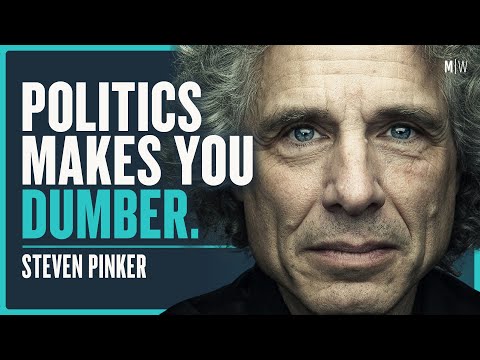
The Problem With Trying To Be Rational - Steven Pinker
WatchChris Williamson // 42:15
