The Evolutionary Architecture of the Heart: Why Our Messiest Emotions are Our Greatest Assets
The Hidden Logic of Human Feeling
We often treat our emotions like uninvited guests at a dinner party—loud, irrational, and prone to making a scene. We apologize for our anxiety, suppress our anger, and feel ashamed of our shame. But this cultural habit of vilifying our internal states misses a profound psychological truth: your emotions are not glitches in your mental software. They are sophisticated, Evolutionary Psychology coordinating mechanisms designed to help you navigate a world that was, for most of human history, incredibly dangerous.
Laith Al-Shawaf, an associate professor of psychology, argues that we suffer from an "emotion paradox." While emotions cause us immense distress and can lead to psychological disorders, we literally could not survive without them. Each feeling state—from the sharp sting of Fear to the heavy weight of Guilt—is an orchestrated response involving your brain, body, and behavior. When you feel afraid, your digestion slows, your heart rate spikes, and your memory actually becomes better at mapping escape routes. You aren't just "feeling" something; your entire organism is shifting into a specific mode of operation to solve a survival problem.
Beyond the Feeling: Emotions as Coordinating Mechanisms
The mistake most of us make is identifying the emotion solely with its "feeling state." We think fear is just that cold shiver in the spine. In reality, the feeling is just one of many changes occurring simultaneously. When Laith Al-Shawaf describes emotions as coordinating mechanisms, he is referring to how they regulate attention, perception, and physiology in a unified direction.
Consider Disgust. It feels aversive because its job is to keep you away from pathogens. But the response goes deeper than a wrinkled nose. Your body actually mounts an immune response, increasing your basal body temperature and releasing pro-inflammatory cytokines before you even touch a contaminated object. Behaviorally, you become less open to new experiences and less extroverted. It is a brilliant, if uncomfortable, defensive strategy. By shifting your entire personality toward caution, your brain reduces the likelihood that you will touch or eat something that could kill you.
The Advocacy of the Self
One of the most empowering shifts in mindset comes from realizing that your emotions are constantly advocating for your interests. However, these aren't just selfish interests; they include the welfare of your children, your friends, and your community. Anger, for instance, is a negotiation tool. It signals to others that they are not valuing your welfare enough and threatens to impose costs or withhold benefits unless they treat you better.
Love functions as a solution to the "commitment problem." Robert H. Frank suggests that love acts as an emotional glue that pulls the future costs of cheating into the present. A purely rational calculator might decide to cheat on a partner for a short-term gain, discounting the future loss of the relationship. But an emotionally bonded person feels the sting of Guilt or the warmth of connection now, making the long-term bond more likely to survive. Our emotions act as the inner advocates that protect our most valuable social investments.
The Smoke Detector Principle: Why We Overreact
If emotions are so adaptive, why do they feel so wrong so often? Why does Anxiety flare up when there is no real threat? This is explained by the "smoke detector principle," a concept championed by psychiatrist Randolph Nesse.
When you install a smoke alarm, you want it to be biased. A smoke alarm that only goes off during a massive fire is a failure; it needs to be sensitive enough to go off when you're just burning toast to ensure it never misses a real inferno. Our brains are built with the same bias. Missing a real threat (a "false negative") could be fatal, whereas reacting to a non-existent threat (a "false positive") is merely a nuisance. Your Anxiety isn't a bug; it is a high-sensitivity security system working exactly as it was designed to work in a dangerous ancestral environment. Recognizing this can take the sting out of the experience. You aren't broken; you are just extremely well-protected.
The Social Guardian: Shame and Reputation
Few emotions are as maligned as Shame, yet it serves a critical role in human group cohesion. For our ancestors, being cast out of the tribe was a death sentence. Shame evolved to prevent social devaluation. It tracks what others would judge us for and triggers a painful response to stop us from engaging in behaviors that would ruin our reputation.
Crucially, research shows that Shame is more about optics than internal morality. You can feel Shame even when you are innocent, as long as you believe the group thinks you are guilty. It is a ruthless mechanism for brand management. On the flip side, Pride encourages us to advertise our skills and achievements to the group, ensuring we receive the status and support we've earned. These are the twin guardians of our social standing, keeping us tethered to the community we need for survival.
Why Happiness is Not the Default
A common source of modern suffering is the "cult of positivity"—the idea that we should be happy most of the time. But Evolutionary Psychology has no interest in your happiness; it only cares about your survival and reproduction. This is why we are trapped on the "hedonic treadmill."
If our ancestors achieved a goal and remained perpetually satisfied, they would stop striving and be outcompeted by those who felt a brief burst of joy followed by a renewed hunger for the next achievement. Our brains are designed to revert to a baseline level of dissatisfaction to keep us moving. Furthermore, modern society creates a massive "evolutionary mismatch." We live in anonymous cities without close kin, eat processed foods, and compare our real lives to the curated social media facades of millions. This cocktail of isolation and constant comparison hyper-activates our Anxiety and Sadness in ways our ancestors never experienced.
Embracing the Complexity
So, how do we live with these powerful, often painful systems? The goal isn't to reach a state of "perfect rationality" where emotions are silenced. As cases of brain damage to the Ventromedial Prefrontal Cortex show, people who cannot feel emotions cannot make even the simplest decisions. They can list pros and cons for hours but lack the "gut feeling" required to pick a seat in a theater or a time for a doctor's appointment.
Instead of vilifying your feelings, adopt a case-by-case approach. Ask yourself: What is the function of this emotion? Is it serving that function right now, or is it a misfire? If you feel Sadness because you are in a dead-end job, listen to its wisdom—it is telling you to reallocate your resources. If you feel Anxiety about a safe situation, acknowledge your brain's "smoke detector" and move forward anyway. By understanding the evolutionary architecture of your heart, you can stop fighting yourself and start navigating your life with greater self-compassion and insight.
- Anxiety
- 15%· concepts
- Shame
- 15%· concepts
- Evolutionary Psychology
- 7%· concepts
- Guilt
- 7%· concepts
- Laith Al-Shawaf
- 7%· people
- Other topics
- 48%
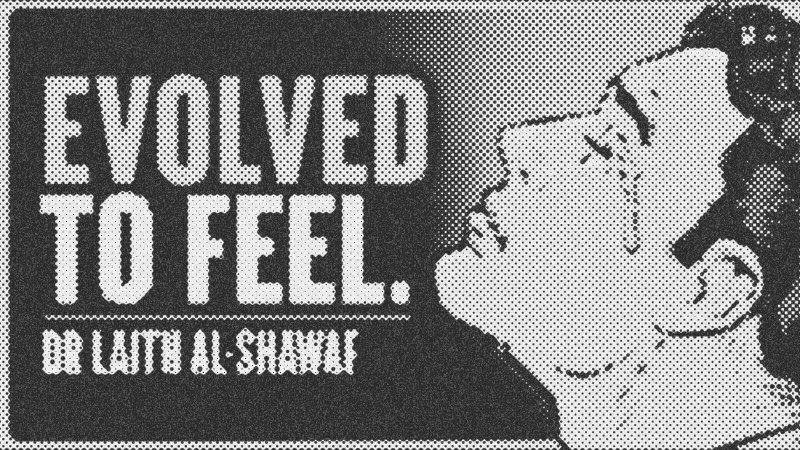
The Origins Of Human Emotions And Their Purpose - Dr Laith Al-Shawaf
WatchChris Williamson // 1:26:24
