Beyond the Mind: Understanding How the Body Records and Releases Trauma
The Disembodied Paradigm: Why We Misunderstand Trauma
Traditional medicine and psychology have long treated the human experience as a series of separate compartments. We visit a physician for the body and a psychologist for the mind. However, this fragmented approach fails to account for the reality of human suffering. Bessel van der Kolk argues that psychology and medicine have become disembodied professions. They focus on thoughts, behaviors, and chemical imbalances while ignoring the physical vessel where all these experiences live.
Trauma is not just a story we tell ourselves about something bad that happened in the past. It is a physiological change. When a person is traumatized, their body’s alarm system remains stuck in the 'on' position. This isn't a cognitive choice; it’s an installation in the brain’s housekeeping system—the parts we share with all mammals. Because traditional talk therapy often stays within the prefrontal cortex, it struggles to reach the deeper, elemental areas of the brain that govern survival. Understanding trauma requires us to look at how people move, how they breathe, and how their bodies react to the world around them, rather than just what they say.
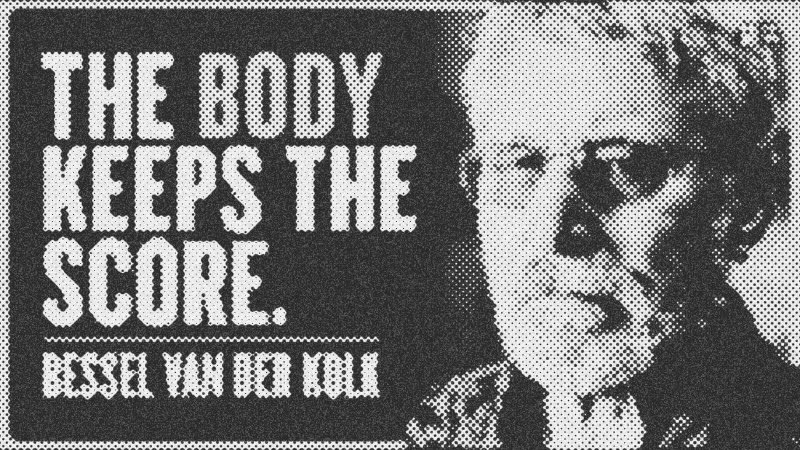
Stress vs. Trauma: The Survival Loop
Being human involves inherent stress. We are wired to rise to challenges, endure difficult days, and navigate broken relationships. Under normal circumstances, when a stressful event ends, our biology returns to a baseline. We feel the relief and move on. Trauma is fundamentally different because it creates a state of being frozen. It robs an individual of the feeling that they are in charge of themselves.
While stress is a temporary biological arousal, trauma is an assault on one's being that changes the very framework of how one experiences the self and the world. It breaks the social connections that define our species. We are social creatures who define ourselves through belonging. In many cases, it isn't the event itself that causes lasting PTSD, but the breakdown of social support following the event. For example, many survivors of 9/11 did not develop chronic trauma because of the massive influx of community support. Conversely, those in domestic violence situations, where home is not a sanctuary, are far more vulnerable. When the people meant to provide safety are the source of the threat, the brain’s ability to process the event correctly collapses.
The Physiology of Shielding and Shame
One of the most heartbreaking consequences of trauma is the tendency to shield oneself from the very thing needed for healing: other people. This is an adaptive response. If a person has learned that those closest to them cannot be trusted, their brain installs a permanent filter of suspicion. They aren't being difficult; they are being protective. This manifests as a deep-seated shame. People often feel ashamed of being triggered by 'small' events in the present, not realizing that their body is reacting to an old alarm that never stopped ringing.
This shame leads to minimization. We tell ourselves we should be 'over it' or that our family was 'normal.' We construct a mask of competence to look acceptable to the world, yet internally, we remain at the mercy of a limbic system that views a partner’s touch or a boss’s tone as a life-threatening assault. This tension between our desire for agency and our lack of control over our internal reactions is the primary battlefield of recovery. We must stop asking 'what is wrong with me?' and start understanding that these reactions are the body’s attempt to survive a world it perceives as dangerous.
How the Body Manifests Illness
If the mind is in a state of chronic elevated concern, the body bears the brunt of that inflammation. Bessel van der Kolk highlights the undeniable link between trauma and somatic illnesses such as fibromyalgia, chronic pain, and autoimmune diseases. While trauma may not be the sole cause of these conditions, it significantly increases vulnerability and exacerbates symptoms.
The medical community has historically been slow to study how we process bodily experiences. We have won Nobel Prizes for vision and hearing, but the science of touch and internal sensation is still in its infancy. When a person is stuck in a traumatic loop, their body is in a state of constant high alert, flooding the system with stress hormones that eventually degrade physical health. To treat the illness, one must treat the underlying lack of safety that the body feels on a cellular level.
The Journey Toward Self-Compassion and Regulation
Healing from trauma requires more than just insight; it requires a new experience of the self. True self-compassion is rarely achieved through cognitive willpower. It often requires modalities that bypass the rational mind. Bessel van der Kolk points to the significant results seen in research involving MDMA and other psychedelics. These substances can temporarily lower the brain’s fear response, allowing individuals to view their past selves with a sense of tenderness and understanding that they cannot access in a normal state of consciousness.
Beyond clinical interventions, the path to recovery involves active self-regulation. This means discovering what makes you feel safe—whether it is music, yoga, martial arts, or touch. The goal is to move from being a passenger in a reactive body to being a conscious participant in your own life. We must teach kids not just the 'three Rs,' but a fourth: self-regulation. By learning how our brains and bodies interact, we can begin to build a society that values internal awareness as much as external achievement.
Conclusion: The Future of Healing
The future of trauma treatment lies in returning to the senses. As we navigate an era of digital anesthetics where screens allow us to ignore our internal worlds, the need for 'body self-awareness' has never been more urgent. We must move toward a model of care that integrates multiple options—from neurofeedback to bodywork—rather than adhering to a single, often outdated, psychological doctrine. The ultimate goal of any therapeutic journey is to gain the freedom to make choices, rather than remaining a puppet of past events. By meeting ourselves with curiosity rather than judgment, we can finally allow the body to stop keeping the score and start living in the present.
- Antonio%20Damasio
- 8%· people
- Bessel%20van%20der%20Kolk
- 8%· people
- Chris%20Williamson
- 8%· people
- EMDR
- 8%· practices
- Jonathan%20Haidt
- 8%· people
- Other topics
- 62%
The Hidden Price Of Unprocessed Trauma - Bessel van der Kolk
WatchChris Williamson // 1:05:36
