The Infinite Regress of Self-Judgement: Navigating Growth in the Public Eye
The Trap of Secondary Emotions and Self-Critique
One of the most profound challenges we face in personal development is not the initial failure or the original negative emotion, but the secondary layer of judgement we pile on top of it. This creates an infinite regress: you feel bad, then you feel bad about feeling bad, and then you feel resentful about the fact that you are feeling bad about feeling bad. It is a psychological loop that strips away the very kindness you need to heal. When Chris Williamson reflects on his recent experiences after high-stakes moments like the Joe Rogan interview, he highlights a vulnerability many high-performers share—the tendency to be unkind to one's own unkindness.
This phenomenon often stems from a distorted self-image where we believe we should be beyond certain struggles. If you view yourself as a resilient, "well-put-together" person, experiencing a dip in confidence feels like a betrayal of your identity. However, true resilience isn't the absence of these low moments; it is the capacity to sit with them without adding the weight of shame. When we judge our own vulnerability, we are essentially trying to bully ourselves back into a state of strength. This never works. Growth requires a radical acceptance of the "sad boy moments"—those times when the tank is empty and the brain feels slippery. By allowing these moments to exist in the light, rather than cutting them out of our personal narrative, we begin to dismantle the power of the infinite regress.
The Paradox of Success: Why We Should Pity the Super-Achiever
There is a common societal tendency to envy those at the top of their fields, yet a deeper psychological investigation suggests that pity might be a more appropriate response. Extreme success is rarely a product of a balanced, content mind; it is frequently an "atypical outgrowth" of deep-seated discomfort, a difficult childhood, or an insatiable need for external validation. When we admire a billionaire or a world-class athlete, we are seeing the final result of a decades-long journey driven by a fuel that most happy people would find toxic.
If you are someone who is comfortable in your own skin, you have already achieved the destination that many successful people are trying to reach via a much more grueling, circuitous route. They are taking the long way up Everest to find the peace that you might already possess on your couch. This doesn't mean we should dismiss their achievements, but we should temper our admiration with an understanding of the price paid. Many high-achievers are puppeted by the expectations of an audience they’ve never met, trapped in a "reality distortion field" where they can no longer behave normally or trust the intentions of those around them. Recognizing this allows us to stop measuring our internal well-being against their external metrics.
Outcomes, Inputs, and the Bounded Game of Life
In the world of habit formation and productivity, the James Clear philosophy of focusing on systems over goals has become the gold standard. The idea is that you don't rise to the level of your goals; you fall to the level of your systems. However, this advice requires nuance based on the type of "game" you are playing. In a bounded game—like football or learning a musical instrument—the goal is tightly defined. In these scenarios, focusing purely on inputs (the practice, the drills) is highly effective because the path to the outcome is clear.
But life is often an unbounded game. If your goals are poorly defined, focusing only on inputs can lead to "fast driving in the wrong direction." You can spend all day labeling your inbox or refining a supply chain for a business that shouldn't exist. This is where an outcome-oriented mindset becomes essential. You must periodically lift your head from the "systems" to ensure the trajectory still aligns with a meaningful result. The danger of being too "system-pilled" is that you can become incredibly efficient at things that don't actually matter. To navigate this, use outcomes to set the compass and inputs to move the needle, but never confuse the two.
The Architecture of Authentic Creation
For anyone building a body of work, the tension between creating for an audience and creating for oneself is a constant battle. The digital age provides perverse incentives to reverse-engineer content based on trends, search terms, and algorithmic demands. Yet, the most enduring work usually functions as a "thinly veiled autobiography." True authenticity isn't a marketing strategy; it's a byproduct of following your own curiosity. When you solve your own problems in public, you create a unique fingerprint that resonates with others because you aren't an outlier—you are a representative of the human experience.
Creating for yourself is the only way to ensure longevity. If you are puppeted by the desires of a faceless crowd, you will eventually grow bitter. By treating your work as a vehicle for your own self-discovery—whether that’s exploring Evolutionary Psychology to understand your own behavior or testing productivity frameworks to manage your own chaos—you ensure that the process remains rewarding regardless of the external metrics. You must play the game of growth loops and platform mechanisms, but you must always remember that the work is not about the game. It is about the pursuit of what you find genuinely interesting.
Periodization as an Antidote to Anxiety
Many high-performers struggle with a binary struggle: anxiety when working hard and depression when taking it easy. This is often because we are "absolute creatures" who struggle with moderation. Just as it is easier to eat zero Oreos than it is to eat exactly two, it is often easier to be 100% "on" or 100% "off" than it is to find a middle ground. The solution lies in periodization—making your work and rest time-bound and intentional.
Anxiety in the workplace often stems from the fear that the pressure will never end. Conversely, depression during downtime stems from a sense of insufficiency or a lack of purpose. By creating a cadence—whether it's the traditional weekday/weekend split or more complex cycles of high-intensity sprints followed by total disconnection—you ameliorate these feelings. You can lean harder into the work when you know a rest is coming on Friday, and you can actually enjoy the relaxation when you know the "demon mode" switch will be flipped back on Monday. Periodization allows you to be an extremist in both directions, which is often more sustainable than trying to maintain a lukewarm equilibrium.
The Wisdom of Curated Instincts
As we move through our 20s and 30s, the goal should be to move from a state of rigid, deliberate control to one of curated instincts. In the beginning, you need the heavy lifting of formal practices: meditation for mindfulness, journaling for gratitude, and strict routines for discipline. You are effectively "boxing in" your lower instincts and training your higher ones. However, as you mature, you can begin to trust the direction of your own flow.
This doesn't mean abandoning discipline, but rather recognizing that you have become the kind of person who can handle unpredictability. Long-term planning is often overrated because it assumes the person you are today will want the same things as the person you will be in five years. Instead of a 10-year roadmap, focus on a few broad directions—adventure, contribution, family, health—and let your trained instincts navigate the specifics. If you have spent years being deliberate, you have earned the right to be more free-flowing. Trust that the version of you who survives the next challenge will be better equipped to plan for it than the version of you today.
- Alain%20de%20Botton
- 8%· people
- Andrew%20Huberman
- 8%· people
- Chris%20Williamson
- 8%· people
- Douglas%20Murray
- 8%· people
- James%20Clear
- 8%· people
- Other topics
- 62%
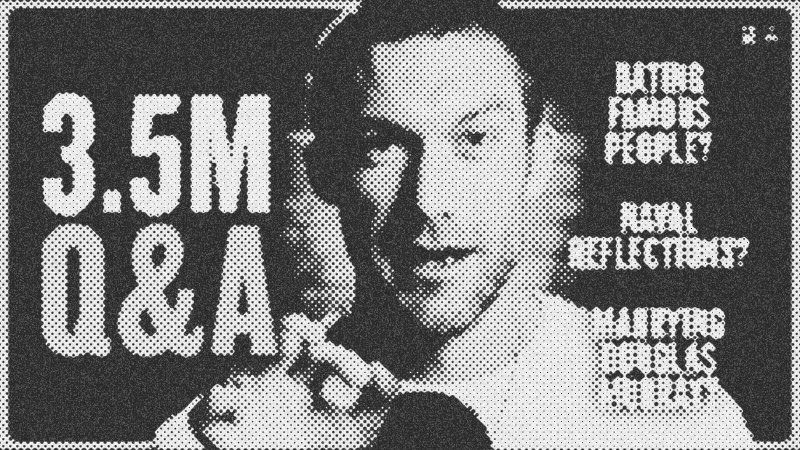
3.5M Q&A - Dating Famous People, Naval Reflections & Marrying Douglas Murray
WatchChris Williamson // 1:27:19
