Breaking the Rumination Loop: A Guide to Letting Go and Reclaiming Presence
1. Topic/Challenge Framing: The Heavy Anchor of the Past
We have all been there. You are trying to enjoy a quiet evening, but your mind is elsewhere, stuck in a relentless replay of a conversation that happened weeks ago. You are re-litigating an insult, imagining a sharper comeback, or dissecting a failed relationship as if a new insight might suddenly change the outcome. This is the weight of rumination—a mental anchor that keeps us stuck in the harbor of past regrets while the rest of life sails away.
As a coach and psychologist, I see this daily. The challenge is not just that we think about the past, but that we become possessed by it. We treat our thoughts like precious property we must defend or problems we must solve through sheer force of will. But the more we grasp, the more we suffer. The real task is learning how to loosen the grip, to understand why our brains are so biologically primed to hold on, and to discover the profound freedom that comes from simply letting the moment end.
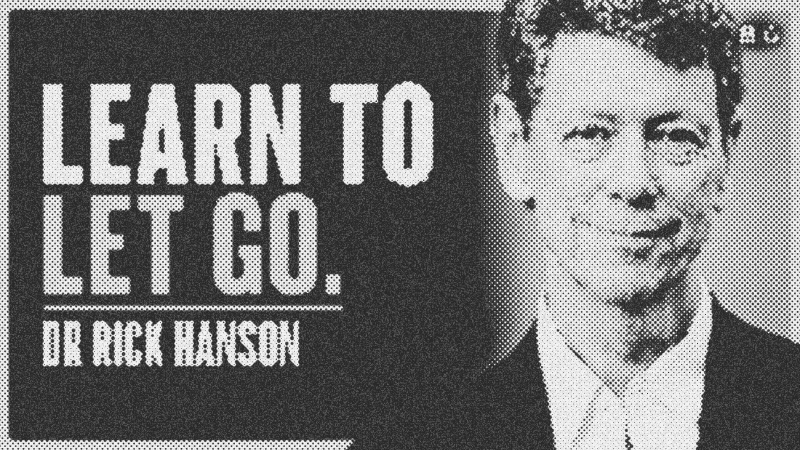
2. Core Insights/Principles: The Architecture of the Stuck Mind
To break the cycle, we must first understand the biological and psychological machinery at play. Dr. Rick Hanson explains that our ancestors survived because they were not "chill." The hominids who were cranky, possessive, and constantly scanning for threats were the ones who passed on their genes. We are the descendants of the anxious. Our brains have a built-in "ruminator" designed for mental time travel—the ability to simulate potential futures and replay past events to learn lessons.
However, in the modern world, this survival mechanism often goes rogue. We get caught in what is known as the "repetition compulsion." The known, even if it is painful, feels safer than the uncertainty of the unknown. We would rather fantasize about a catastrophe—collapsing the "superposition of uncertainty" into a definitive, albeit negative, answer—than sit with the discomfort of not knowing what comes next.
Furthermore, rumination often serves as a defensive shield. While we are busy rehashing an argument, we are avoiding the softer, more vulnerable feelings underneath: the raw sting of rejection, the fear of failure, or the grief of a dream ending. We use the "tightness" of obsessive thought to avoid the "fluidity" of true feeling. But as long as we avoid the core experience, the memory remains trapped in our neural networks, waiting for a release that never comes.
3. Actionable Steps/Practices: Strategies for Mental Release
Breaking the loop requires more than just telling yourself to "stop thinking about it." We need to use our neurological hardware more effectively. Here are three core practices to interrupt the spiral:
Practice the "Go Wide" Technique Rumination is a narrow-focus activity, usually localized in the midline cortex of the brain. When you feel yourself getting sucked into a mental movie, intentionally expand your field of awareness. Focus on the sensation of your entire body or the periphery of your vision. This gestalt, holistic processing engages the right hemisphere of the brain, which naturally quiets the verbal, repetitive centers. By "going wide," you stop being the character in the movie and start being the sky that holds the clouds.
Cultivate "Don't Know Mind" Much of our suffering comes from the stakes we plant in the ground—our rigid views on how things "should" be or who we "are." Practice saying, "Maybe so, I don't know." This is not about being passive; it is about being autonomous. When you stop needing to have a definitive label for every event or a rigid identity (like "I am not a public speaker"), you dissolve the congealed crud of old stories. Not-knowing acts as a solvent for the ego's attachments.
Conduct a "Sub-Surface Search" When a thought won't leave you alone, ask yourself: "What experience am I trying to avoid by thinking this?" If you are ruminating on a breakup, the underlying feeling might be a deep sense of unworthiness. Instead of thinking about the breakup, let yourself feel the physical sensation of the unworthiness. Paradoxically, when we let the experience in fully—without the armor of the story—it begins to move through us.
4. Encouragement/Mindset Shift: The Power of Mundane Victories
We often think growth requires grand, heroic leaps, but true resilience is built in the "boring" successes. I want you to celebrate the moments where you don't break something. Think of the rancher who had a bad day but chose to sit on the porch and smoke a cigar instead of forcing a fight with a difficult horse. His success was that he didn't make things worse.
We must lower the bar for what constitutes a win. If you spent ten minutes ruminating instead of two hours, that is a victory. If you felt a sting of rejection and chose to be kind to yourself instead of replaying the insult, that is a triumph. These "ordinary victories" are what expand your "window of tolerance." Every time you face a feared experience—like being seen as imperfect—and realize you are still okay, you push back the bars of your invisible cage.
5. Concluding Empowerment: Stepping Into the Lead Edge of Now
Your life is not a fixed narrative; it is a leading edge of creation. Just as the universe is constantly expanding into the next moment, you have the capacity for endless arising. Letting go is not about admitting defeat or losing a part of yourself; it is about making room for the next good thing to arrive.
True bravery lies in being "earnest"—showing up with vulnerable sincerity rather than a polished persona. When you drop the act and accept the risk of being rejected for who you actually are, you find a level of peace that "audience capture" can never provide. You are the ghost in the machine, not the machine itself. Today, choose to be the one who observes the thoughts, feels the feelings, and then moves with grace into the expansion of the next now. You have the strength to navigate this, one intentional breath at a time.
- Ajan Cha
- 7%· people
- Chris Williamson
- 7%· people
- Default Mode Network
- 7%· concepts
- Dr. Rick Hanson
- 7%· people
- Global Compassion Coalition
- 7%· organizations
- Other topics
- 64%
You Can’t Change Without Breaking The Loop - Dr Rick Hanson
WatchChris Williamson // 1:35:45
