Beyond the Degree: Navigating the Turbulent Transition to Adulthood
The Identity Crisis of Freshers Week
Entering university represents a seismic shift in your psychological landscape. For many, Freshers Week is less about the parties and more about a desperate, often subconscious, search for security. You are plucked from the familiar confines of home and thrust into a high-stakes social arena where your previous identity no longer carries currency. This often results in what I call 'Velcro socialising'—the tendency to latch onto the first person you meet in a corridor or a lecture hall because the alternative, being alone in the unknown, feels intolerable.
We must recognize that this surge of seeking approval is a natural response to total environmental overwhelm. However, the risk is that you anchor your entire university experience to a small, non-representative sample of people who happened to be nearby during those first seventy-two hours. To truly grow, you must push past this initial insecurity. Consider broadening your social net through structured environments like sports teams or events companies. These organizations provide a surrogate family and a support structure of older, more experienced peers who can help you interpret your new world without the blind desperation that characterizes a group of eighteen-year-olds clutching onto each other for dear life.
The Psychology of the Academic Workday
One of the most destructive traps students fall into is the 'familiarity paradox.' You read your notes, you highlight them with neon colors, and your brain tells you that you know the material because it looks familiar. In reality, you’ve only mastered recognition, not recall. To build true resilience and mastery in your studies, you must shift from passive exposure to active retrieval. Evernote serves as an excellent digital scaffolding for this process. By creating a systematized, searchable database of your learning, you offload the cognitive burden of organization, allowing your mind to focus on the deep work of interpretation.
Parkinson's Law dictates that work expands to fill the time available for its completion. If you tell yourself you have a semester to write a dissertation, your brain will wait until the final forty-eight hours to activate, creating a state of high-cortisol panic that impairs long-term memory and creative thinking. The 'minimum effective dose'—just thirty minutes to an hour of intentional work per day—is the antidote to this cycle. By treating your degree like a nine-to-five job, you reclaim your evenings and weekends. This isn't just about productivity; it’s about emotional regulation. Knowing that your tasks are managed allows you to engage in social life without the underlying hum of academic guilt.
Navigating the Intimacy Minefield
Relationships at university are often used as emotional shields. When everything around you is changing, a partner from home or a new 'instant' relationship provides a sense of familiarity that can, unfortunately, stifle your growth. Many students arrive at university with a long-distance partner, only to find themselves in a 'Battle of the Somme' of emotional attrition. They spend their weekends on FaceTime or crying on the phone, effectively checking out of the life they are supposed to be building in their new city.
We must be honest about the statistics of these relationships. They often fail not because of a lack of love, but because of a divergence in developmental timing. You are changing at a faster rate between eighteen and twenty-one than at almost any other point in your life. Clinging to a relationship that no longer serves your growth is a form of self-sabotage. If you find yourself in a toxic loop, or if you realize you are only staying in a relationship for the comfort of the familiar, you owe it to yourself—and the other person—to call it quits. Perspective is your greatest tool here; understand that your sample size of life experience is currently small, and what feels like the end of the world is often just the beginning of a necessary evolution.
The Physical Foundation of Mental Growth
Your physical state is the substrate upon which your mental health is built. There is a specific biological window between the ages of eighteen and twenty-five where your body is essentially a 'walking ball of steroids.' Your hormonal profile is at its peak for building the muscle mass and bone density that will carry you through the rest of your life. To waste this window through a sedentary lifestyle and a diet of processed convenience food is a profound missed opportunity.
Physical training, whether through a traditional gym, a CrossFit box, or a university sports team, provides more than just aesthetic benefits. It acts as a 'safety valve' for the stresses of student life. When your academic results are uncertain and your social life is turbulent, the gym is the one place where input directly equals output. This sense of agency is vital for maintaining self-esteem. Furthermore, building basic domestic competence—using a slow cooker or learning to meal prep—prevents the 'fatness' and lethargy that so often plagues students. Investing in your physical health is not vanity; it is the ultimate act of self-respect.
Financial Realism and the Investment Mindset
We must view a university degree for what it truly is: a massive financial investment. Taking on sixty thousand pounds of debt to pursue a 'vocational signal' to employers requires a high level of intentionality. If you are coasting through your degree without engaging with your professors or utilizing the library resources, you are effectively paying for a product you aren't using.
However, the university environment also offers a low-risk playground for entrepreneurship. The most successful students are often those who supplement their formal education with 'alternative education'—learning skills like copywriting, digital marketing, or getting a PT qualification. These skills provide a hedge against the uncertainty of the graduate job market. Don't be afraid to pivot if your course no longer aligns with your passions. Spending three years on a subject you hate because you're afraid of the 'sunk cost' of the first year is a psychological trap. Growth happens when you have the courage to admit when a path is no longer leading where you want to go.
Cultivating the Mindset of a Life-Long Learner
The ultimate goal of the university experience is not just to survive, but to emerge as a more complex, capable, and self-aware individual. This requires a mindset of radical 'yes'—saying yes to the novelty of a trip to Hadrian's Wall, yes to the discomfort of a new society, and yes to the vulnerability of making new friends.
Remember to maintain a cadence with your family. They are the roots that allow you to branch out into this new world. Inviting your parents to your university city or checking in with them once a month isn't just for their benefit; it helps you integrate your past self with the person you are becoming. Avoid the 'slippery slope' of basicness—don't let your entire identity be consumed by one facet of uni life, whether that’s the party scene or the library. Strive for a rich, multi-dimensional life. Your time at university is a brief, intense laboratory for the rest of your life; use it to build a foundation of resilience, discipline, and intentionality.
- Anton Kreil
- 10%· people
- Chris Williamson
- 10%· people
- CrossFit
- 10%· companies
- Evernote
- 10%· products
- Freshers Week
- 10%· concepts
- Other topics
- 50%
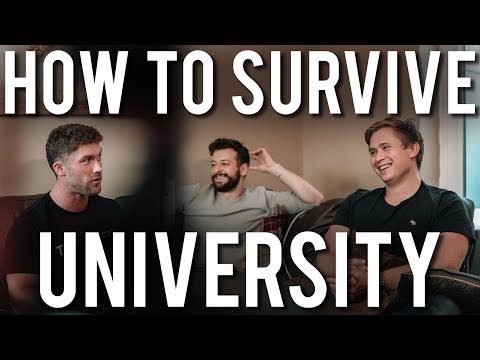
How To Survive University
WatchChris Williamson // 1:37:18
