Beyond The Game: Neil Strauss on Trauma, Enmeshment, and the Evolution of Modern Intimacy
The Long Arc of Personal Evolution
Life is rarely a straight line. For Neil Strauss, the journey from the world’s most infamous pickup artist to a psychologist-adjacent researcher of human trauma represents more than just a career shift; it is a profound case study in the power of intentional growth. When we look at the trajectory of an individual who once defined himself by the mechanics of courtship and now defines himself by the depth of his healing, we see a universal blueprint for how any of us can transcend our past versions. Growth happens when we stop trying to hack the external world and start investigating the internal architecture that drives our choices.
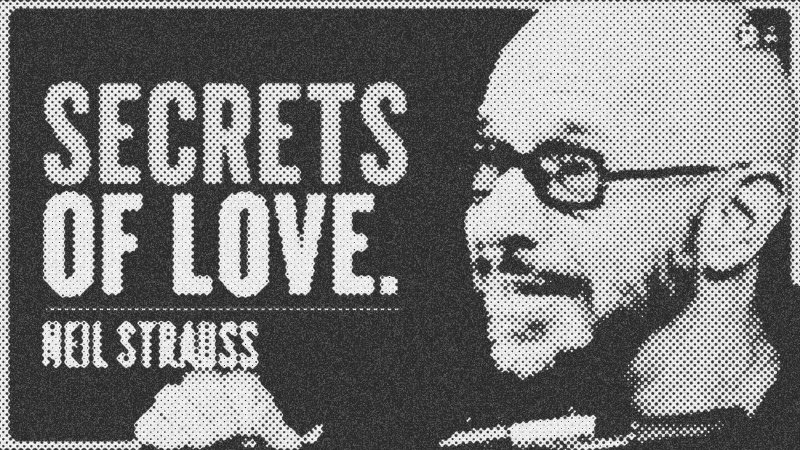
Neil Strauss rose to prominence with The Game, a book that functioned as an anthropological deep-dive into the subculture of pickup artists. While the public often remains tethered to that 20-year-old identity, his private evolution moved through the messy reality of long-term partnership in The Truth, and finally into a state of post-divorce integration. He now models a radical form of co-parenting that defies traditional societal boxes, proving that if we are healthy, we can design relationship structures that serve our unique needs rather than conforming to a rigid cultural template. The goal isn't to find the right "game" to play, but to become the kind of person who no longer needs a mask.
The Architecture of Connection and the Mating Crisis
We currently find ourselves in what some researchers call the "confluent era" of romance, where relationships are maintained only as long as both parties find mutual benefit. While this offers unprecedented freedom, it also introduces a paralyzing paradox of choice. When the digital world offers an infinite scroll of potential partners, the incentive to do the hard work of internal repair diminishes. We have moved from a time of constrained choice, which ironically enabled higher satisfaction through commitment, to an era of hyper-optionality that breeds cynicism.
Within this landscape, movements like the Black Pill community have emerged, focusing on LMS (Looks, Money, Status) as the ultimate arbiters of romantic success. This reductionist view is a safety blanket for the cynical. By convincing oneself that love is a purely transactional market based on unchangeable traits, one avoids the vulnerability of actually trying and potentially failing. However, high-status behavior is not about the car you drive or the symmetry of your face; it is about the story you tell yourself and how that story reflects in your interactions. True competence and security are the underlying needs that people mistake for a desire for money or height. When you embody the core qualities of security and self-worth, the superficial metrics lose their power.
Unpacking the Invisible Strings of Enmeshment
To understand why we struggle in our adult lives, we must look at Enmeshment. While most people understand the trauma of abandonment—where a parent is physically or emotionally absent—enmeshment is its equally damaging opposite. It occurs when a child is forced to meet the emotional needs of the parent. Whether it is a depressed mother looking to her son for happiness or an anxious father using his daughter as a surrogate therapist, the result is the same: the child’s own needs are subjugated to keep the peace.
This creates a specific brand of adult dysfunction. Those raised in enmeshed households often view intimacy as a threat to their freedom. They feel suffocated by affection because, in their childhood, "love" meant being used for someone else's stability. As a result, they often date "projects"—people who need fixing. This allows the enmeshed individual to maintain a position of control while avoiding the terrifying vulnerability of a true peer-to-peer connection. Healing from this requires a radical shift in Locus of Control. Instead of blaming the partner or the culture, we must investigate why we are reactive and how we can reparent ourselves to feel safe in the presence of genuine intimacy.
The Three-Step Formula for Radical Growth
Transformation is not a passive event; it requires a structured approach to un-brainwashing ourselves from the "cult" of our upbringing. Neil Strauss suggests a three-tier modality for those serious about breaking generational patterns. First, one needs deep, intensive workshops like The Meadows or the Hoffman Process. These environments act as an emotional exorcism, allowing individuals to experience who they are without the baggage of their historical wounds. These are not merely "talk therapy" sessions; they are visceral, emotional purges that reset the nervous system.
Second, growth requires weekly accountability. Group therapy is often more effective than individual sessions because there is nowhere to hide. When five peers mirror your behavior back to you, it is much harder to dismiss the feedback as the singular opinion of a therapist. Finally, one must develop "tools in the moment." This includes practices like Nonviolent Communication, which allows us to discharge tension by honoring what is "alive" in the other person rather than descending into defensive combat. By widening the gap between stimulus and response, we move from being reactive victims of our biology to being intentional authors of our lives.
The Power of the Wounded Self
Perhaps the most provocative shift in the pursuit of personal development is recognizing that high achievement is often fueled by low self-esteem. We see this in figures like Winston Churchill or Elon Musk. Churchill, despite leading the world through its darkest hour, was haunted by a father who viewed him as a "social wastrel." Elon Musk describes his mind as a storm that most people would find unbearable. This suggests that "not feeling like enough" isn't a bug in the human system; it can be a feature that drives us to improve the world.
Self-compassion, therefore, is not about reaching a state of perfect self-love where all insecurities vanish. It is about talking to yourself like the parent you needed, rather than the parent you had. It is about accepting that you may never feel like you truly belong, and using that very feeling to be kinder and more observant. When we stop striving for a sanitized version of ourselves and start integrating our wounds into our mission, we find a version of authenticity that is grounded in reality rather than a marketing slogan. Growth is a continuous process of recognizing the strings that pull us and having the courage to cut them, one by one, until we are truly free.
- Neil Strauss
- 15%· people
- Elon Musk
- 10%· people
- Black Pill
- 5%· organizations
- Byron Katie
- 5%· people
- Chris Williamson
- 5%· people
- Other topics
- 60%
The Truth About Women & Relationships - Neil Strauss, World's #1 Pickup Artist
WatchChris Williamson // 1:48:49
