The Wisdom Trap: Why Being Smart Isn't Enough for a Good Life
The Illusion of Intelligence and the Quest for Wisdom
Many of us fall into the trap of equating high cognitive ability with a successful life. We assume that because we can solve complex equations, lead companies, or out-debate our peers, we are naturally equipped to handle the messy, unpredictable nature of existence. However, raw intelligence is merely a high-performance engine; without a steering wheel and a clear sense of direction, it often drives us faster toward a cliff. This is the central challenge of modern growth: recognizing that being "smart" can actually become an impediment to becoming wise.
Wisdom is far more elusive than raw computation power. It involves perspective, empathy, and the humbling realization that the more you know, the more you discover your own ignorance. When we rely solely on our intellect, we become rigid. We think we have the world figured out, and as a result, we stop being teachable. The core problem is that intelligence often fuels the ego, while wisdom requires its dismantling. To grow, we must move beyond the pride of what we know and embrace the discomfort of what we have yet to experience.
The Shoreline of Ignorance and the Necessity of Humility
One of the most profound paradoxes of personal growth is that the further you travel, the more you realize how much terrain remains untouched. As the island of your knowledge grows, so does the shoreline of your ignorance. This isn't a reason for despair; it's a call for humility. True wisdom is a horizon, not a destination. You can look back and see how much progress you have made compared to your younger self, but looking forward, the distance to perfection remains infinite.
This humility is the primary gatekeeper of growth. If you believe you have already arrived, you close the door to new insights. Many high-achievers struggle here because their identity is built on being the person with the answers. To become wise, you must be willing to be the person with the questions. You have to admit that Marcus Aurelius and other ancient philosophies are not just things you read about, but frameworks you must actively test against the friction of real life. Learning from the experiences of others is a shortcut to this humility. Why insist on stubbing your toe on the same rock when others have already documented the pain for you? The ego tells us we are special and the rules don't apply, but wisdom reminds us that the human condition is remarkably consistent across centuries.
Practicing Regulation Over Eradication
There is a common misconception that to be wise—specifically in the Stoic sense—one must become a robot, devoid of emotion. This couldn't be further from the truth. The goal of a well-lived life is not the eradication of emotion, but its regulation. We all feel anger, envy, fear, and elation. The wise person simply refuses to be a slave to those impulses. They create a space between the stimulus and the response.
This regulation is a skill that must be cultivated in the small, insignificant moments of life so that it is available during the catastrophic ones. It is about deciding who is in charge: your impulsive "adapted child" who reacts to old wounds, or your rational, adult self who sees the situation for what it is. Physical practices, such as exercise or difficult manual labor, serve as an excellent training ground for this. When you are cold, tired, and want to quit, you practice the act of saying, "My body feels this way, but my mind is still in command." This internal governance is what allows a person to maintain equanimity while the world around them is in chaos.
The Weight of Moral Character: Lessons from the Hanoi Hilton
To understand the true depth of wisdom, we must look at individuals who were tested in the most extreme conditions imaginable. The story of James Stockdale, a naval officer held as a prisoner of war for seven years, offers a masterclass in resilience and integrity. Stockdale didn't just survive physical torture; he navigated a complex moral minefield. He held secrets that could have altered the course of the Vietnam, and he chose to maim himself—beating his own face with a stool—to ensure he could not be used as a propaganda tool by his captors.
What sustained Stockdale wasn't a belief in his own superiority, but a commitment to the people around him. He understood that he was his brother's keeper. His wisdom was rooted in the realization that if he was only for himself, he was nothing. This shift from the "selfishness of youth" to the "service of leadership" is the hallmark of maturity. Most of us will never face a North Vietnamese prison camp, but we all face moments where our integrity is tested by convenience or careerism. Wisdom gives us the strength to say no to the easy path when the easy path requires us to betray our core values.
Avoiding the Major Blunders and Multiplying by Zero
A common mistake among the highly intelligent is focusing too much on optimizing their strengths while ignoring their catastrophic vulnerabilities. In mathematics, you can multiply a massive number by a series of other massive numbers, but if you eventually multiply by zero, the result is always zero. Life works the same way. You can have a brilliant career, a high-performing diet, and vast wealth, but if you neglect your character or make a single massive moral blunder, you can lose everything.
Many "smart" people fail because they stop doing the repair work on their own psyches. They carry unaddressed childhood trauma or ego-driven blind spots that eventually lead to a "midlife crisis" or a disastrous professional move. They begin to drink their own Kool-Aid, believing that because they were right once on a contrarian bet, they are infallible. Wisdom is the insurance policy against multiplying by zero. it involves constantly checking for the "snakes in the grass"—the small, unaddressed flaws that have the potential to grow into life-altering disasters. It is about having the negative capability to hold two contradictory ideas in your head at once: the confidence to act and the humility to know you might be wrong.
Reclaiming Your Path Through Journaling and Reflection
In a world of constant noise and "life hacks," the most powerful tool for growth remains one of the simplest: the practice of self-reflection. Journaling is not just a way to record events; it is a way to maintain "nodding terms" with who you used to be. It allows you to track your growth incrementally and recognize when you are falling into old, destructive patterns. It provides a mirror for your own mind, helping you see the difference between what you say you value and how you actually behave.
When you feel lost or unmoored by the challenges of life, looking back at your own thoughts from years prior can provide a profound sense of continuity. It reminds you that "this too shall pass." Every triumph and every grief is ephemeral. The wise person understands this transience and uses it to fuel a sense of presence. You don't have to be perfect; you just have to be better at the repair after the rupture. Whether in your relationships or your personal habits, the goal is to shorten the distance between losing your way and finding it again.
The Final Shift: From Knowing to Being
Ultimately, the journey from intelligence to wisdom is a journey from the head to the heart. It is moving from the world of abstract concepts to the world of lived experience. You can read every book by Seneca the Younger, but you aren't a Stoic until you remain calm while your plans are falling apart at the airport. You aren't wise until you can take a compliment with grace rather than rejecting it with false humility.
You are the architect of your own character, and growth happens one intentional step at a time. The work is never finished, and the path is often uncomfortable, but the reward is a life that is grounded, resilient, and deeply meaningful. Stop trying to be the smartest person in the room and start trying to be the most present, the most empathetic, and the most teachable. That is where your true power lies.
- Abraham Lincoln
- 7%· people
- Chris Williamson
- 7%· people
- Elon Musk
- 7%· people
- Epictetus
- 7%· people
- Hanoi Hilton
- 7%· places
- Other topics
- 64%
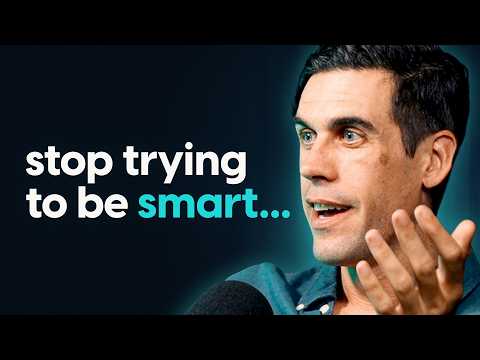
Why Most Smart People Become Stupid - Ryan Holiday
WatchChris Williamson // 1:49:17
