The Anatomy of Inquiry: Decoding the Evolutionary and Neurological Roots of Curiosity
The Hidden Architecture of Human Inquiry
Curiosity is often dismissed as a simple personality trait, a lighthearted itch to know more. However, as Mario Livio reveals, this drive is a complex psychological and neurological system that defines the human experience. It is the engine of our evolution and the foundation of our greatest intellectual achievements. To understand curiosity is to understand the very mechanism that propelled us from the African savannah to the stars.
We often assume curiosity is a singular force. We feel it when we wonder about a neighbor's business or when a scientist spends decades mapping the genome. But these are distinct psychological states. By breaking curiosity down into its core components, we begin to see how it functions as both a survival mechanism and a source of profound joy. It is not just about the desire for information; it is about how our brains process uncertainty, surprise, and the anticipation of discovery.
The Four Pillars of the Inquisitive Mind
Psychologist Daniel Berlyne categorized curiosity into four distinct types, a framework that serves as the bedrock for modern research. The first is perceptual curiosity. This is the immediate, visceral reaction to something that surprises us or contradicts our existing knowledge. It is the feeling of cognitive dissonance when we see something that doesn't belong. This type of curiosity is often rooted in an aversive state—an unpleasant feeling of confusion that we seek to resolve by finding an answer.
Contrasting this is epistemic curiosity. This is the intellectual drive behind scientific research and high-level art. It is the profound quest for the 'why' and 'how.' Unlike the aversive nature of perceptual curiosity, epistemic curiosity is associated with a pleasant state of anticipation. It is the intellectual hunger that keeps us reading a book late into the night or conducting experiments in a lab. It is a proactive search for meaning rather than a reactive attempt to resolve a surprise.
On the other axis, we find diversive curiosity and specific curiosity. Diversive curiosity is our defense against boredom; it is the restless search for stimulation that leads us to check our phones or seek new entertainment. Specific curiosity, conversely, is the focused desire for a particular piece of information, such as remembering the name of a film or a historical date. Every human possesses these four types, but the intensity and frequency of each vary wildly from person to person.
The Neural Conflict: Fear versus Reward
Recent advances in neuroscience, particularly functional MRI studies, have provided startling evidence that different types of curiosity activate entirely different regions of the brain. When we experience perceptual curiosity—that sense of being surprised or confused—the brain's conflict-monitoring centers light up. These areas are associated with unpleasant feelings and anxiety. The brain perceives a gap in knowledge as a problem to be solved, a tension that must be relieved. In this context, curiosity is the tool we use to escape discomfort.
Epistemic curiosity operates on a completely different circuit. When we are driven by the deep desire to learn and understand, the brain's reward system—specifically the areas associated with the anticipation of a positive outcome—becomes active. This is the same neural pathway triggered by the expectation of food or social validation. This suggests that for the lifelong learner, the act of seeking knowledge is inherently pleasurable. It is not just the discovery that feels good, but the journey toward it.
This duality explains why curiosity can feel both like a burden and a gift. It can be the anxiety of not knowing or the thrill of the chase. Recognizing which state you are in can help you manage your mental energy. If you are feeling the aversive pull of perceptual curiosity, focus on resolving the conflict quickly. If you are in the flow of epistemic curiosity, savor the process, as your brain is literally rewarding you for the effort of expansion.
Evolutionary Origins and the Remedy for Fear
From an evolutionary perspective, curiosity was never a luxury; it was a survival requirement. Our ancestors needed to be curious about their environment to find food and avoid predators. However, they faced a constant trade-off between the potential reward of exploration and the existential risk of the unknown. This led to a finely tuned system where curiosity became a primary tool for overcoming fear.
There is a profound psychological truth in the phrase: curiosity is the best remedy for fear. When we are afraid of something, it is often because we lack sufficient information. We fear the 'other'—whether that be a different culture, a new technology, or a career change—because our brains interpret the unknown as a threat. By engaging our curiosity, we replace vague, terrifying projections with concrete facts. When we learn about the stranger or the new industry, the perceived threat often dissolves. Knowledge acts as a stabilizer, turning a chaotic, frightening environment into a navigable landscape.
Case Studies in Infinite Curiosity
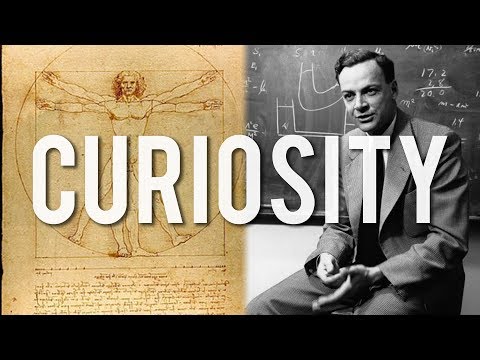
To see these principles in action, we look to the 'curiosity giants' of history. Leonardo da Vinci stands as perhaps the ultimate example. His journals reveal a mind that refused to be siloed. He investigated the flight of birds, the anatomy of the human heart, and the optical properties of shadow with equal intensity. For Leonardo, there was no boundary between art and science; both were simply methods for investigating reality.
In the modern era, Richard Feynman displayed a similar disregard for traditional boundaries. A Nobel-winning physicist, Feynman was also an expert safecracker, a bongo player, and a self-taught artist. He famously claimed that everything is interesting if you look at it deeply enough. This is the hallmark of high epistemic curiosity: the belief that the world is an endless source of fascination if one simply takes the time to ask the right questions.
We also see this in contemporary figures like Brian May. Known globally as the guitarist for Queen, May also holds a PhD in astrophysics, an interest he pursued decades after his musical success began. These individuals remind us that curiosity is not just about what you know, but about the willingness to remain a student of the world regardless of your current level of expertise.
Cultivating the Inquisitive Mindset
While research suggests that curiosity has a genetic component—about 50% according to twin studies—the remaining 50% is determined by our environment and intentional practice. We can strengthen our 'curiosity muscle' through specific strategies. For those raising children, the key is to encourage the process of inquiry rather than just providing answers. When a child asks a question, asking 'Why do you think that is?' encourages them to build their own mental models and test their hypotheses.
For adults, the most effective way to spark curiosity is to find a 'bridge' from an existing interest to a new one. If you are interested in finance but bored by history, looking at history through the lens of economic shifts can make the subject come alive. By attaching new information to something we already care about, we utilize our brain's existing reward structures to fuel the learning process. Curiosity is not a fixed trait we are born with; it is a fire we must intentionally feed. By choosing to be curious, we don't just learn about the world—we change how our brains interact with it, replacing fear with fascination and boredom with wonder.
The Future of Human Curiosity
As we look forward, the role of curiosity will only grow in importance. In a world where information is ubiquitous, the value lies not in knowing facts, but in the ability to ask the right questions and synthesize information across disciplines. The polymaths of the past were not just geniuses; they were people who refused to stop asking 'why.'
Curiosity remains our most potent tool for innovation and empathy. It drives the scientist to solve the next great medical mystery and the neighbor to understand someone from a different walk of life. By embracing our inherent drive to know, we ensure that we continue to grow, not just as individuals, but as a species. The future belongs to the curious, to those who see every unknown not as a threat, but as an invitation to explore.
- Brian May
- 7%· people
- CERN
- 7%· companies
- Daniel Berlyne
- 7%· people
- Fabiola Gianotti
- 7%· people
- Isaac Newton
- 7%· people
- Other topics
- 64%
What Makes Us Curious? | Dr Mario Livio
WatchChris Williamson // 51:11
