The Brutal Evolution of Autonomy: Freedom, Belonging, and the Architecture of Human Resilience
The Threshold of Existence: Lessons from Near-Death
When we discuss growth and mindset, we often focus on the additive—new habits, more knowledge, better systems. However, the most profound psychological shifts often occur at the subtraction of everything we know. Sebastian Junger recently encountered this literal and figurative void. After decades of reporting from war zones, it wasn't a bullet but a ruptured aneurysm in his pancreatic artery that brought him to the brink. Losing three-quarters of his blood volume, Junger experienced what he describes as a 'black pit' pulling him away while his deceased father appeared to welcome him.
This threshold state is more than a medical anomaly; it is a psychological mirror. For an atheist like Junger, the experience challenged the rigidity of materialist worldviews. From a coaching perspective, this highlights a vital truth: our brains are wired for narrative and symbolism even when the lights are going out. Whether this was an 'animal-level' hallucination triggered by low blood oxygen or a glimpse into a hidden dimension, the result was a radical re-centering on the present. Resilience is often born from the realization that we do not 'own' tomorrow; we only ever have this exact moment. When we stop trying to control the future, we find the ultimate freedom in the now.
The Paradox of Choice: Trading Temporal Freedom for Meaning
We often fall into the trap of thinking freedom is the absence of constraints. We imagine that the fewer people who need us, the freer we are. This is a psychological mirage. Junger spent his middle years as a bachelor with 'all the freedom in the world,' yet he discovered that this version of autonomy can feel aimless. At age 55, he shifted his life toward marriage and fatherhood, a move that many see as a surrender of independence.
In reality, this is an exchange of currencies. You can give up 'temporal freedom' (your time) to gain 'economic freedom' through a high-paying job. Or, you can trade the 'safety and stability' of modern life for the 'wilderness freedom' of a 400-mile trek along railroad lines. Junger’s journey from a war reporter sleeping under bridges to a father of two young girls illustrates that the most profound liberation often comes through commitment. Emotional freedom—the kind found in love and responsibility—is boundless. It has no depth and no limits, but it requires the intentional sacrifice of one’s own ego. We must stop viewing commitments as chains and start seeing them as the anchors that allow us to weather the storms of life.
The Mutual Defense Pact: Why Community Is Non-Negotiable
Anthropologically, humans are social primates. We lack claws, fangs, and speed. Our only biological advantage is the group. Sebastian Junger argues that there is a permanent, healthy tension between individual freedom and community belonging. In the Modern Wisdom Podcast, he explores the 'mutual defense pact' of early American settlers. These individuals escaped the oppression of the church and colonial governments for the wilderness, but they immediately had to form strict group norms to survive.
If you were a 14-year-old boy in a 1700s stockade, you didn't have the 'freedom' to be selfish; you carried a rifle. If you refused, you were cast out to certain death. Today, we outsource this survival to the fire department, the police, and a global supply chain. This outsourcing creates the illusion that we don't need anyone. We see people showing up at state houses with guns they didn't forge, wearing clothes they didn't stitch, fueled by gas they didn't drill, all while claiming they are 'self-made.' True self-awareness begins by acknowledging our radical dependence. Resilience isn't about being an island; it is about being a vital, contributing part of a larger whole.
Outrunning, Outfighting, and Outthinking: The Underdog Strategy
How does a small group maintain its autonomy against a massive, powerful foe? Junger identifies three primary mechanisms: run, fight, and think. Historically, groups like the Apache maintained their freedom for three centuries by being mobile and outrunning their enemies. They refused the sedentary life of agriculturalists, who were easily rolled over by the Spanish.
When running isn't an option, you must outfight. Humans are unique in that smaller coalitions can defeat larger ones through sheer intensity and strategy. Junger cites the Montenegrins, who defeated the Ottoman Empire despite being outnumbered 12 to one. However, in modern society, we rarely use bullets; we use brains. This is 'outthinking' the oppressor. Junger looks at the labor movement and the Irish rebels of 1916. These groups won because they utilized lateral networks—often led by women—that the state could not easily infiltrate or decapitate. Success as an underdog requires more than just grit; it requires a sophisticated understanding of how to disrupt the hierarchies of power through communal intelligence.
The Crisis of Leadership: Moral Cowardice vs. Heroic Sacrifice
We are currently suffering from a leadership vacuum that is both psychological and political. In a small-scale tribe, a leader who was a coward or selfish was often killed by their own people. There was no room for fraud. Today, we live in a society of millions where anonymity allows leaders to hide in safe buildings while others take the risks. Junger points to Michael Mallin and James Connolly as examples of heroic leadership. These men were on the front lines, literally bleeding with their soldiers.
In contrast, modern political figures like Mitch McConnell or Dianne Feinstein are often criticized for prioritizing financial enrichment or political preservation over the public good. Real leadership is given from below, not imposed from above. It is rooted in the principle of 'Officers Eat Last.' If a company or a country is suffering, the leaders must experience the negative consequences first. Until we demand leaders who are willing to sacrifice their careers—and their comforts—for the truth, our 'freedom' will remain a fragile, superficial concept. True authority is earned in the trenches, not in the ivory tower.
Conclusion: The Mundane Beauty of Freedom
Ultimately, freedom is not a grand, transcendent state of being. It is mundane. It is the ability to walk along a railroad track and know that, for a few hours, you are the only person in the world who knows where you are. It is the small step to the left that we all take when we eventually transition from life into death. By understanding the brutal history of how our ancestors fought for autonomy, we can better appreciate the 'beloved' community we have today. Growth happens when we stop fleeing from our obligations and start recognizing that our greatest strength is found in our commitment to one another. The mystery of life remains, but the path to a meaningful existence is clear: be in the moment, protect your tribe, and never trade your integrity for a false sense of security.
- Sebastian Junger
- 14%· people
- Apache
- 7%· people
- Dianne Feinstein
- 7%· people
- Donald Trump
- 7%· people
- Irish rebels
- 7%· people
- Other topics
- 57%
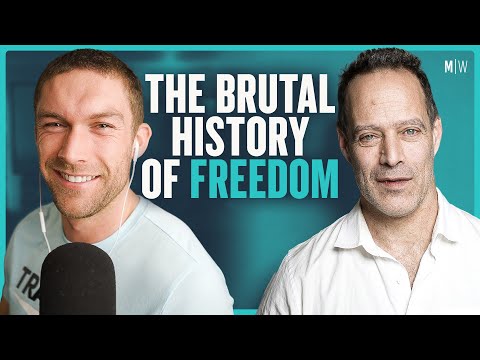
The Brutal History Of Freedom - Sebastian Junger | Modern Wisdom Podcast 396
WatchChris Williamson // 1:13:08
