The Path to Self-Mastery: Navigating the Inner Landscape with Shaolin Wisdom
The Core Challenge: Why We Struggle to Manage Ourselves
Most of us live under the illusion that we are in control of our lives. We plan our careers, we curate our social media feeds, and we manage our teams at work. Yet, as Shi Heng Yi points out, many of us are essentially strangers to our own internal machinery. We focus on managing external people and circumstances before we have learned the first thing about managing the one person we carry with us through every single experience: ourselves.
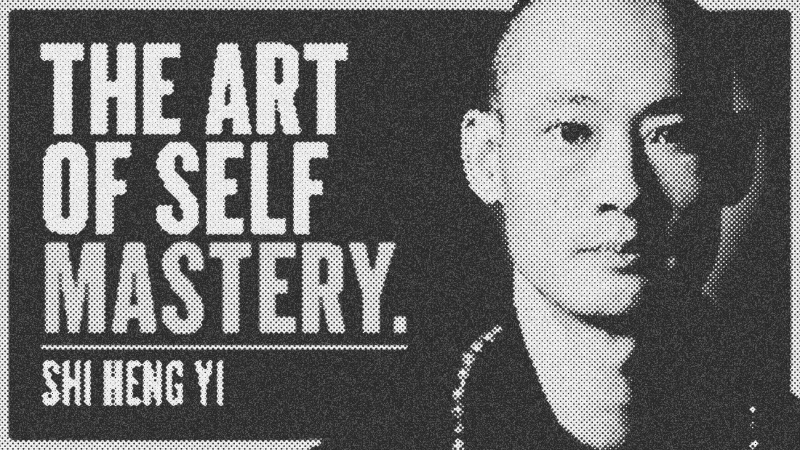
Self-mastery isn't about attaining a fancy title or reaching a specific destination. It is the realization that no matter where you move or what job you take, your dark sides, your pain, and your triggers follow you. We spend years at university or in the gym training our intellect and our muscles, yet we neglect the most fundamental training of all—the training of the mind. If we don't understand the layers of our own suffering and mental cycles, we remain reactive puppets, pulled by the strings of external stimuli and ancient habits.
Core Principles: Understanding Your Mental Diet
We have become a society obsessed with physical health. We obsess over organic vegetables, veganism, and biological quality. But what about the quality of what we feed our minds? Shi Heng Yi introduces a profound perspective: your thoughts are the food for your mental state. If you wake up and immediately nourish competitive thoughts, stress, or the feeling that you are constantly "behind," you are poisoning your internal ecosystem before the day has even begun.
A central pillar of Shaolin Temple Europe philosophy is the ancient insight that you are not your body and you are not your mind. This sounds abstract, but it is deeply practical. If you were your body, you could simply tell it to stop aging or stop feeling pain. If you were your mind, you could decide exactly what your next thought will be. The fact that you cannot do these things proves that there is a distinction between the "I"—the observer—and the biological and mental structures we inhabit. These structures carry conditioned information, often passed down through generations, which Modern Wisdom host Chris Williamson explores through the lens of epigenetics. Understanding this allows you to detach from your suffering. You begin to see your reactions not as who you are, but as patterns playing out on a screen.
The Trap of the Achievement Cycle
We often fall into a repetitive loop: wanting, pursuing, achieving, and then immediately wanting again. This is the cycle of the conditioned identity. We think that getting the new phone, the degree, or the job title will provide sustainable fulfillment. It won't. Shi Heng Yi describes this as running after things that are forgotten within a week of attaining them.
To break this cycle, we must find the balance between being and doing. Doing is necessary—we must pay bills and feed families. But constant doing without being leads to a life without peace. Conversely, being without doing leads to a life without progress. True self-mastery is the ability to hold a moment of achievement, to be proud and still, before consciously deciding what is worth your limited lifetime. It’s the difference between being driven by a compulsive pattern and making a conscious choice to invest your energy into a vision that actually matters.
Actionable Steps: Practices for Inner Clarity
Transitioning from theory to transformation requires consistent practice. Shi Heng Yi emphasizes that the best time to build your resolve is when things are going well. If you wait for a catastrophe to start meditating, you are playing on "hard mode."
- Physicality as a Gateway: Start with the body. Whether it is Tai Chi, Qi Gong, or Kung Fu, moving the body with awareness is the first step. If you aren't aware of the physical sensations you carry, you will never be aware of the subtle traumas hidden in your mind.
- The Movie Experiment: Practice detaching from your identity. Imagine you are jumping out of yourself and watching the character of "you" in a movie. Observe the patterns. What triggers this character? What makes them repeat mistakes? This observer perspective is the beginning of freedom.
- Commit to the Schedule: Discipline isn't just about doing more; it's about sticking to what you committed to, regardless of how you feel. Feelings are unstable; they change with the weather. A schedule provides a container for your goals that is independent of your fluctuating mood.
- Selective Focus: In an age of distraction, practice doing one thing at a time. If you are writing an email, don't listen to music or check your phone. Mobilize your total energy into that one task. Where attention goes, energy flows.
Facing the Shadow: The Courage to Heal
Perhaps the most difficult part of self-mastery is dealing with regret and the "dark stuff" we hide from ourselves. Many people carry old baggage—frustrations, hurts, and traumas—that they suppress. Shi Heng Yi warns that this locked energy eventually manifests as physical sickness or mental distress.
Healing requires two things: forgiveness and letting go. You must forgive others, but more importantly, you must forgive yourself for your past mistakes. This isn't easy or comfortable. It requires the bravery to look at the negative things you have done or experienced and acknowledge them without running away. In Shaolin Temple Europe training, suffering in practice always leads to a greater victory afterward. The same applies to your inner work. Facing your shadow is painful, but it is the only way to reach a state of ease that is independent of external circumstances.
Encouragement: Becoming the Guide in a Burning House
When you start this work, you aren't aiming to become a superhuman who never feels anger or sadness. Instead, you are aiming to become less compulsive and less reactive. The world around you will always be in some state of turmoil. Governments will make decisions you dislike, and people will disappoint you. If your peace depends on the world being perfect, you will never be at peace.
Self-mastery allows you to stay stable while the house is burning. Because you are at ease, you can actually be of service to others. You become the guide who can lead people out of the fire because you haven't lost your own temper or clarity in the smoke. This is the greatest gift you can give the world: a version of yourself that is no longer puppeted by the past, but is fully present and intentional.
Concluding Empowerment
Your path to growth happens one intentional step at a time. It begins with the simple realization that the answer is already out there, waiting for you to ask the right question. You have the inherent strength to navigate your dark sides and emerge with a mind that is clear, a body that is aware, and a heart that is at peace. Don't wait for the next crisis to start. Look inside, face what is there, and recognize that the freedom you seek isn't found in doing whatever you want—it's found in mastering the one who wants.
- Shi Heng Yi
- 42%· people
- Shaolin Temple Europe
- 17%· organizations
- Chris Williamson
- 8%· people
- Kung Fu
- 8%· personal growth
- Modern Wisdom
- 8%· tv shows
- Other topics
- 17%
Freedom Doesn’t Mean Doing Whatever You Want - Shaolin Monk Shi Heng Yi
WatchChris Williamson // 59:02
