Beyond the Rule of Fight Club: A New Blueprint for Modern Masculinity
The Architecture of Suppression and the One Rule of Men
We often navigate our lives according to unwritten scripts, and for men, the most pervasive script is one that mirrors the first rule of Fight Club: you do not talk about it. Specifically, you do not talk about suffering, struggling, or the internal collapse that occurs when life hits the ringer. This "One Rule" suggests that strength is synonymous with suppression. If your relationship ends, if your career falters, or if your sense of self begins to erode, the cultural mandate is to push it down. We’ve been conditioned to believe that if we can avoid these emotions for long enough, we will somehow emerge stronger on the other side.
However, this seeking of strength through suppression is a profound psychological trap. As a psychologist, I see how this compression creates a part of the self that actively works against the whole. When we treat our internal world as an enemy to be conquered, we create a brittle version of strength. While there is a grain of truth in the necessity of stoicism—being the "strongest person at your father's funeral" as Jordan Peterson suggests—problems arise when this becomes our only modality. When stoicism shifts from a situational tonic into a daily toxin, it doesn’t just hide the pain; it severs our connection to our own resilience. We aren't actually becoming stronger; we are just becoming more isolated within ourselves, living in an existential aloneness that eventually leads to a catastrophic bottoming out.
The Ghosts of War and the Shadow of Competition
To understand why men struggle to break this rule, we must look at the generational and evolutionary echoes that define the male experience. Much of what we consider "traditional masculinity" is actually a malignant emotional inheritance from the World Wars. For nearly a century, huge cohorts of men were sent into lethal environments where hyper-suppression was a survival requirement. When they returned, they were expected to simply "mow the lawn" and sell dishwashers, carrying the weight of seen and unseen horrors. This hardness, where vulnerability was quite literally the enemy, was passed down from father to son across at least three post-war generations.
Compounding this is the inherent nature of male competition. Men often transact in the currency of status, and in a competitive hierarchy, showing weakness is seen as handing your opponent a weapon. Even among best friends, an unconscious sizing-up occurs. Because status is a game you lose the moment you admit you're playing it, men withhold their financial, sexual, or emotional struggles to maintain their position within the tribe. This creates relationships that are a mile wide but an inch deep. We see the rise of Modern Wisdom and other introspective platforms because there is a desperate hunger to move past this surface-level existence, yet the fear of losing status keeps many men locked in a silent struggle with their own "shadow."
The Myth of Male Vulnerability and the Double Standard
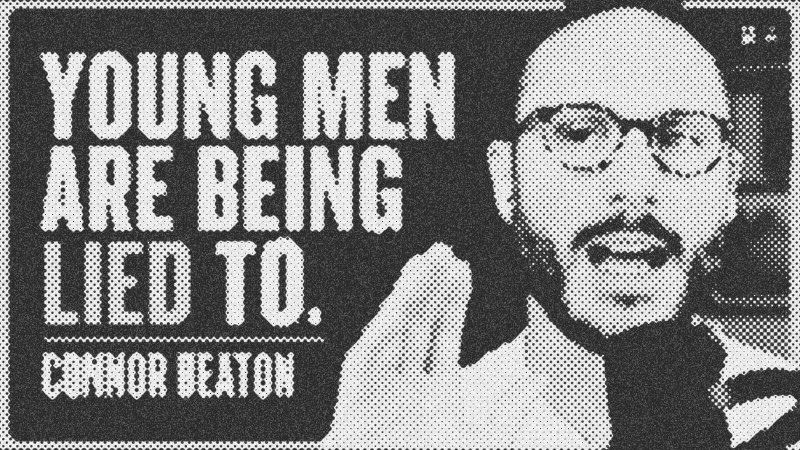
There is a common societal narrative today that suggests all male problems would vanish if men were simply "more vulnerable." This is what Connor Beaton calls the "Myth of Male Vulnerability." While it sounds compassionate, it often functions as a female-oriented solution to a male-specific problem. The reality is that the world—and often the women in it—is frequently unprepared for the reality of a man’s raw emotional expression. Many women, having grown up with fathers who never showed weakness, find a man’s sudden emotional collapse foreign or even frightening.
Furthermore, the data surrounding male vulnerability is sobering. Research mentioned by Chris Williamson notes that in the United Kingdom, an overwhelming 92% of men who took their own lives were actually in therapy, and 80% had been labeled as "low risk." This suggests that our current therapeutic models, which often treat men as "defective women" who just need to talk more, are failing to capture the nuance of male distress. Men are often met with a zero-sum view of empathy: if we focus on men's issues, we must be taking away from women's progress. This cultural stunting forces men into a conundrum where they are told to open up, but then face social or romantic consequences when they do. The real request from society is often not vulnerability, but rather a performative emotionality that men find increasingly difficult to navigate.
The Fatherless Void and the Loss of Initiation
One of the most significant structural challenges facing modern men is the "vacancy" left by the absence of father figures and elders. With one in four children growing up in fatherless households and an education system dominated by female perspectives, many boys reach adulthood without ever being influenced by a healthy, integrated man. Historically, masculinity was modeled and initiated. The "men of the tribe" would take the boys and put them through processes that taught them how to handle aggression, power, and grief.
Without these rites of passage or mentors like Carl Jung to guide them through the "shadow," young men often find themselves in a state of "over-validation" from the feminine. They learn to be "nice guys" who equate goodness with acquiescence, or they swing into reactive opposition because they have no stable masculine boundary to push against. A father’s role is often to provide structure, order, and Rough and Tumble play. When that is missing, the boy never learns the edges of his own strength. This creates a generation of men who are either afraid of their own power or who use it in destructive, unrefined ways because they never had a man show them the difference between being a monster and being a man who has his monsters under control.
Performance, Potency, and the Bedroom Minefield
Nowhere is the pressure of performance more acute than in the sexual lives of men. There is a persistent expectation that men should be "sexual protagonists"—always ready, always proficient, and always dominant. However, we are living in a landscape of high stress and low testosterone. As Connor Beaton points out, many men are in a constant state of sympathetic nervous system dominance (stress), which is physiologically incompatible with sexual function.
There is also a fascinating disconnect in desires. Studies by Aella suggest that on average, women desire more sexual dominance than men feel comfortable providing. This is likely due to the "me too" headlines and the fear of being labeled as aggressive or predatory. Men are trying to thread a needle through a minefield of conflicting messages: be more dominant, but don't be aggressive; be vulnerable, but don't be weak. This confusion is toxic to masculine potency. When men like Chris Williamson share their journey of optimizing their physiology—doubling testosterone levels and seeing the resulting shift in mood and energy—it highlights how much of the modern "male crisis" is a convergence of psychological confusion and physical depletion. We cannot expect men to be resilient and clear-headed if their biological foundations are in the toilet.
Taking the First Step: Confession and Community
If you find yourself nodding along, feeling that weight of the "One Rule," the path forward requires a radical shift in strategy. Growth doesn’t happen in isolation; it happens through confrontation. The first step, as Carl Jung and many spiritual traditions suggest, is confession. This isn't about wallowing; it's about bringing your "internal truth" onto the table where it can be worked with. You must find a space—a men's group, a trusted mentor, or a focused therapeutic environment—where you can break the rule of silence.
Start by identifying your maladaptive coping mechanisms. Are you using weed, pornography, or late-night distraction to avoid the reality of a job you hate or a relationship that is failing? Don't try to change everything at once. Replace one destructive habit with a generative one. Seek out "iron that sharpens iron." We are not meant to process grief or hardship in isolation. By building deep-rooted relationships with other men, you create a foundation of belonging that allows you to face the challenges of the world with a sense of assuredness. True strength is not the absence of struggle; it is the capacity to confront your shadow and integrate it into a life of purpose, one intentional step at a time.
- Carl Jung
- 11%· people
- Chris Williamson
- 11%· people
- Connor Beaton
- 11%· people
- Aella
- 6%· people
- Austin
- 6%· places
- Other topics
- 56%
Advice To Men Who Are Struggling - Connor Beaton
WatchChris Williamson // 1:33:23
