The Agency Myth and the Great Disconnect: Navigating Modern Identity, Fertility, and the Future of Connection
The Fragility of Choice and the Trap of Digital Commodification
We live in an era that worships at the altar of personal choice, yet we are increasingly blind to how those choices can lead to a psychological dead end. The rise of digital platforms like OnlyFans has been marketed as the ultimate expression of female agency—a way for women to seize control of their sexuality and financial destiny. However, this narrative often masks a deeper vulnerability. When we look at the high-profile cases of Bonnie Blue and Lily Phillips, we see more than just entrepreneurs; we see individuals navigating a hyper-exposed reality that mimics the psychological toll of abusive relationships.
This isn't just about moralizing; it’s about the archaeology of a reputation. In the marriage market, a digital footprint in the sex industry functions much like a criminal record does in the job market. It is a permanent marker that follows an individual, and more importantly, their future children, into every room they enter. The "easy money" promised by these platforms often comes at the cost of long-term social capital. Most participants earn a pittance while assuming the same catastrophic reputational risks as the top 1% of earners. This trade—observable metrics like bank balances for hidden metrics like self-worth and future security—is a fundamental miscalculation that many young women are making under the guise of liberation.
Rethinking Agency as a Personality Trait
We often speak of agency as if it is a universal human constant, but it may be more accurate to view it as a personality trait distributed along a bell curve. High-agency individuals like Elon Musk bend the world to their will, but they are the outliers. Most people naturally follow established life scripts, and historically, those scripts provided the guardrails necessary for a functioning life. When we dismantle these guardrails in the name of total freedom, we don't necessarily empower the average person; we often leave them adrift.
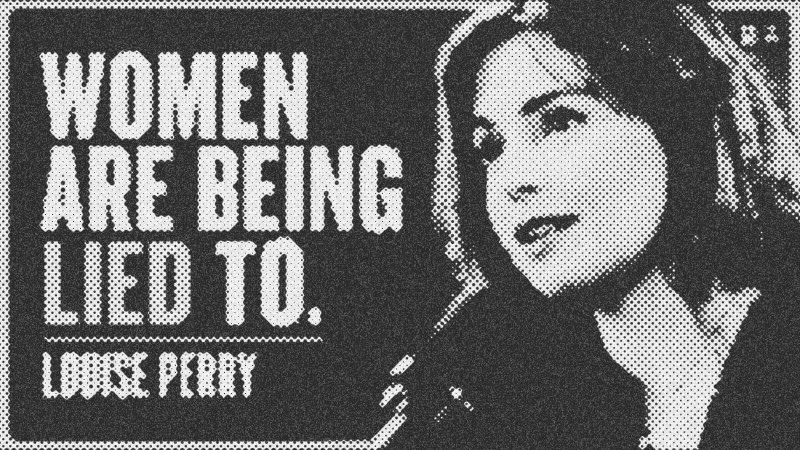
Louise Perry suggests that the modern obsession with designing one's life from first principles assumes a level of wisdom and foresight that most of us simply do not possess in our twenties. The guardrails of the past—marriage, community expectations, and religious frameworks—understood human nature better than many individuals understand themselves. By removing these "paternalistic" oversights, we have created a environment where people are free to make choices that are maladaptive to their long-term happiness, such as delaying family formation until their reproductive window is nearly closed.
The Coordination Problem and the Marriage Recession
Lyman Stone identifies the current decline in marriage and fertility not as a rejection of children, but as a massive coordination problem. The data suggests that once people get married, they generally still want and have children. The bottleneck occurs because young people are failing to couple up in their twenties. This is driven by a lack of "costly signals" from young men. In previous generations, military service or early home ownership signaled to women that a man was reliable and capable of providing resources during the vulnerable period of pregnancy and early motherhood.
Today, extended adolescence—driven by the devaluation of university degrees and the skyrocketing cost of housing—prevents men from sending these signals until much later in life. Simultaneously, women have become more successful in education and early-career earnings. This creates a mismatch: women naturally seek partners who are at least as competent and resourceful as they are, but the pool of such men in their own age bracket is shrinking. This "mating gap" leads to the SoHo House phenomenon, where high-achieving women in their late twenties find themselves frustrated by a lack of mature, committed partners, ultimately leading to further delays in family formation.
The Politicization of the Cradle
Discussing declining birth rates has become a minefield of political accusations, often dismissed as "right-wing" or "fascist." This reaction stems from a fundamental conflict between universalist and particularist worldviews. The left often views any focus on in-group preference—caring more about one's own community or country's future—with suspicion. However, every society has a vested interest in its own survival. The current demographic collapse is an "Almighty Bottleneck" that will test the survival of modern infrastructure.
If the only groups currently maintaining high fertility are those who have rejected modernity—such as the Amish or Ultra-Orthodox Jews—we face a terrifying question: Can the high-tech, medicalized world we value survive if the people capable of maintaining it aren't the ones having children? The tragedy of the fertility crash isn't just a loss of numbers; it's the potential loss of the very technology, like antibiotics and C-sections, that has ended the era where 50% of children died before adulthood. We are currently selecting for cultures that prioritize family over individual liberation, and while this may ensure the survival of the species, it may not ensure the survival of the modern world as we know it.
Parenting in the Age of Neuroticism and Performance
Motherhood in the 21st century has become a high-stakes performance, often colored by extreme neuroticism. This trait, while evolutionarily adaptive for spotting predators (the "snake on the floor"), has become a barrier to entry for many. The pressure to be an "optimal parent" creates a cycle of anxiety that discourages people from having more than one child, if any. We are witnessing a shift where the most neurotic individuals—those most worried about climate change or economic instability—are opting out of the gene pool entirely.
This means we are effectively selecting for a future population that is more "chill" and less concerned with global catastrophes. In the short term, however, this makes parenting feel lonely and insurmountable. The loss of the "village" means that parents are trying to recreate traditional life unilaterally, which often leads to exhaustion and isolation. True traditional living was never about a nuclear family in the woods; it was about a dense web of genetic relatives who shared the burden of childcare. Without that coordination, modern parenting remains a grueling marathon that few feel equipped to run.
Conclusion: The Search for a New Integration
The challenges we face—from the hollow promises of the digital sex trade to the plummeting marriage rates—are symptoms of a society that has optimized for short-term desire at the expense of long-term meaning. We cannot return to the 1950s, but we must find a way to re-integrate the wisdom of the past with the realities of the present. This requires recognizing that total agency is a myth and that some guardrails are necessary for human flourishing. The future belongs to those who can solve the coordination problem of marriage and family while maintaining the technological miracles of the modern age. Growth happens one intentional step at a time, but we must be sure we are stepping toward a future that actually has people in it.
- Amish
- 8%· people
- Andrea Hines
- 8%· people
- Bonnie Blue
- 8%· people
- Daniel Sloss
- 8%· people
- Elon Musk
- 8%· people
- Other topics
- 58%
Why So Many Women Feel Lost in Their 30's - Louise Perry
WatchChris Williamson // 1:29:01
