The Possible Mindset: Breaking the Glass Ceiling of Limiting Beliefs
The Chasm of Comfortable Complacency
Most people spend their lives navigating a narrow band of existence. On a scale of one to ten, they hover perpetually between a four and a six. This is the zone of comfortable complacency. It is the job you don't love but don't hate enough to quit. It is the relationship that lacks passion but provides just enough security to avoid the pain of loneliness. We have become experts at hedging against the 'ones'—the moments of heartbreak, failure, and physical agony—but in doing so, we unintentionally strip the 'tens' off the table. You cannot have the peak experiences of human existence without being willing to risk the valleys.
Colin O'Brady refers to this as a life of quiet desperation. In our modern world, we are insulated by conveniences. We move from air-conditioned homes to heated car seats, distracted by the constant dopamine hits of social media. This insulation creates a fragile spirit. When you never face true adversity, your perspective on what is possible shrinks. You begin to mistake your current comfort for your maximum capacity. Breaking out of this chasm requires an intentional invitation to discomfort. It requires a realization that the things we fear—the 'ones'—are often the very catalysts that propel us toward our greatest achievements.
The Possible Mindset vs. Limiting Beliefs
Our greatest barriers are rarely physical. They are the stories we tell ourselves about what we can and cannot do. These are not 'limiting truths' or 'limiting facts'; they are limiting beliefs. A belief is something that can be reoriented and rewritten. The distinction is critical. If you believe you lack the time, money, or talent to pursue a dream, you have placed a glass ceiling over your potential. This ceiling is imaginary, yet it feels as solid as concrete until you choose to shatter it.
Colin O'Brady discovered the power of a Possible Mindset in a hospital bed in Thailand. After a horrific accident involving a flaming jump rope, he was left with third-degree burns over 25% of his body. Doctors told him he would likely never walk normally again. His mother, however, refused to accept that narrative. She dared him to dream of a future beyond the bandages. He chose to visualize crossing the finish line of a triathlon. This wasn't just optimism; it was a radical shift in his internal architecture. By focusing on what was possible rather than what was probable, he was able to endure the grueling, painful process of learning to walk again. Eighteen months later, he didn't just finish the Chicago Triathlon; he won it. This victory was won in his mind long before it was won on the pavement.
The Architecture of Endurance: Lessons from Antarctica
Antarctica is a place that does not care about your feelings. During his solo, unsupported crossing of the continent, Colin O'Brady faced temperatures of minus 40 degrees and a sled weighing 375 pounds. On the first day, he found himself in tears, barely able to move his gear a quarter of a mile. This is the moment where most people quit. The voice of the 'loser' inside the head becomes a roar, listing all the reasons why the goal is impossible.
Survival in such environments depends on the ability to move from the macro to the micro. When the finish line is a thousand miles away, thinking about the end is paralyzing. You have to focus on the 'wooden chair' moment—the next single step. Endurance is built on consistency over time, not sudden bursts of inspiration. It is the discipline to get out of the tent when the wind is screaming at 60 miles per hour and the visibility is zero. Colin O'Brady notes that his competition with Louis Rudd was a vital catalyst. Even though they were alone, the knowledge that another human was out there pushing the limits forced both men to recalibrate their own perceived ceilings. Competition, when framed correctly, is a tool for mutual elevation.
The 12-Hour Walk: A Prescription for Clarity
To bridge the gap between the average life and a life of purpose, Colin O'Brady developed a methodology called the The 12-Hour Walk. This is not an exercise in athleticism; it is a laboratory for the mind. The rules are simple: walk out your front door, put your phone on airplane mode, and spend 12 hours in silence and solitude. No music, no podcasts, no distractions.
In our noise-polluted society, we have lost the ability to be alone with our thoughts. We use technology to escape the discomfort of our own internal dialogue. The The 12-Hour Walk forces you to confront your limiting beliefs head-on. Around hour five or six, your legs will tire, and your brain will begin to bargain with you. It will tell you that this is stupid, that you've done enough, and that you should go home. If you can push through that mental barrier, you reach a state of clarity and peace that is inaccessible through any other means. This practice is a 'reboot' for the human spirit. It teaches you that you are capable of much more than your brain's protective mechanisms suggest. By conquering one day, you prove to yourself that you can conquer the narratives that hold you back from your 'Everest.'
Integrating Resilience into Daily Life
You do not need to walk across Antarctica to experience a profound transformation. Growth happens in the 'region beta'—the space where things are bad enough to force a change but not so comfortable that you stay stuck. We often wait for a catastrophe to move us, but true resilience is the choice to move before the crisis hits. It is about stacking small 'pebbles' of effort every day.
Your greatest power lies in your inherent strength to navigate challenges. Whether you are recovering from a physical injury or trying to escape the stagnation of a 'five out of ten' life, the path forward is the same: recognize your limiting beliefs, adopt a mindset of possibility, and take the first intentional step. Your 'song' shouldn't stay inside you. Life is meant to be lived at the tens, with a full appreciation for the ones that got you there. The summit is just a collection of small rocks; your life is a collection of small, courageous choices.
- Colin O'Brady
- 28%· people
- The 12-Hour Walk
- 11%· products
- Antarctica
- 6%· places
- Chicago Triathlon
- 6%· products
- Endurance
- 6%· products
- Other topics
- 44%
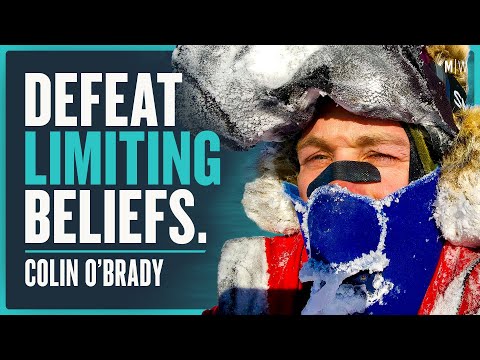
The Man Who Walked Across Antarctica - Colin O’Brady
WatchChris Williamson // 1:05:36
