Hormozi warns most people stay in comfortable misery way too long
The Tragic Comfort of the Mildly Bad Life
Most people do not ruin their lives through spectacular, explosive failures. Instead, they slowly dissolve them through a series of comfortable compromises. This quiet tragedy is best understood through a cognitive phenomenon known as the Region Beta Paradox. Originally coined by researcher Daniel Gilbert, the paradox explains why humans are often slower to recover from mild stressors than from intense ones. If you have to travel a distance of under a mile, you walk; if the distance is greater, you drive. Paradoxically, you arrive at your destination faster when the journey is longer because the severity of the distance triggers a change in your mode of transport.
Apply this to human behavior, and the implications are devastating. When a situation is catastrophic—such as a sudden job loss, a dramatic betrayal, or a physical injury—it forces immediate adaptation. The sheer weight of the crisis provides the activation energy required to make a massive change. However, when a situation is merely mediocre, we languish. We stay with a partner we do not love because they are not physically abusive. We keep a job we despise because the boss is moderately polite and the paycheck covers the rent. This is the zone of comfortable complacency.
Alex Hormozi argues that many individuals would actually be far better off if their lives were significantly worse. If your living situation were completely intolerable, you would move. If your business were losing thousands of dollars a day, you would pivot or shut it down. Instead, millions of people get trapped in a lukewarm purgatory, living an "okay" life that acts as a velvet cage. The mildness of the discomfort prevents the activation of our psychological defense systems, leaving us to slowly waste our most precious asset: time.
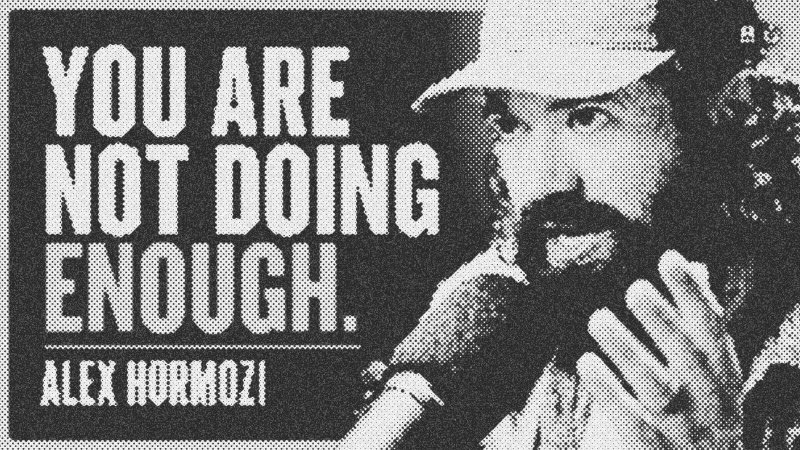
To break free from this complacency, we must cultivate absolute intellectual honesty. The average person is obese, has less than a thousand dollars in their savings account, and is highly likely to end up divorced. If you look around and see that your daily habits, your risk tolerance, and your choices mirror those of the collective majority, you are statistically guaranteed to achieve the exact same average results. Independent thinking is not a luxury reserved for the elite; it is a survival mechanism. It is a muscle that must be worked daily. In the beginning, flexing this muscle feels incredibly unnatural—almost like trying to move your ears. But with consistent practice, independent decision-making becomes your default operating system, and the automated, autopilot behavior of the crowd begins to look like absolute madness.
The Crippling Tax of Unmade Decisions
There is a hidden cost that drains human potential faster than lack of skill, lack of capital, or bad luck: the accumulated weight of unmade decisions. Every time you delay a choice—whether it is ending a toxic partnership, firing a disruptive employee, initiating a difficult breakup, or simply answering a high-stakes email—you pay a continuous, compounding toll on your mental bandwidth. This is the concept of "anxiety cost."
Your brain is a supercomputer with a highly limited amount of random-access memory (RAM). When you carry an unmade decision, your mind plays out endless hypothetical scenarios in the background. What if I leave? What if I stay? What what will Tom think? How will my father react? This mental hamster wheel runs continuously, consuming vital cognitive resources that should be channeled into creative output, deep focus, and strategic execution. The moment you make the decision, you reclaim that bandwidth. Even if the decision is difficult or painful, the loop is closed, the energy drain stops, and your mind can finally reset.
Consider the difference in operational speed between a typical individual and a high-agency performer. The average person takes a week to make a single major decision. They solicit opinions from friends, weigh hypothetical outcomes, and procrastinate to avoid discomfort. Over a month, they might make four key decisions. Conversely, a high-performing leader makes those same four decisions in four consecutive days. By compressing the timeline from decision to action, they move through life at seven to ten times the speed of the average person. While the average person is still debating their first move, the high-agency individual has already made ten moves, failed seven times, learned three crucial lessons, and advanced their position.
This speed is not a product of recklessness; it is a product of understanding that commitment is defined by the elimination of alternatives. The Latin root of the word decision is decidere, which literally means "to cut off." True decision-making is not a gentle exploration of options; it is a violent severing of safety nets. Until you completely eliminate alternative escape routes, you are not committed. You are merely playing. High performers do not wait to feel ready or comfortable. They make the choice, burn the ships, and force themselves to adapt to the new reality because they know that the pain of a hard conversation is temporary, but the anxiety cost of an unmade decision is an endless tax on the soul.
Slaying the Parent Demon to Build High Agency
For many, the single greatest obstacle to personal freedom is not societal expectation or financial limitation, but the lingering ghost of parental approval. We carry a booming voice in the background of our minds—a paternal or maternal authority that dictates what constitutes a respectable career, a safe relationship, and a worthy life. Slaying this dragon is the primary initiation ritual of adulthood.
To build true agency, one must be willing to endure the profound discomfort of being misunderstood, criticized, or even disowned by those who raised them. When Hormozi made the decision to quit his prestigious consulting job and drive across the country to start his first gym, his father vehemently disapproved. The tension was so intense that Hormozi could not even bring himself to have the conversation face-to-face; he waited until he was physically driving through Ohio, states away, to break the news. He was terrified of the disapproval, yet he realized a devastating truth: the moment of his father's highest pride in him was the moment Hormozi was the most deeply depressed.
This paradox is a common experience for high-potential individuals. Parents often optimize for safety, prestige, and predictability. They want you to live a life they can easily explain to their friends at dinner parties. But safety is the enemy of greatness, and predictability is the death of passion. If you live your life seeking to maximize their pride, you are essentially outsourcing the architecture of your existence to someone who does not have to live inside your mind. You are trading your internal peace for their external approval.
Slaying this dragon requires a massive frame shift: realizing that those who criticize your path are often projecting their own unfulfilled potential. When parents, peers, or friends attempt to pull you back into conformity, they are not doing so out of malice. They are doing so because your courage highlights their complacency. Your willingness to step out of the herd forces them to look at the dreams they abandoned. When you realize that their anger is actually deep-seated regret dressed up as concern, you can view them with empathy rather than resentment. You can understand, and as Blaise Pascal famously noted, to understand is to forgive. But understanding does not mean compliance. You must leave the state—either literally or metaphorically—to build your own stack of undeniable proof.
The Dark Triad of High Performance
There is a polite myth in modern self-improvement culture that great achievers are fueled entirely by sunshine, passion, and a healthy desire for self-actualization. This is a complete lie. When you look closely at the individuals who achieve historic levels of success, you find they are rarely driven by well-balanced, peaceful motivations. Instead, they are fueled by a potent, highly volatile chemical mix: a superiority complex, a crippling sense of insufficiency, and extraordinary impulse control.
These three traits form an incredible psychological engine:
- The Superiority Complex (The Cheese): An absolute, unshakeable belief that you are destined for greatness. It is the conviction that you are capable of achieving things most people deem impossible, that you belong at the top, and that your potential is limitless. This is the positive pull that draws you toward massive targets.
- The Crippling Sense of Insufficiency (The Cat): A deep, terrifying fear that you are fundamentally not enough. It is the constant whisper that you might be a coward, a failure, or a worthless piece of waste. This is the negative push that runs you away from mediocrity. It is the starved rat pulling harder because it smells the cheese in front of it and the cat behind it.
- Extraordinary Impulse Control: The ability to lock yourself in a room and focus on a single, boring task for years without needing immediate gratification. It is the capacity to say "no" to the thousand flashing lights of distraction in order to protect your singular direction.
This combination is highly toxic if left unmanaged, but it is undeniably effective for generating massive output. Many high performers spend their entire lives trying to cure their insecurities, not realizing that those very insecurities are the fuel that built their empires. The key is not to eliminate the pain, but to learn how to use it rather than letting it use you.
This is the fundamental difference between the hero and the villain. Both characters have the exact same backstory: pain. The villain experiences trauma and says, "The world hurt me, so I am going to hurt the world back." The hero experiences the exact same trauma and says, "The world hurt me, so I am going to make sure the world never hurts anyone else like this." The villain is used by their pain; the hero uses it as raw material for alchemy. If you have a chip on your shoulder from childhood bullying, a broken home, or severe disappointment, do not waste energy trying to pretend it does not exist. Twist the knife in your own heart, harness that dark energy, and use it as rocket fuel to escape the gravitational pull of your current circumstances.
The Illusion of the Arrival and the Reality of the Toil
One of the most persistent lies we tell ourselves is: "When I achieve X, I will finally be happy." We construct elaborate, conditional equations for joy, assuming that some external milestone—a certain net worth, a specific title, a perfect relationship—will permanently cure our internal restlessness. But the human brain is not wired for arrival; it is wired for pursuit.
Every time you hit a long-sought-after goal, you will experience a brief, fleeting spike of dopamine, followed almost immediately by a profound sense of nothingness. The finish line dissolves the moment you cross it. If you have ever run an all-nighter with a team, eating cold pizza at 3:00 AM to finish a project, you know this truth. In retrospect, the part of that experience you cherish was not the moment you submitted the file; it was the struggle, the camaraderie, and the shared exhaustion of the kitchen table. The reward was the toil.
To survive the long, grueling arc of a creative or entrepreneurial life, you must learn to fall in love with the work itself. High-performing individuals become experts because they learn to derive deep satisfaction from the mundane, repetitive actions that others find boring. They do not work hard to achieve a result; they achieve a result because they love the physical sensation of trying hard. They measure success by input, not output.
When Hormozi wrote his book 100M Leads, he did not just throw together a quick guide to capitalize on his brand. He spent six hours a day, from 6:00 AM to noon, every single day for two years writing it. He completed nineteen drafts and four full end-to-end rewrites. By the time the book was released, he was not anxious about the public reception because he had already won. He had done everything within his physical power to make it perfect. He had left everything on the field. That is the only way to build true, unshakeable self-esteem. You do not gain confidence by shouting empty affirmations in the mirror; you gain it by stacking up an undeniable mountain of physical proof that you are exactly who you say you are.
The Brutal Art of the Hard No
In the beginning of your journey, your biggest challenge is getting anyone to pay attention to you. You have no opportunities, no leverage, and no distractions. During this phase, saying "yes" to almost everything is a viable strategy to find traction. But the moment you start to achieve success, the game completely inverts. Your ability to say "no" becomes the sole determinant of your ceiling.
Success acts as an opportunity magnet. Suddenly, you are inundated with joint ventures, partnership offers, speaking gigs, and investment opportunities. These options are not bad; they are highly attractive, lucrative, and prestigious. This is the classic "woman in the red dress" distraction from The Matrix. Neo is walking through a crowded street, trying to learn how the program works, when a stunning woman in a bright red dress walks past. He cannot help but look back to admire her. When his mentor Morpheus tells him to look again, the woman has transformed into an Agent holding a gun directly to his head.
Every beautiful, shiny distraction that is not your primary goal is a woman in the red dress. And as you become more successful, the women in the red dresses get exponentially hotter. When you are making fifty thousand dollars a year, a ten-thousand-dollar side hustle looks incredible. When you are running a business doing tens of millions of dollars, a prospective partner offering a five-million-dollar joint venture will tempt you. But if that venture does not directly align with your singular, billion-dollar target, it is an Agent in disguise. It will steal your time, dilute your focus, and murder your momentum.
To build a truly monumental life, your "no" muscle must become legendary. You must develop what can only be described as a ruthless, almost pathological level of focus. Hormozi's investment firm, Acquisition.com, receives three thousand inbound business deals every single month. That is one hundred companies a day begging for capital and partnership. In two years, they have closed exactly thirteen deals. That is an acceptance rate of under 0.05%. The rest are met with a firm, polite, and immediate "no." True focus is not about choosing what to do; it is about choosing what not to do, even when the alternative is incredibly attractive.
Action is the Only Form of Learning
We live in an era of unprecedented intellectual gluttony. We consume podcasts, read books, bookmark threads on Twitter, and attend weekend seminars, convinced that we are engaged in the noble pursuit of self-improvement. But there is a massive difference between acquisition of information and actual learning. Most of what we call "education" is actually just highly sophisticated procrastination.
Let us operationalize the term: learning means same condition, new behavior.
If you are exposed to a specific situation, and your physical behavior in that situation does not change, you have learned absolutely nothing. You have simply memorized some vocabulary. If you listen to a three-hour podcast on mindset reframes, nod your head in agreement, and then walk into your office the next morning and tolerate the exact same lazy employees, the exact same bad habits, and the exact same toxic conversations, you are completely uneducated. You have merely entertained yourself with the illusion of progress.
True intelligence is not your IQ score; it is your rate of learning—specifically, the speed with which you translate a new insight into a physical change in behavior. When a high-agency person reads a concept that resonates, they do not file it away in an Evernote folder to look at later. They immediately implement it. They call the meeting, change the diet, fire the partner, or rewrite the sales script that very afternoon. They close the gap between knowing and doing down to zero.
This is why consistency will always outperform sporadic genius. A mediocre plan executed with violent consistency will destroy a perfect plan that is constantly debated and never implemented. Stop looking for the perfect hack, the perfect morning routine, or the perfect timing. The work is simple, it is incredibly boring, and it just needs doing. There are no shortcuts, there is no one coming to save you, and the clock is ticking. Slay your distractions, close your open loops, and make the hard decisions today, because in three generations, everyone who ever knew you will be dead. Do it for you.
- $100M Leads
- 14%· books
- Acquisition.com
- 14%· companies
- Alex Hormozi
- 14%· people
- Chris Williamson
- 14%· people
- Evernote
- 14%· products
- Other topics
- 29%
How To Move 10x Faster In Life - Alex Hormozi (4K)
WatchChris Williamson // 2:54:29
