The Spirit of Music: Reclaiming Authenticity in an Age of Fast Culture
The Hunger for Substance in a Fast-Food Culture
We live in an era of unprecedented accessibility. Every song ever recorded sits in our pockets, yet we often feel more disconnected from art than ever. Victor Wooten presents a sobering analogy: modern music has become the equivalent of fast food. It is designed for immediate consumption, engineered to trigger specific neurobiological responses through "hooks," and stripped of the complex nutrients that once nourished our collective soul. When we prioritize convenience over quality, we lose the vibration that permeates the skin and moves the heart.
The challenge we face is not just technological; it is a shift in our relationship with value. We once paid for music and received television for free. Today, we pay for streaming services and complain when there is nothing to watch, while demanding our music cost nothing. This devaluation has led to a "race to the bottom of the brain stem." Producers utilize the "hive framework"—hook, intro, value, call to action—to ensure we don't click away. But in this desperate grab for attention, the nuance, the breath, and the "spirit" of the music are often the first things sacrificed. We are consuming calories without nutrition, and our cultural health is suffering for it.
The Dilution of the Human Vibration
Victor Wooten points to a technical degradation that many of us sense but cannot quite name. It begins with the transition from live, analog vibrations to digital compression. A live performance touches the whole body; it is a physical energy that moves sand into geometric patterns through Cymatics. When we move that energy to a CD, it shrinks. When we compress it into an MP3, it becomes a fraction of its former self.
Beyond the file size, we have begun to "sanitize" the human element out of the art. Through quantizing, we force every beat into a perfect mathematical grid, removing the natural sway of a human heartbeat that made groups like The Beatles or Led Zeppelin feel alive. Through pitch correction, we remove the expressive "bends" and microtones that carry the singer's emotional intent. We are trading the beautiful imperfections of the soul for a sterile perfection that fails to resonate. To find our way back, we must move past the "hook" and seek out the substance—the music that comes "from the ground," uncompressed and deeply felt.
Listening to the Whispers and Shouts of Life
Our journey of personal growth is often marked by two types of events: coincidences and accidents. Victor Wooten views these not as random occurrences, but as life communicating with us at different volumes. A coincidence is a whisper—a magical alignment where we don't see the gears turning behind the scenes. An accident, however, is life shouting at us because we failed to listen to the whispers.
Consider the small "accidents," like locking your keys in the car. If you rewind the tape of your day, you can usually find the moment where you neglected to pay attention. You saw the keys on the desk, but you didn't listen to the internal nudge to pick them up. On a larger scale, the COVID-19 Pandemic acts as a global accident—a catastrophe that forces us to re-evaluate our systems and our preparation. These moments are not intended to harm us, but to help us grow stronger. Much like skin grows back thicker after a cut, our resilience is built through the struggle. We must learn to find the "silver lining" in the accident to avoid the even larger catastrophe further down the road.
Loaning Confidence: The Chick Corea Principle
One of the most profound shifts in mindset comes from the realization that confidence is not always something we must generate from within; sometimes, it can be borrowed. Victor Wooten recalls a terrifying moment when he was asked to play upright bass for the legendary Chick Corea. Despite his world-class status on the electric bass, Wooten felt like a novice on the upright. He didn't believe in himself, but Chick Corea believed in him.
This is the power of a mentor or a supportive community: they can loan you their belief until yours catches up. When you are in your own head, terrified of failing, you are closing yourself off to the dialogue. Wooten realized that while he was struggling through a solo, Chick Corea was feeding him ideas, trying to have a conversation. Because Victor was trapped in his own fear, he couldn't hear the help being offered. To get out of our own way, we must realize that our audience—whether it's a concert crowd or a boardroom—is actually our group of cheerleaders. They want us to succeed. When we stop trying to "not be wrong" and start trying to "feel right," we open ourselves up to a level of performance that technique alone can never reach.
Actionable Steps for Creative Resilience
To reclaim your inherent strength and move toward your potential, you must practice intentional steps to rewire your mindset:
- Prepare Beyond Competence: Confidence is the byproduct of preparation. Prepare until there is no place for fear to hide. When your "worst" performance is still better than what is required, you are free to play.
- The "Worst Solo" Exercise: When you feel paralyzed by the need to be perfect, give yourself permission to be horrible. In his workshops, Victor Wooten has students play the "worst" music they can. This breaks the emotional constriction of perfectionism. Often, the "bad" solo is more emotionally resonant than the "good" one because the real person finally comes out.
- Focus on the Gift, Not the Fault: Whether you are teaching a child or coaching yourself, focus on the strengths. If a student plays a "wrong" note, recognize it as a "cool note" that just belongs in a different context. When you focus on gifts, the faults often disappear on their own.
- Adopt a "Yin Yang" Perspective: Accept that bad things will happen as a part of the balance of life. We don't tell stories about the time everything went perfectly; we tell stories about the struggle. Embrace the problem as the necessary soil for growth.
The Return to the Source
Your greatest power lies in recognizing that you are already special. You possess a fingerprint that has never existed before and will never exist again. Yet, society often encourages us to fit in, to be fearful, and to accept the "fast food" version of ourselves. We must return to the source—the place where music is not just notes and scales, but joy, rhythm, and movement.
Growth is not about filling yourself with more knowledge until you are "good enough." It is about peeling away the layers of fear and the need for external validation until the real you is exposed. Whether you are a musician, an athlete, or a parent, your task is to express your unique spirit with honesty. When you play from that place of authenticity, you don't need a hook to get people's attention. The realness of you will naturally attract the realness in others. Move with intention, listen to the whispers, and remember that you have the inherent strength to navigate any shout that life throws your way.
- Victor Wooten
- 36%· people
- Chick Corea
- 21%· people
- Aretha Franklin
- 7%· people
- COVID-19 Pandemic
- 7%· people
- Cymatics
- 7%· people
- Other topics
- 21%
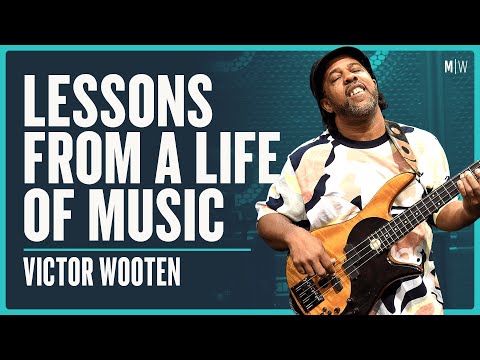
The Spirit Of Music - Victor Wooten | Modern Wisdom Podcast 304
WatchChris Williamson // 1:16:55
