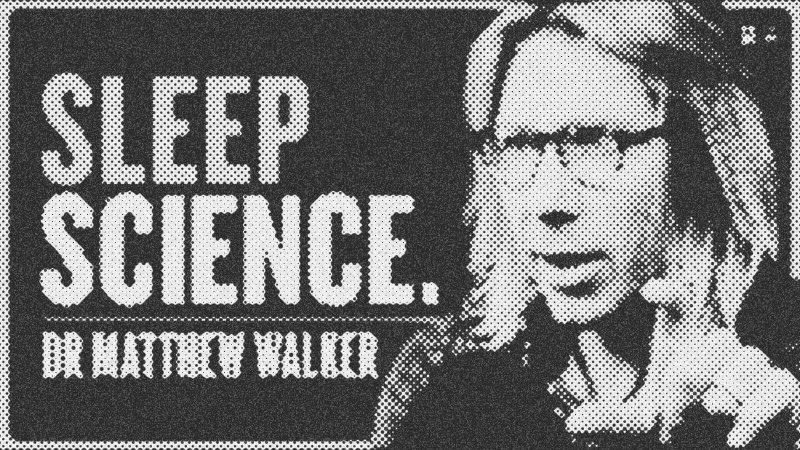
The Sleep Architecture: Reclaiming Your Biological Potential with Dr. Matthew Walker
The Four Macros: A New Framework for Rest
Most of us view sleep as a binary state—we are either awake or unconscious. However, Matthew Walker, a neuroscientist and professor at UC Berkeley, argues that we must conceptualize sleep through a more granular lens. Just as nutrition is defined by macronutrients, sleep is governed by four distinct pillars: Quantity, Quality, Regularity, and Timing (QQRT). If you focus on these four, you secure 80% of your physiological success.
Quantity is the most common metric, typically cited as seven to nine hours for adults. However, a dangerous misconception exists regarding time in bed versus time actually asleep. Sleep efficiency—the percentage of time spent unconscious while in bed—is the true measure of success. A healthy sleeper maintains an efficiency of 85% or higher. If you spend eight hours in bed but only sleep six and a half, you are functionally sleep-deprived. To combat inefficiency, Matthew Walker suggests a counterintuitive approach: sleep restriction. By cinching down the time spent in bed, you force the brain to build "sleep pressure," retraining the system to fall asleep instantly and stay asleep, much like a focused athlete maximizing a short window in the gym.
The Wired but Tired Phenomenon: Stress and the HPA Axis
In our modern existence, many suffer from being "wired but tired." This state occurs when the body is physically exhausted, but the brain remains in a state of hyper-arousal. This is often a result of an imbalance between the sympathetic nervous system (fight or flight) and the parasympathetic nervous system (rest and digest). When the HPA Axis is overactive, cortisol floods the system, jacking up the heart rate and core body temperature.
Sleep is not just a passive drop into darkness; it is a physiological permission slip. If your heart is racing and your temperature is elevated, the brain will not grant that permission. This is further exacerbated by the "Rolodex of anxiety" that often begins the moment our heads hit the pillow. Because modern life demands constant reception—emails, social media, notifications—we rarely engage in reflection during the day. Consequently, the brain uses the silence of the night to process stressors, leading to rumination and catastrophizing. To break this cycle, Matthew Walker advocates for a "worry dump" two hours before bed—physically writing down anxieties to offload them from the brain's active RAM.
The Supremacy of Regularity
While quantity is vital, recent data suggests that regularity may actually be the more powerful predictor of longevity. A massive study of over 300,000 individuals revealed that those with the most regular sleep patterns (going to bed and waking up within a 15-to-20-minute window) had significantly lower mortality risk than those with erratic schedules, even when the erratic sleepers occasionally got more total hours. Regularity anchors the 24-hour master clock in the brain, allowing for the optimal release of hormones like melatonin.
Matthew Walker notes that highly irregular sleepers—those with a two-hour "wobble" in their schedule—effectively live in a state of perpetual social jetlag. This irregularity is a primary driver of "sleep procrastination," where individuals stay up late for non-essential activities like Netflix or social media. This behavior hits the "mute button" on biological sleep signals, masking exhaustion with digital activation. To counter this, setting a "to-bed alarm" is just as critical as a wakeup alarm.
Chronotypes and the Genetic Lottery of Timing
Timing, the final "T" in the macro framework, refers to your Chronotype. Whether you are a morning lark, an evening owl, or somewhere in between is largely determined by 22 specific genes. It is not a choice or a sign of character; it is a genetic gift. Society, however, is heavily biased toward morning types, often labeling evening owls as lazy.
When a night owl is forced to wake up at 6:00 AM for a corporate schedule, they lose a massive portion of their REM sleep, which is concentrated in the later hours of the morning. This mismatch leads to higher rates of depression, anxiety, and cardiovascular disease. Matthew Walker emphasizes that fighting your biology is a losing battle. Understanding your chronotype via tools like the Morningness-Eveningness Questionnaire is essential for aligning your professional life with your biological reality. When you sleep in synchrony with your genes, the quality of your mood and emotional regulation transforms.
The Neurobiology of Dreaming and Emotional First Aid
Dreaming, particularly during REM sleep, serves a profound evolutionary purpose: it is overnight therapy. Matthew Walker describes REM sleep as a "nocturnal soothing balm" that strips the painful, bitter rind away from emotional memories. During REM, the brain is the only time it is completely devoid of noradrenaline (the brain's version of adrenaline). This allows us to re-process difficult experiences in a safe chemical environment.
This process is what allows us to wake up the next day feeling less "stung" by the previous day's traumas. In conditions like PTSD, this mechanism fails because noradrenaline levels remain too high, leading to repetitive nightmares where the brain tries, and fails, to strip the emotion from the memory. Beyond emotional health, REM sleep is the engine of creativity. While deep sleep cements individual facts, REM sleep builds the "Mind Wide Web," finding distant, non-obvious associations between disparate pieces of information. This is the difference between simple knowledge and true wisdom.
External Interferents: Caffeine, Alcohol, and THC
We live in a culture of self-medication, yet the substances we use to manage our energy often sabotage our sleep architecture. Caffeine has a half-life of five to six hours and a quarter-life of up to twelve. An espresso at noon can still be circulating in your brain at midnight, blocking the adenosine signals that tell the brain it is time to rest. Even if you can fall asleep after coffee, the caffeine reduces the amount of deep, slow-wave sleep by up to 20%, effectively aging your brain's sleep profile by a decade.
Alcohol is perhaps the most misunderstood sleep aid. It is a sedative, and sedation is not sleep. Alcohol fragments sleep, causing hundreds of "micro-awakenings" that you won't remember but will feel the next day. Crucially, it is a potent blocker of REM sleep. Similarly, THC may help with sleep onset, but it creates a dependency and severely suppresses REM sleep. When users stop using THC, they often experience "REM rebound," where intense, terrifying dreams flood back as the brain attempts to pay off its long-standing dream debt.
The Future of Sleep Technology
As we look forward, the focus is shifting from chemical interventions to electrophysiological ones. Since sleep is an electrical phenomenon, the most effective way to enhance it may be through the same currency. Matthew Walker is involved with technologies like StimScience, which uses transcranial direct current stimulation to "fertilize the soil" of the prefrontal cortex, amplifying deep sleep brain waves.
Other emerging fields include kinesthetic stimulation—rocking the bed at specific frequencies to mimic slow-wave sleep—and thermal regulation. Companies like Eight Sleep use temperature cooling to help the body reach the one-degree Celsius drop required for deep sleep. While these "hacks" are exciting, Matthew Walker warns against the hubris of trying to compress eight hours of sleep into four. Evolution had 3.6 million years to find a "zip file" for sleep; the fact that it hasn't suggests that the duration is non-negotiable for human flourishing.
- Matthew Walker
- 30%· people
- THC
- 7%· products
- Alcohol
- 4%· products
- Andrew Huberman
- 4%· people
- Caffeine
- 4%· products
- Other topics
- 52%
How To Fix Your Sleep & Supercharge Your Life - Dr Matthew Walker
WatchChris Williamson // 2:42:58
